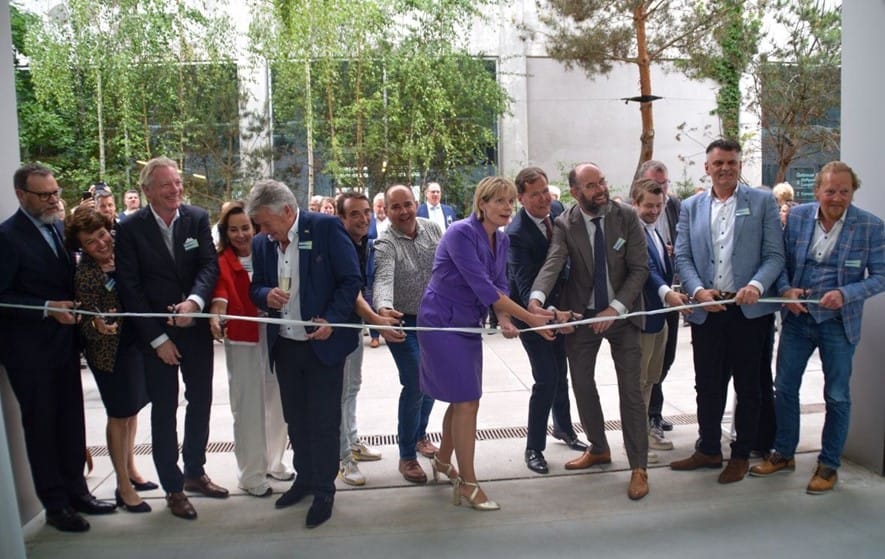
On 18 January, we visited The Hague with our regional organisations, on the initiative of the Arnhem-Nijmegen Green Metropolitan Region and The Economic Board. This was the first edition of the Green Metropolitan Café, which we will be organising regularly in The Hague. In a venue at The Hague Central Station, we presented our region to politicians and civil servants from The Hague. The topic of this meeting was: What will our region look like in 100 years’ time?
Attendees from The Hague included several Members of Parliament and civil servants from the Ministries of the Interior and Kingdom Relations (BZK), Economic Affairs and Climate Policy (EZK) and Agriculture, Nature and Food Quality (LNV). Representing our region were mayors, councillors and civil servants, as well as representatives from Staatsbosbeheer and the Utrecht Metropolitan Region.
The year 2120
Following a welcome address by Hubert Bruls (Mayor of Nijmegen and Chair of the Arnhem-Nijmegen Green Metropolitan Region), Tim van Hattum (WUR) painted a picture of our region in the year 2120. He wrote a vision paper on this subject.
Following a detailed assessment of our region’s physical characteristics – such as rivers, soil types and location – he analysed various aspects of the impending changes to the climate and economy. The conclusion of his study is: “By 2120, sea levels will have risen, rivers will be more erratic and cities will be warmer. Not everything will be possible everywhere; but if we make smart choices, there will still be plenty we can achieve even in this changed climate. We must work in harmony with nature rather than imposing our will on it. This means giving rivers more space, storing water for dry periods, protecting prime agricultural land, and enhancing nature and biodiversity. If we take this as our starting point, we will create a robust spatial framework for a relaxed, circular, green, productive and connected region.”
In his presentation, he explains that the water issue is different from what many people think. “Everyone thinks that half of the Netherlands will soon be under water, but that is not the case. We do, however, need to make space for more erratic rivers, as has already been done in Nijmegen as part of the ‘Room for the River’ project. We must also respond to increasing drought.”
On the reason for thinking a hundred years ahead: “The Netherlands is a Living Lab; we have the knowledge in-house; we need to step up the pace; looking far ahead offers opportunities for this and is also necessary.”
Ahmed Marcouch, Mayor of Arnhem and Chair of The Economic Board, responded with a call to get started quickly: “We must pass on a liveable environment from one generation to the next, and the future begins today. We must invest now in both the current generation and future generations; that is what we will reap later.”
Board member Ilko Bosman added: “Our region is also a Living Lab, with the Energy, Health and High-tech clusters. We need to make choices, and also start thinking in terms of scope for innovation and regulatory burdens.”
Making contacts
Afterwards, there were informal drinks, where interesting contacts were made. For example, officials from the Ministry of the Interior and Kingdom Relations are planning a three-day working visit to Gelderland; they are interested in housing, energy and the economy. We will help them with recommendations and tips.
A series of meetings
This was the first session in a series of meetings organised by the Groene Metropoolcafé in The Hague. The next session will take place in May/June, just before the European elections, and another café session will be organised in The Hague after the summer.
The aim is to foster constructive dialogue on cooperation between central government and the region and to showcase what we as a region have to offer.