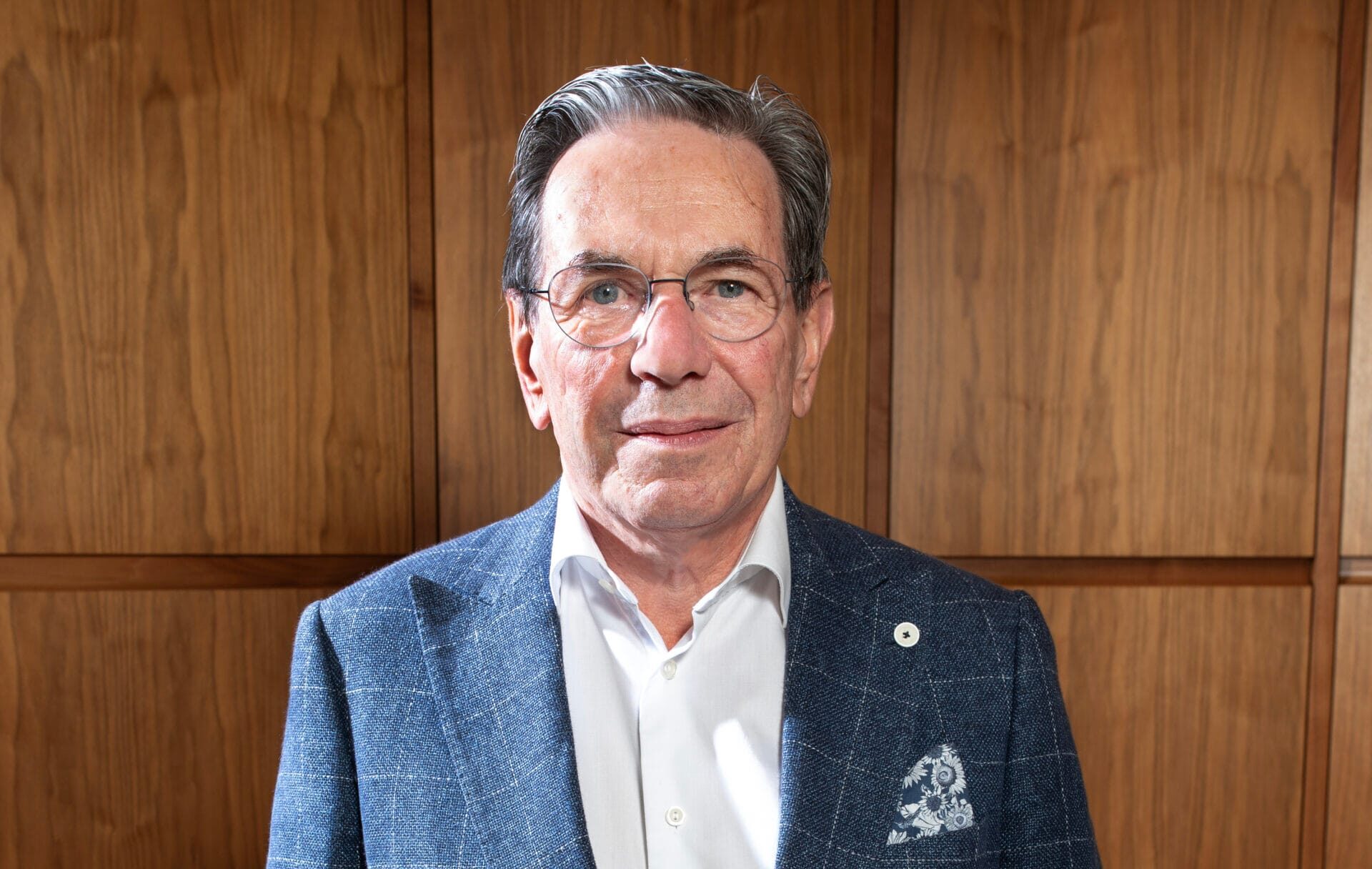
Huub Sanders is an entrepreneur through and through. Don’t bother the co-founder of the international biotech company Byondis with long, fruitless meetings. He used to have little time for collaboration anyway. After a long journey marked by highs and lows, that has changed. It is no coincidence that he is a member of The Economic Board.
Byondis’ history began in 1991 with the founding of Synthon. The company developed generic medicines – copies of branded medicines containing the same active ingredients. Sanders was one of the first employees. The company grew into a large multinational, with 2,500 staff worldwide at its peak.

Huub Sanders
Photo credit: Friso Keuris
Focus on biotech
But global competition was becoming increasingly challenging. Sanders: “Patent regulations in the Netherlands and Europe are much stricter than in other parts of the world. This created an uneven playing field compared with companies from, for example, China or India. In addition, the world’s largest pharmaceutical companies also began to get involved in generic medicines. Our competitors were no longer just local companies.”
As a result, Synthon gradually shifted its focus towards biotech from 2007 onwards. It first changed its name to Synthon Biopharmaceuticals and then, in 2020, to Byondis. That company applies the latest insights in tumour biology and immunology, particularly for the development of ADCs – antibody-drug conjugates. These are innovative, targeted cancer medicines. Synthon was sold in two parts. It is now owned by the American firm Goldman Sachs.
Outdone by a Japanese company
Biotech is a tough, competitive world, as Sanders and his business partner Jacques Lemmens discovered in 2023. “We developed a very good product for breast cancer. It didn’t make it to the finish line because, as newcomers, we took a little too long. A Japanese company pipped us to the post. Their product now generates around 8 billion a year. We’d set everything up for production and then, with a heavy heart, had to say goodbye to those people.”
Byondis is therefore now taking a different approach. “We have new products in development, but we no longer take them through to phase 3. If we can demonstrate in phase 1 that the product is effective and safe, we then look for a partner willing to take over the licence.”
Helping the region move forward
Meanwhile, Byondis is increasingly seeking regional collaboration. “We have a 7.5-hectare site on Microweg in Nijmegen, where our head office is located. As we’ve had to adjust our strategy in recent years, there is now plenty of space there to accommodate businesses. We have electricity and the necessary planning permission, even to construct a 14-storey building. We are looking for pharmaceutical companies, but also high-tech firms. They can benefit from us, and we from them. This is how we aim to further support the region.”
“I think the pharmaceutical sector is being sidelined,” he says firmly. “We sometimes allocate too much money to things that do not directly benefit the region or the country.” He gives an example. “I’d like to see venture capital for pharmaceutical companies, provided by a national investment bank, outside the government budget. That can be done quite simply. If we want 100 million, it shouldn’t be government aid, but a loan at a very favourable interest rate. If, as an entrepreneur, you also have to put some of your own money into it, that in itself creates a screening process. Then you don’t need all sorts of people to assess the applications, which causes a lot of delays.”
Key role for the pharmaceutical sector
“At The Economic Board, I’m sometimes a bit like a bull in a china shop,” laughs Sanders. “I prefer action to talk. And I’d like to help the region keep up with the times.”