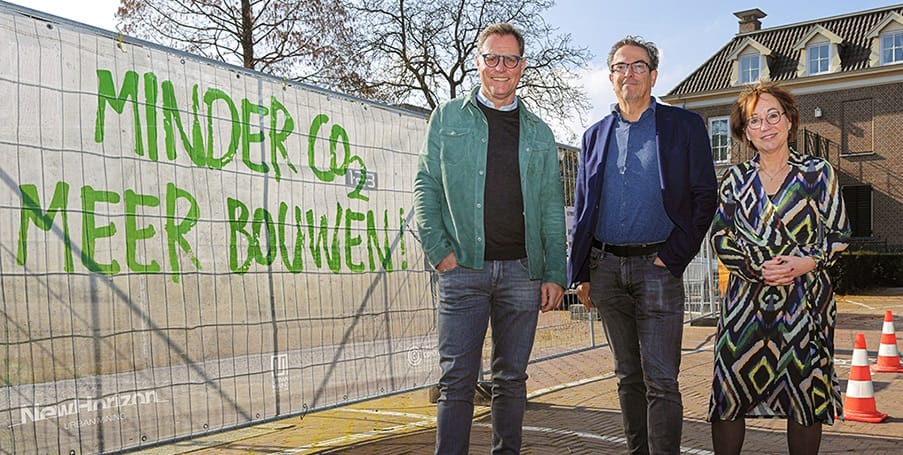
Using the above slogan from New Horizon, the municipality of Wijchen is promoting how it is putting circularity into practice by ‘harvesting’ materials from the former town hall for reuse. Building, rebuilding and renovating must become sustainable and circular. The ambitions are ambitious; to realise them, we need everyone on board: clients, builders, research institutions and suitable staff.
Bea Schouten welcomes us to the Town Hall in Wijchen. As a councillor, she is responsible for a broad portfolio: Climate and Energy, Wellbeing and Health, the Social Support Act (WMO) and Youth Care, Sport, Art, Culture and Recreation. In addition, she coordinates activities in the field of circular construction and infrastructure, acting as the spearhead for circular construction and infrastructure within the Arnhem-Nijmegen Green Metropolitan Region.
She describes herself as an ambassador who puts stewardship, sustainability and circularity on the agenda and promotes them.
Concrete and local
A concrete example of circularity can be found within walking distance of her current workplace. In the former town hall, New Horizon is ‘harvesting’ materials on behalf of the local council, in line with the principle of ‘urban mining’.
“The materials are removed from the building and reused within New Horizon’s network,” explains Schouten. “This creates connections between companies that find new uses for existing materials. Such networks and marketplaces, where ‘harvesters’ and (re)users find one another, bring circularity to life and give similar initiatives a boost.
In addition, the Green Metropolitan Region has plans to set up marketplaces where, for example, farmers and builders can meet; as a local authority, we are keen to contribute to this.”
“In the tender process for the construction of a new residential estate in Wijchen, we are prioritising sustainability and circularity. We are asking the project developers of the two largest new-build projects in our municipality to contribute ten thousand euros per private-sector home they build in these projects. This money goes into the Housing Fund. This fund is used to improve the quality of life in existing residential neighbourhoods that need it most, including by making these neighbourhoods more sustainable and providing more green spaces and less concrete.”
Playing field
Circularity is a key aspect of sustainable construction, maintenance and renovation of homes. Schouten: “According to the Housing Deal between central government, the province of Gelderland and 18 local authorities, thousands of new homes are to be built in the Arnhem-Nijmegen region by 2040, with sustainability, circularity and quality of life being key considerations. From 2030 onwards, the Arnhem-Nijmegen region aims to carry out at least fifty per cent of its construction projects using circular methods, with a view to achieving a circular living environment by 2050.
That is the framework. The scope for action within it is determined, amongst other things, by legal, financial and economic possibilities, education and the labour market.”
With circular construction, materials can be reused at the same level
Realising this ambition requires a diametrically different mindset regarding material use, education and policy support in building and designing the living environment. As client, the government has an important pioneering and exemplary role in this.
Building the future
“Traditional housing construction still dominates, but is becoming a challenge due to the depletion of raw materials and its impact on the environment and health. The construction of the future is modular, circular and bio-based,” says a resolute Bernd Hendriksen.
He is co-founder of mHome, a Nijmegen-based consortium of companies that develops, finances and builds bio-based modular housing units. “The benefits are clear. In circular construction, materials can be reused at the same level. Furthermore, every material comes with a ‘passport’ detailing its origin and composition.
In bio-based construction, there is the added element that only ‘renewable’ materials are used, such as wood, wood fibre and metisse.
A major advantage of modular construction is that the modules are mass-produced in a factory-style working and processing environment. CO₂ emissions and disruption on the building site are practically zero, as we erect the buildings in just a few days. Furthermore, the modules can be combined in many different ways, allowing a building to expand or contract according to the users’ needs.”
At present, this construction method is still a niche market. Hendriksen: “The trick is to reach the tipping point in terms of volume, which will bring costs down and make the concept even more attractive to clients.”
Hendriksen refutes the notion that circular and bio-based concepts are only suitable for small-scale construction: “The materials are available; it is the production method that determines how quickly you can scale up in terms of construction volume. We are already working on commissions for housing associations and healthcare institutions.”
“It’s important to demonstrate that circular construction is simply feasible. Project developers and users need to be able to see and experience first-hand what a circular home looks like, how it’s built and what the financial benefits will be in the long term. That’s what wins people over. With the ambition of the Housing Deal, we are moving towards that situation and that tipping point.”
Here, houses grow
Christiaan Holland, director of Hub Holland and project lead at Via-T, takes a broader view of circular construction.
“In circular and bio-based construction, I also see a major role for the agricultural sector in terms of growing building materials such as wood, flax and hemp. A pilot scheme is currently underway in De Liemers in which agricultural businesses supply biogas to brickworks. This creates a sustainable cycle and an alternative revenue model. As a province and as The Economic Board, you can also support such initiatives.
In this way, alongside the agri-food sector, an ‘agrohome’ sector can grow, encompassing cultivation, processing and use. I can already picture the slogan: ‘Houses grow here’. It is a cycle that can become a revenue model for all parties, and a great deal of work is being done to develop the knowledge and expertise in this area.”
When it comes to knowledge and expertise in circular construction, Holland, as the Via-T facilitator, is the point of contact. “Via-T is the knowledge centre for innovation, sustainability, circularity and craftsmanship for future-proof construction.
In practical terms, this is achieved through collaboration between vocational education and construction and installation firms. Through close cooperation with further education (MBO), higher professional education (HBO) and university-level education (WO), Via-T contributes to the development of knowledge on future-proof construction and ensures that regional SMEs can make use of this knowledge. It also helps to produce more ‘carpenters of the future’ with the right skills.”
“The starting point was the Hubertushal in Nijmegen. Via-T is currently in transition and is temporarily based on Streekweg in Nijmegen, whilst awaiting the completion of a new building in Nijmegen West. Here, training facilities and exhibitions showcasing the latest techniques and innovations will be given their rightful place. But Via-T is more than just a physical location; it is a community in which partners work together. There are now 50 organisations on board,” explains Holland.
“One thing is clear: sustainable and circular construction requires a completely new approach: different work processes, new methods and techniques, the use of different materials, different logistics, and the training of skilled workers from a sustainable perspective. Vocational and higher vocational education programmes are already incorporating this to a limited extent into their curricula. The new perspective and approach are gradually filtering through into working practice, but Via-T is set to significantly ramp up the pace and impact of this change.”
Realising the sustainable and circular ambitions of the Housing Deal is a tour de force. Holland calls it ‘the major overhaul’. Local initiatives, in conjunction with regional cooperation between stakeholders, form the basis; they give concrete form to the major shift in thinking and practice that must be achieved whilst continuing to operate.
This article also appeared on the website of Het Ondernemersbelang