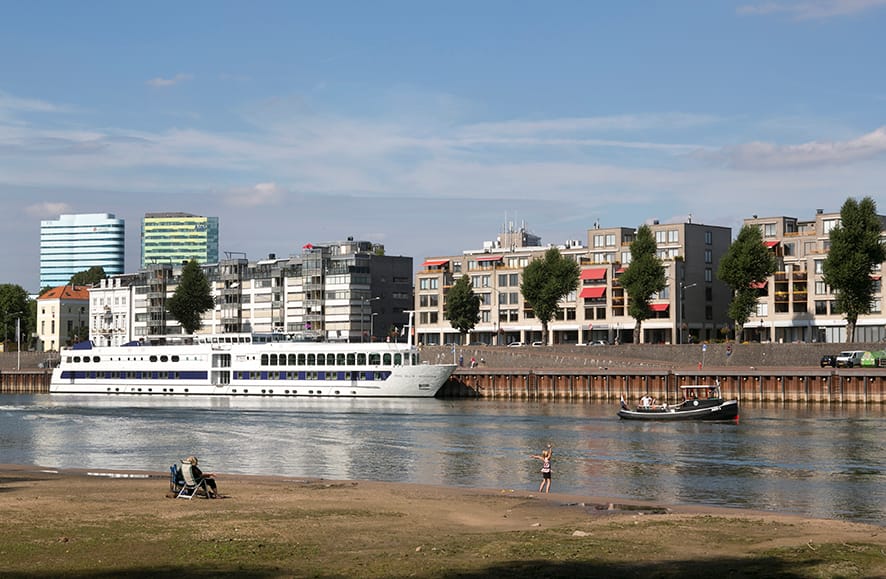
Do you know where the bricks in your street come from? Or the bricks many houses are made of? Chances are they were fired in one of Gelderland's brick factories along the Rhine, Waal and IJssel rivers.
Four regional manufacturers have the ambition to realise a collective sustainable and future-proof energy supply, enabling them to produce paving and masonry bricks completely climate-neutral.
The initiative by the four Gelderland brick manufacturers (Caprice, Rodruza, Vandersanden and Wienerberger) is called Brick Valley. Together, they make over 1 million paving bricks and hundreds of thousands of masonry bricks every day that make the Netherlands habitable and walkable.
Brick Valley's goals: 50 per cent CO2-reduction by 2030, 100 per cent energy neutrality by 2050. These are not childish ambitions. Where will they come from? And how will they realise them? We asked Ruud van Kolfschooten, process director and programme director of Brick Valley.
Cultural and regional heritage
"To make wear-resistant ceramics from clay, you need a lot of heat, as much as 1,000 to 1,200 degrees. Previously, that heat came from coal and oil; in recent decades from natural gas. The product brick is not only cultural and regional heritage, but also incredibly sustainable. We use sustainable clay from the rivers. Bricks last for hundreds of years.
Product waste goes back into the process and old bricks can be reused. The only thing that is not environmentally friendly is that huge heating process. So we have been exploring sustainable alternatives to natural gas with Brick Valley since 2021."
Collective and individual sustainability
The four manufacturers in Brick Valley are also individually taking action to promote climate neutrality. They are using heat pumps where possible, reducing energy consumption through process modifications and focusing on dematerialisation (brick strips, narrower bricks and bricks with recesses), so that less clay and thus less energy are needed for production.
Brick Valley does not undertake the quest for a collective sustainable and future-proof energy supply on its own. To do so, they work intensively with knowledge institutions, governments and area users. All with a common shared ambition: emission-free into the future.
Green hydrogen
Ruud van Kolfschooten: "Electrification seems the most logical, but you can't reach such high temperatures with that. And then you would have to modify the entire production process, for which no breakthrough technology is currently available.
Biogas is another option. That comes mainly from manure fermentation and you actually want to collect that nearby. Those options are not sufficiently available at the moment. A brick factory needs a lot of energy!
For now, only green, read: CO2-free, hydrogen. We are now intensively investigating the applicability of this option. Major challenges are availability, location and cost."
Four hydrogen routes
Brick Valley is exploring four 'hydrogen routes': the so-called North-South backbone, the inland navigation route, local hydrogen production and the associated local hydrogen network.
"The North-South backbone builds on Gasunie's efforts to convert old natural gas pipelines into hydrogen pipelines," said Ruud van Kolfschooten. "Then there would be a branch come towards Zevenaar and the Ruhr area, to which Brick Valley can connect. Completion of the North-South route is planned for 2027/2028, but it remains to be seen whether that will be achieved.
Another option: supply hydrogen via inland vessels in the form of ammonia, liquid hydrogen or LOHC. For that, though, you need social acceptance. So a lot of consultation with municipalities and province."
Local hydrogen network
"Meanwhile, we are also looking at option 3: local hydrogen production," continues the process director. "So local production of hydrogen, by electrolysers with a capacity between 2.5 and 25 megawatts. Brick Valley's hard requirement is that the electrolysers be powered by locally produced renewable electricity (solar panels and wind power).
And finally, option 4: the establishment of a local hydrogen network. This requires the construction of a whole new pipeline network. The existing natural gas pipelines cannot be used for this, as a mixture of hydrogen and natural gas is transported through the pipelines and customers of natural gas only are also connected to the network. A local hydrogen network must therefore be built, in addition to the existing natural gas infrastructure."
Accelerating energy transition in the region
Ruud van Kolfschooten: "We are keeping all routes open for the time being. We are also in close contact with all stakeholders to find solutions that lead to CO2-neutral production of the beautiful sustainable product brick.
Whatever it will become, Brick Valley will help accelerate the energy transition in the region. Our future Smart Energy Hub will help solve grid congestion. Other companies, municipalities and organisations in the region will soon be able to tap into this."
Cluster 6
Brick Valley is a project within Cluster 6’s frontrunner programme. The largest industrial emitters in the Netherlands are broadly divided into five regional clusters/regions (Rotterdam, Zeeland, Amsterdam, Groningen and South Limburg).
Cluster 6 comprises nine highly diverse sectors, including the food industry, the paper and cardboard industry, the ceramics industry, waste processors and data centres, all of which face CO₂ reduction targets and are spread throughout the Netherlands. These do not form part of the five major industrial clusters, but are just as essential to achieving the energy transition.