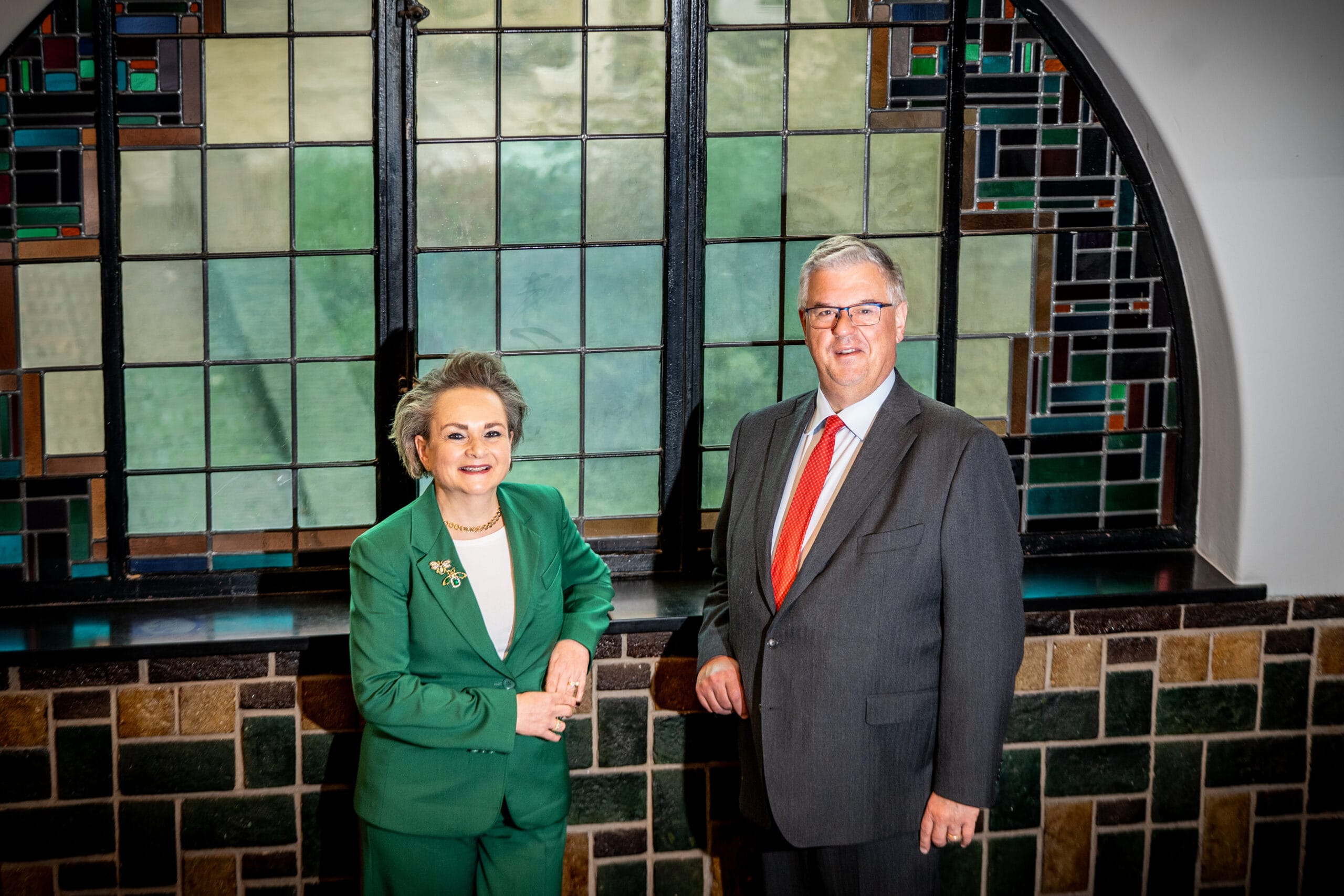
Ten years ago, the establishment of The Economic Board was anything but a foregone conclusion. Since then, Lifeport Arnhem-Nijmegen Region has charted a joint economic course and its influence has grown. The mayor of Nijmegen, Hubert Bruls, was one of the founders. Alexandra van Huffelen, Chair of the Executive Board of Radboud University, is now Chair of The Economic Board. Together, they look back and look ahead.
“I caught the regional bug quite early on,” laughs Bruls. When he returned as mayor of Nijmegen in 2012, he already had extensive experience of regional collaboration – first as a councillor in the Arnhem-Nijmegen Hub, and later as mayor of Venlo. Yet he was surprised upon his return. “Cooperation in the Arnhem-Nijmegen region had become something of a given. It had lost some of its momentum. There was also a lack of structured cooperation between local authorities, knowledge institutions and businesses. Since the Chambers of Commerce ceased to represent regional interests, cooperation with the business community in particular had become fragmented.”
Much discussion
Bruls decided to take the initiative. But it took another two to three years before The Economic Board actually got off the ground. Bruls: “We wanted the key players around the table. The local authorities, research institutions and businesses that could really make a difference to the region. That proved to be a challenge. And there was also a lot of discussion about the substantive direction. I always say: pick one thing and do it well. But we couldn’t agree on a single theme that would set the region apart.”
“Ultimately, we settled on Food, Health and Energy. Over the years, these themes have evolved into our current focus on Energy, Health and High Tech.”
The bit in the mouth
“The early years were really tough,” recalls Bruls. “We had to get used to working together. Sometimes I thought: how much longer are we going to have to keep at this? But you have to grit your teeth and get on with it. If you believe in something, you have to dare to see it through.” With the benefit of hindsight, he would approach things differently. “I would have started a few concrete projects sooner, rather than spending years discussing the agenda and priorities,” he says, looking back. But that perseverance has paid off. “Now it’s really taking off,” he notes with satisfaction.
A robust organisation and strong collaboration
Van Huffelen nods. When she took up the post of chair in 2025, she found a solid organisation and strong collaboration. “A wonderful foundation was laid ten years ago. The enthusiasm for continuing to grow together has only grown stronger since then.”
According to both, a key benefit is the mutual trust that has been built up, including between educational institutions. “It goes without saying that universities and universities of applied sciences seek each other out,” says Bruls. “But the fact that vocational colleges are now also participating as equal partners is a wonderful side effect.”
Beethoven Plan
Just how important that collaboration is became clear a few years ago when the government unveiled the Beethoven Plan to strengthen the Dutch chip industry. To Bruls’s surprise, the Arnhem-Nijmegen region was not mentioned in that plan. “Even though one of the largest semiconductor clusters in the Benelux is based here,” he says, still indignant. The region acted swiftly. A joint talent programme was set up, which also channelled funds from the Beethoven Plan to the region. “Without The Economic Board, that would have been much more difficult,” says Bruls.
More self-assured and proactive
Van Huffelen adds: “It now goes far beyond talent alone. We actually want to develop new business activity here. Take the plans for advanced packaging in the chip industry, solutions for grid congestion and innovations in healthcare. We have so much expertise here, as well as opportunities to put that expertise into practice. That offers enormous opportunities.” According to Bruls, the region’s attitude has thus changed fundamentally. “Ten years ago, we perhaps worked together mainly out of necessity. Now we’re telling the Netherlands and Europe: we have something to offer. We’ve become much more self-assured and proactive.”
Now is the time to act
With the Regional Investment Agenda, the Lifeport Partner Fund and a joint lobbying agenda, a new phase is beginning. “The plans are in place,” says Bruls. “There is hardly any debate about them now. It’s now a matter of putting them into practice. In the areas of the economy, housing, mobility and knowledge development.” Van Huffelen is ambitious: “We mustn’t think too small. We want to double the size of the semiconductor cluster and continue to grow in Energy and Health. To do that, we need to attract talent, including from abroad.” She also dreams of more start-ups and scale-ups that transform the region’s knowledge into new business activity.
Not without its concerns
But growth also brings concerns. “How do we ensure everyone is on board?”, Bruls wonders aloud. “People really do appreciate the green character of this region. They’re worried that everything will soon be built over. I understand that.” In his view, economic development must therefore go hand in hand with preserving what makes the region special. “To preserve beautiful old things and traditions, you actually have to innovate.” Van Huffelen agrees with him. “We don’t just want a region with attractive jobs. People must also be able to live here happily, raise their children here and enjoy the open spaces and greenery.”