The Human Capital Agreement for the Lifeport Arnhem-Nijmegen Region will follow a more focused strategy for the period 2027–2030. The updated agreement focuses on people, technology and productivity. The collaboration builds on the results of recent years and aims to make better use of talent, work more efficiently and scale up successful initiatives in the Lifeport region.
Looking back on four years of collaboration
In recent years, entrepreneurs, educational institutions, public authorities and civil society organisations have worked closely together within the Human Capital Agreement to tackle this challenge. What began in 2023 as a shared ambition has since grown into a regional ecosystem with concrete programmes, projects and talent agendas for the Energy, Health and High Tech sectors. Thanks to this collaboration, the region has also managed to attract more than five euros in additional funding for every euro of public funding – from sources including government schemes, programmes and private investment – to implement programmes, projects and talent agendas focused on the regional human capital challenge.
The current agreement expires at the end of 2026. At the same time, the labour market is changing due to increasing digitalisation and the influence of AI. This calls for a review: are we still focusing on the right challenges, and is our approach effective? Commissioned by the Arnhem-Nijmegen Green Metropolitan Region, the Province of Gelderland and The Economic Board, work has therefore begun on reassessing the Human Capital Agreement. As part of this, a summary report has been drawn up, compiling lessons learnt, results and opportunities for development from recent years. The report is based on discussions with 45 partners from the education sector, the business community and government.
From reaping the rewards to looking ahead
The key conclusion from the review report is clear: the region has demonstrated that collaboration works. A solid foundation of partnerships, talent plans and projects is now in place. At the same time, the next phase requires a greater focus on structural safeguards, ownership, implementation capacity and impact. The challenge no longer lies in launching new initiatives, but in sustainably organising, scaling up and embedding what works.
“The labour market does not stop at the boundaries of an organisation, local authority or sector. That is precisely why we must learn together, invest together and scale up successful solutions regionally.”
– Adam Galijašević, Programme Manager for the Human Capital Agreement, The Economic Board of the Arnhem-Nijmegen Region
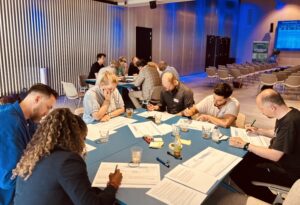

Co-creation sessions in the Arnhem-Nijmegen region
Setting the course together during co-creation sessions
To further shape the direction of HCA 2.0, two regional co-creation sessions took place on 25 June and 2 July 2026, attended by representatives from 45 organisations across the business sector, education, government and the voluntary sector. Some organisations were represented by several delegates. During these meetings, the first step was to gather a broad overview of the developments and challenges facing the region. Participants then jointly explored the types of solutions needed to keep people in sustainable employment, train talent for tomorrow’s economy and harness innovation to tackle labour market shortages.
The outcomes of these sessions have been collated and, together with the evaluation, labour market analyses and the infrastructure already in place, form the substantive basis for the new Human Capital Agreement.
A new direction for the HCA
The insights gained from this process will lead to a more focused strategy for the period 2027–2030. As part of this, the existing priority areas will be consolidated into three interlinked programme strands.
- The first programme strand focuses on making better use of, developing and mobilising talent.
- The second programme strand focuses on increasing the inflow of talent for the priority sectors of Energy, High Tech and Health.
- A new addition is the third programme strand: working smarter and differently. This focuses on technology, innovation and new ways of organising to increase labour productivity and ease the pressure on the labour market.
This strategy aligns with a key trend evident at both regional and national levels: not only training and attracting more people, but also making better use of available talent and harnessing innovation to tackle social and economic challenges. The strategy has been submitted to and approved by the board of The Economic Board, the ‘Productive Region’ consultative body of the Arnhem-Nijmegen Green Metropolitan Region and the Province of Gelderland. Its implementation involves close collaboration with the labour market regions.
“With HCA 2.0, we are working together to build a labour market in which talent is utilised more effectively, people continue to develop, and organisations can work more intelligently and productively. By connecting people, skills and technology, we are strengthening our region’s capacity for action and creating scope for sustainable economic and social development.”
– Renate Bouwman, Labour Market Strategist, The Economic Board Arnhem Nijmegen Region
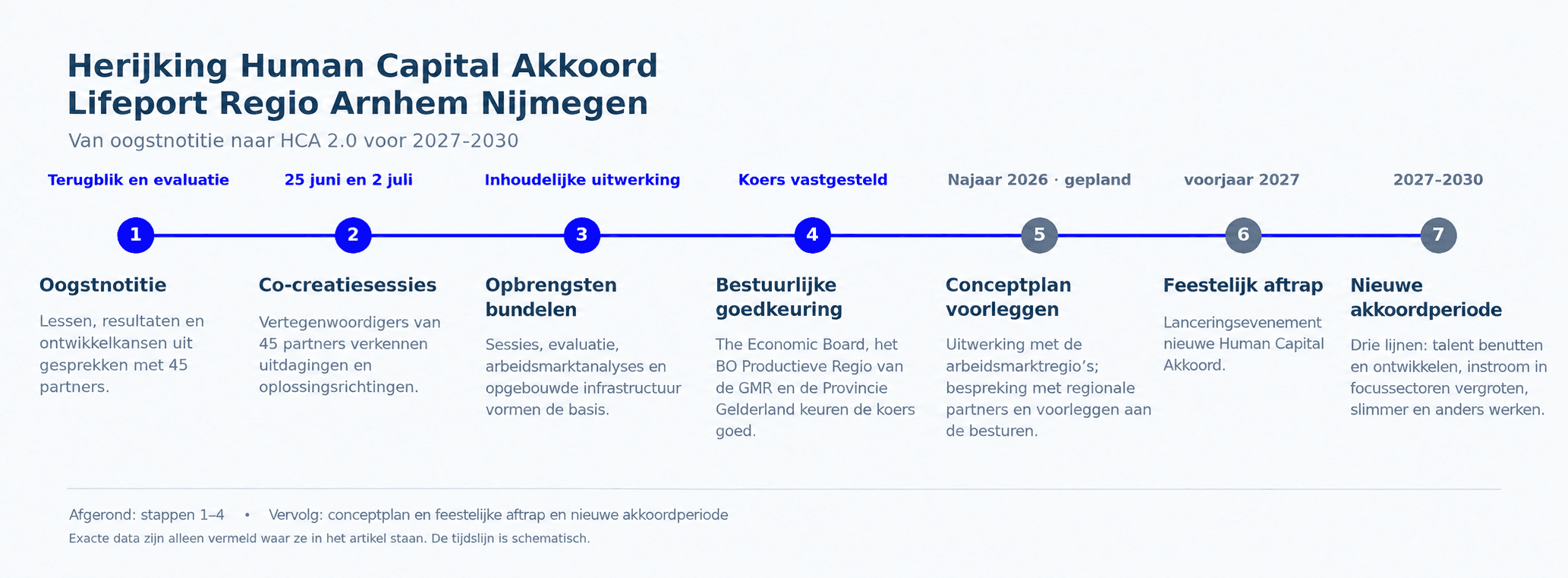
Towards a new agreement
The findings of the review process are currently being further developed into a draft Human Capital Agreement 2027–2030. Based on the agreed strategy, the draft plan will be discussed with regional partners this autumn and submitted to the governing bodies of the Arnhem-Nijmegen Green Metropolitan Region, the Province of Gelderland and The Economic Board.
In doing so, the regional partners are taking the next step in the development of the new Human Capital Agreement: moving from pioneering to structural embedding, with the aim of creating a future-proof labour market and a resilient economy for the Lifeport Arnhem-Nijmegen region.
A festive kick-off
The new Human Capital Agreement deserves a celebratory launch. That is why we will soon be marking the launch together with our regional partners. More on this will follow shortly!