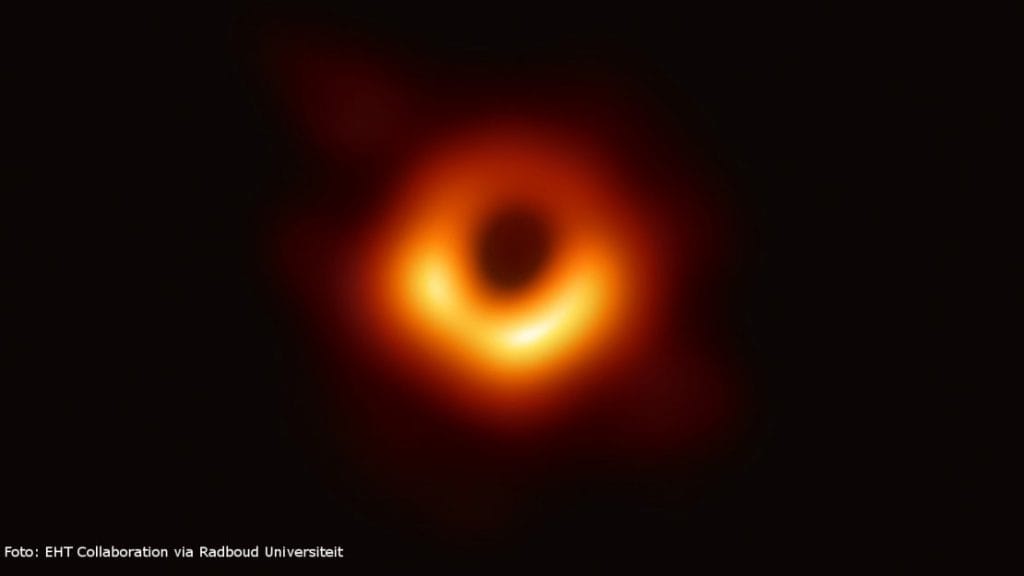
Heino Falcke is the German professor at Radboud University who made global headlines in 2019 when his research group became the first to publish a photograph of a black hole. He is brimming with plans and hopes for new breakthroughs that will amaze both the scientific community and the general public. Thanks to a multi-million investment by Radboud University at the end of November, that ambition is once again within reach.
No less than 11.9 million euros. That is the amount that Radboud University’s Executive Board is making available to Heino Falcke’s research group over the coming years. The funding, in the form of a guarantee, is spread over 1 million euros per year for ten years for the international Event Horizon Telescope (EHT) network, plus a further just under 2 million for the construction of a major telescope in Namibia.
Critical phase
A few weeks after that announcement, Falcke is still very pleased. “It gives us a new perspective, a new direction.”But ‘relieved’ is perhaps a better word than ‘pleased’, because the funding was actually desperately needed. “Without funding, we found ourselves in a very critical phase. We’ve achieved success and should now be reaping the rewards.” But that proved difficult due to a lack of funds.“With EHT, we submitted two proposals to the NWO (Netherlands Organisation for Scientific Research, ed.) which were rejected in the first round, even before we’d submitted a full proposal,”he says.
Colleagues in the US, amongst other places, did secure many millions, which meant Nijmegen was in danger of falling behind. Talented Nijmegen students from Falcke’s team left to work abroad.“I’m very proud of that, but at the same time you’d like to see others joining your team. We didn’t manage to achieve that. Our research has been a great success for the university so far; it generates a lot of visibility. We mustn’t let that slip through our fingers. That’s why I’m very pleased that the university has taken the lead, so that we can carry on and there is stability. It’s also an important signal that the university believes in us. This investment therefore offers plenty of opportunities to secure funding from other sources.”
Of course, there are conditions attached to this substantial sum.“After one to two years, there will be a ‘critical design review’ and we’ll have to demonstrate that our plans are feasible and that we’ve secured funding. There’ll be another review after five years.”He jokes:“If I’ve gone off to the Caribbean by then, the funding will obviously stop. But I’ve no intention of doing that.”
Short films
The funding opens up new prospects. Perhaps Falcke and his team will make global headlines once again, just as they did in 2019.“We published a few smaller papers last year and are now working very hard on larger publications. There could certainly be some exciting things among them.”Not just for the scientific community, but also for the wider public.“One of the aims of the telescope in Namibia is that we’ll be able to use it not only to take photographs but also to capture videos of black holes. We’re also starting to understand better and better what happens inside black holes. My colleague Monika Moscibrodzka is involved in creating realistic simulations using supercomputers. Based on these, we can see in detail what’s going on in there. We’re effectively diving into the black hole.”
Falcke enjoys connecting with people outside the scientific community. For example, he regularly inspires them with his presentations, such as at a major event organised by The Economic Board two years ago. He has also written a book for the general public: ‘Light in the Darkness – Black Holes, the Universe and Us’. He also answers a lot of questions. “I even get letters or messages from young children; just recently from a nine-year-old girl who said she’d already read the book twice. It’s a subject that raises a lot of questions.” He wants people to gain the best possible understanding of black holes. “The big Hollywood film *Interstellar* features a black hole. Visually, it was a decent attempt, but there’s still plenty of room for improvement. Next time, they should give us a call so we can provide them with better models,” he says with a wink. “We’re also collaborating on exhibitions, including one coming to Het Valkhof in a few years’ time, as well as a planetarium film. We want to make black holes more tangible for the general public, although ‘tangible’ is, of course, a strange word to use when talking about black holes.”
Opportunities for companies
Another ambition of his is to build a bridge with the business community. "We have a very different network than many companies themselves. With our Radboud Radio Lab led by Marc Klein Wolt, we work with top institutes around the world, but also with all kinds of involved companies and governments in other countries. We are working on many different questions, from data storage to the use of hydrogen and solar energy. For instance, there are many opportunities in Namibia; a lot is happening in that country. Tapping into that is definitely interesting for regional companies."