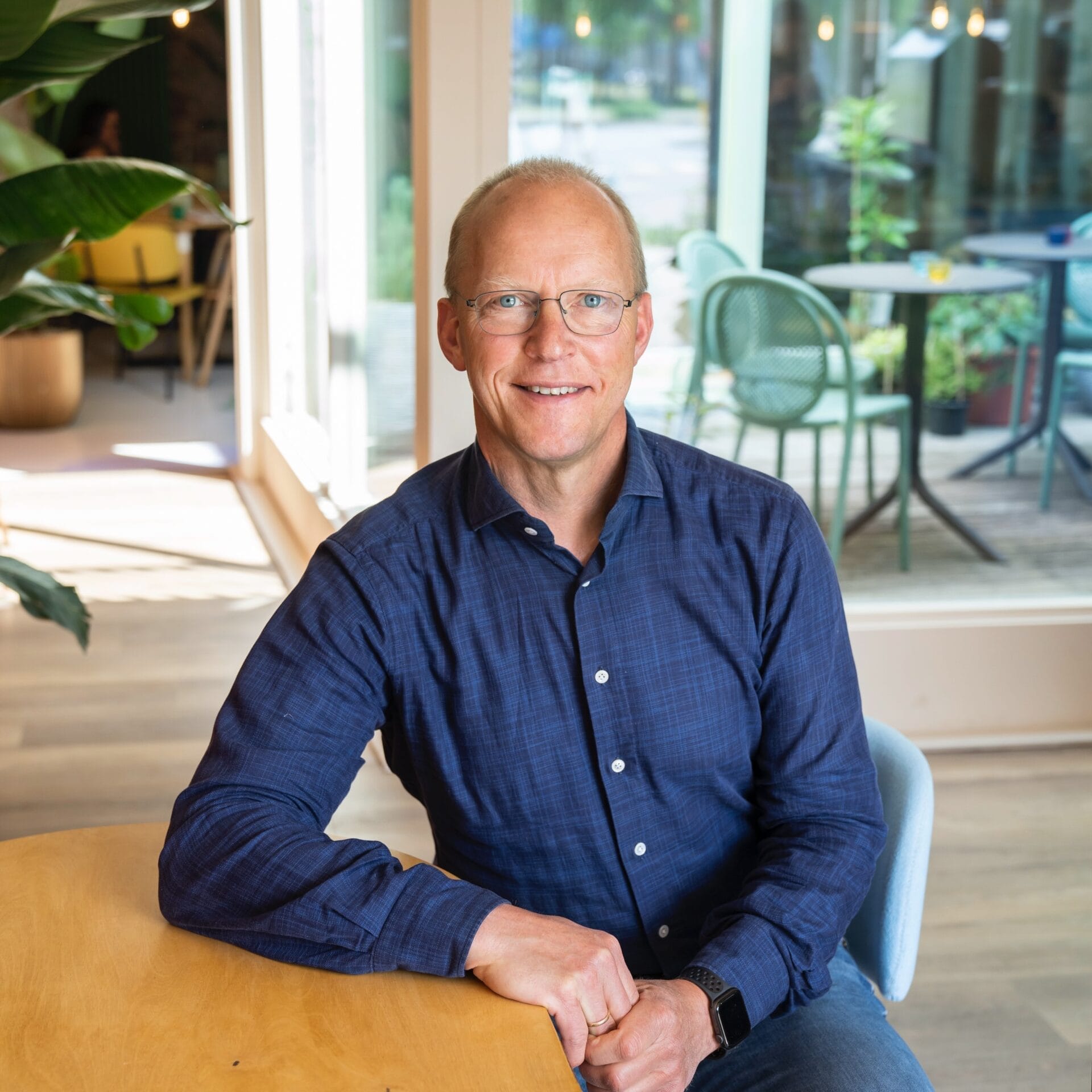
After a career as project development manager at Essent and Vattenfall, Albert Bloem came up with the idea for Talent for Transition; a platform that links start-ups via a traineeship to companies in the energy transition. We spoke to Albert about this refreshing and successful initiative.
'This guidance creates solid professionals who make conscious choices about what they focus on.'
Talent for Transition
Albert explains how the idea for ‘Talent for Transition’ came about and why the energy transition calls for an innovative approach.
‘Traditional employment practices are geared towards developing early-career professionals within a single organisation. With Talent for Transition, young people at the start of their careers develop themselves in a broader way. They build a strong network and gain exposure to different perspectives within the energy sector. This support produces well-rounded professionals who make informed choices about where to focus their efforts.’
‘On the other hand, we are increasing companies’ capacity to recruit valuable and broadly-oriented talent. These talented individuals are graduates from universities of applied sciences and research universities with a mix of arts, sciences and social sciences backgrounds. We match them with suitable assignments that highlight the other side of the coin; in this way, we show humanities students that technology can be incredibly interesting, and science students that the social sciences really do add value to the energy transition.
In every intake, we also include newcomers with a refugee background. We provide this specific group with advice and guidance so that they feel more at home in Dutch working culture. Thanks to these different backgrounds, we end up with a diverse group of people.’
Towards a wider understanding
'Our world is becoming more complex and the challenges more urgent. If you want to effectively change something, it is important to understand each other first. We need professionals who include the environment around a project and have an eye for the interests of local residents and stakeholders. I want to tackle change on the basis of understanding, but still often experience compartmentalisation and bureaucracy in our systems. Surely it is all about explaining and applying projects properly? For this, we need professionals like an engineer who talks to a licensing authority or a project manager who understands the importance of local residents.'
The trainee programme
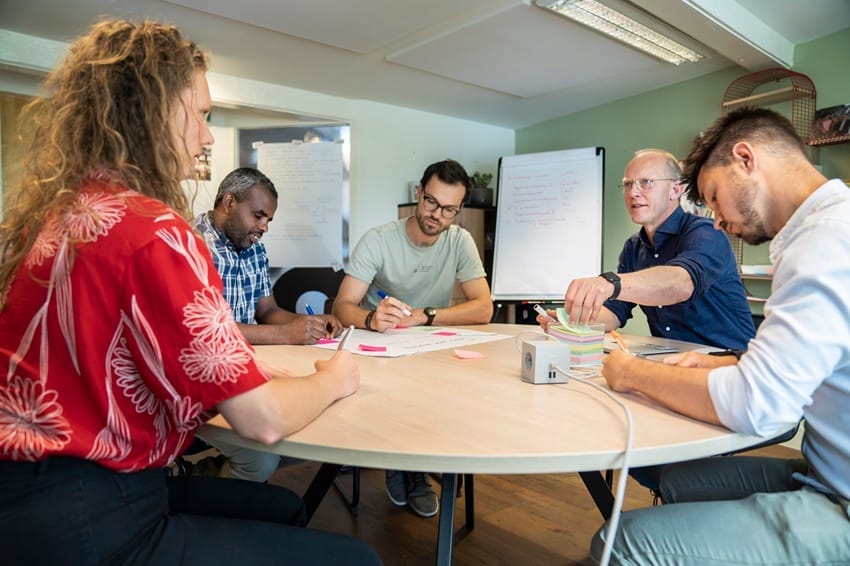
The trainees follow a two-year balanced programme at two or three companies. During this programme, Talent for Transition supports them in their personal and professional development.
‘Through the programme, the trainees get to know themselves better and develop a clear understanding of their strengths and areas for development. We also support them with specialist modules such as project management, energy knowledge and communication skills. In the second year, we address questions such as: ‘How do you build a team? How do you secure buy-in? How do you work with others to drive change?’
We combine the training days and workshops with one-to-one coaching and peer supervision. Finally, there is also room for socialising, and our platform offers a useful network for the future. This approach gives the trainees a broader view of the possibilities.’
From recruitment budget to development budget
Albert thinks a shift in thinking is needed among employers. 'We really need to move from recruitment budget to development budget. Employers are pulling out all the stops to attract staff. Yet we still see little focus on talent development and low-threshold inflow. I think employers should be more creative and not look for an excuse in lack of time to coach starters. Couple a junior with an experienced senior, for instance. We see daily that this gives energy to both. With Talent for Transition, we guide these principals in their role as mentor and facilitator.'
'We build bridges and convince more and more companies to look beyond qualification requirements.'
Albert noticed that many young people drop out because of the qualification requirements in job ads. 'Employers find it difficult if someone does not meet all the tick boxes in a vacancy. We bridge the gap and convince more and more companies to look beyond qualification requirements. At Talent for Transition, for instance, it is not a requirement to do something with engineering in your studies. You do have to show that you have an affinity with sustainability and energy. This attitude makes finding candidates easier for us. Of course, it helps that we supply good talents and guide both employee and employer well. Employers appreciate our guidance; after a successful placement, a spot usually becomes available immediately for a new trainee.´'
Working regionally on energy transition
Albert himself, in addition to his work with Talent for Transition, is very active in the regional energy sector. ‘There are big ambitions for the charging infrastructure. To achieve this, you need people from different backgrounds who can develop, build, design and operate charging infrastructure. It’s all about training and mentoring people. We’ve been working with Connectr from the start and are helping with the Plugin & Play programme, amongst other things.
Through Plugin & Play, companies and educational institutions are tackling the question: how do you ensure you have enough people to provide the Netherlands with sufficient charging infrastructure in a short space of time? Although it is still in an exploratory phase, this has the potential to act as a catalyst for more charging infrastructure. We are increasing the intake capacity at the participating companies.’
In addition, Radboud University, Wageningen University and Arnhem Nijmegen University of Applied Sciences are important suppliers of talent and we support educational institutions in linking education to the labour market in public-private partnerships. We also work intensively with Tennet, Alliander and Vattenfall regionally and support the province of Gelderland with its climate approach. Personally, I am also involved as a volunteer with Energiecoöperatie Rijn en IJssel.
Charged for the future!
Albert rounds off the interview feeling proud. 'On average, about 90% of the participants flow out to one of the clients. It makes me proud that we have already delivered 10 lightings with almost 90 starters to the labour market. Moreover, we are now working hard to develop almost 50 more trainees and the 15th batch has just started. We are growing every year and have already received great appreciations for this, including a number of FD gazelles and a place in the KvK innovation top 100.
Would you like to know more about Talent for Transition? Or would you like to apply as a client or trainee? Then visit https://www.talentvoortransitie.nl/
Human Capital Agreement
The Economic Board, the Arnhem-Nijmegen Green Metropolitan Region and the Province of Gelderland are working together under the Human Capital Agreement to achieve a balanced labour market; read more.