The soil in the Netherlands is unhealthy and depleted, and the water system is coming under increasing pressure. Action is needed to restore soil and water systems to health.
At the Soil Valley Foundation, various parties are working together on solutions to these wide-ranging challenges. What does this organisation look like, and what interesting developments are currently taking place? Franske van Duuren is programme manager at Soil Valley and tells us all about it.
Soil: improving agriculture and climate adaptation
Van Duuren explains: “At Soil Valley, we are working on two aspects of soil management: one is improving the soil to support agricultural production. Secondly, it’s about climate adaptation; we need to cope with drought and flooding. Soil and water are, in fact, inextricably linked. Better water management in the soil leads to better harvests, and measures to improve harvests – with crops that grow better – also help retain more water.” 
Living Lab
Van Duuren: "We are building a Living Lab, in which we are setting up local transition projects with applied research. Experiments will take place for and in the field. So really at the farm or in the city."
Living Lab
A living lab is a user-centred approach to research. Researchers, entrepreneurs, public authorities and citizens work together within it. They formulate research questions to gain the knowledge that is needed. And they investigate, design and test the products, services or working methods developed. The aim is to achieve a desired transformation, such as soil improvement.
“The difference compared to research in knowledge institutions is that the demand comes from the field, from businesses or citizens facing a problem. In doing so, we support start-ups that are developing new technologies or processes. We also focus on human capital development. Because if we don’t train the people involved, it’s difficult to put into practice.”
Soil Valley also functions as a knowledge centre. It organises events, training courses and masterclasses, thereby sharing the knowledge developed and providing an overview of it.
Projects
Currently, three major projects have just started at Soil Valley.
- The SHAPE project, an Interreg project in which Dutch and German researchers are developing monitoring tools for soil health. Using soil photography and AI, they map the soil. For example, the soil life, which nematodes, or nematodes, are present in what quantities?
- Secondly, there is the Soil Valley Regional Deal, part of the Healthy Green Growth Regional Deal. Van Duuren: “With the Regional Deal funding, we can now set up a number of demonstration projects that would otherwise not have been possible, and we can further expand the Living Lab.”
- Thirdly, there is the Pathways to Resilience project, a Horizon project in which partners are developing a methodology to make regions climate-resilient.
Special start with company Royal Eijkelkamp
A few years ago, soil and water research specialist Royal Eijkelkamp started this initiative at the InnoFields site in Giesbeek. Van Duuren: "Royal Eijkelkamp set out to make this site an experimental field. This is still evident from the commitment, which is from the business community. That's special, because most Living Labs come from knowledge institutions. So there is a different vibe here and a different focus, more on applicability and marketing. That is precisely what is so important for that soil, because there is little to earn from it. The sensors and methods do, but a farmer who makes his soil healthy doesn't earn that much. So you have to look at the ecosystem services where you can help such a farmer."
Current form and new plans
The initiative, which originated with Royal Eijkelkamp, has since grown into a larger organisation, operating as a separate foundation with its own staff. Royal Eijkelkamp is now one of the main partners.
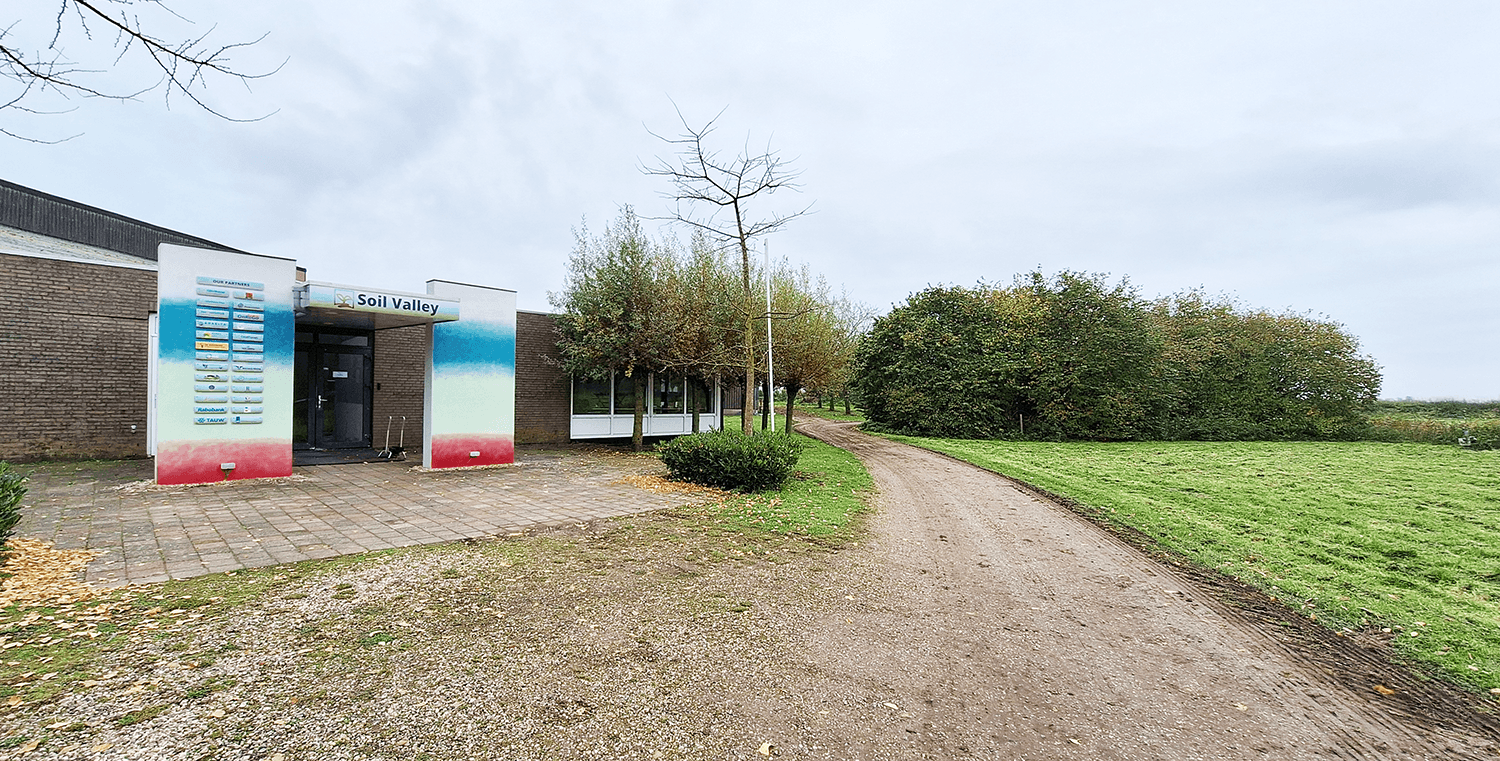
Some of the experiments take place at the InnoFields site, the physical location of Soil Valley, which features offices, a laboratory, trial plots and Bodemliefde, an organic market garden where a great deal of educational activity also takes place.
But research is also being carried out in the ‘real’ world, in towns, on golf courses and on plots of farmland.
New buildings are planned for the next few years, including a large hall where businesses can collaborate with educational institutions and where events can be held. There will also be space for start-ups to set up.
Van Duuren: “We want to grow into a knowledge and research hub of international significance. A Horizon application is currently underway with four other European countries to establish a European Living Lab.”
Contact
Franske van Duuren: franske.vanduuren@soilvalley.eu