
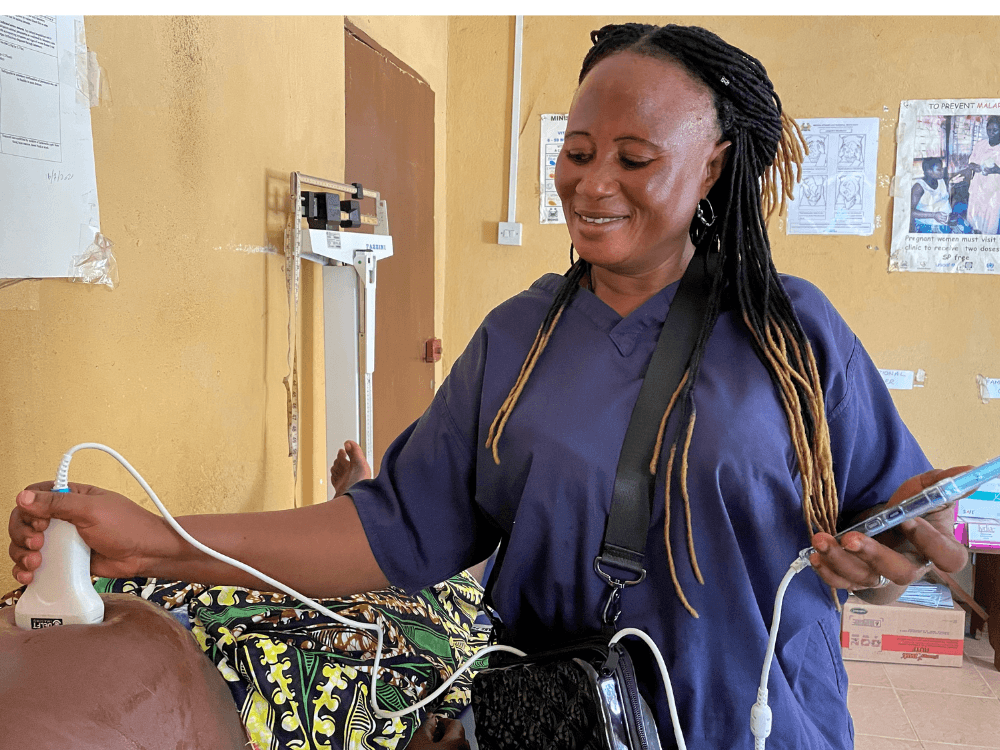
In a collaboration with Delft Imaging, the Radboudumc is researching this portable ultrasound tool. Babychecker is an app that uses artificial intelligence to detect pregnancy risks and is now deployed in different parts of the world. There is also a personal story behind this technology. For researcher Sofia, this is much more than an algorithm: it is work with meaning.
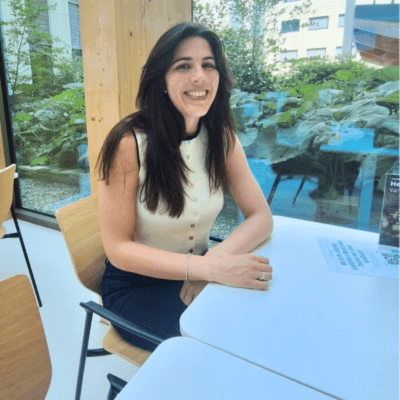
Sofía Sappia
Driven by impact, not just technology
Originally a biomedical engineer, Sofía came to the Netherlands from Argentina to study medical image analysis. In her previous work, she was already doing research, but missed something essential: social relevance.
"It was interesting, I learned a lot," she says, "but it felt mainly academic. With Babychecker, it's different. Here you immediately see what you are doing it for."
Text continues below video
That motivation only got stronger when she herself travelled to Sierra Leone, where the technology is put to practical use. There, she saw how women, often after long journeys on foot, finally gained access to an ultrasound. Something that would otherwise be impossible for many of them.
"When you see it there with your own eyes, you really realise what the impact can be. That a simple scan can make the difference between getting help on time or not."
For Sofia, it is precisely this combination of technology and humanity that drives her: working on solutions that are not only smart, but actually improve lives.
Babychecker: smart care where it is needed most
Babychecker's strength lies in its simplicity. With a smartphone and a portable ultrasound probe, healthcare providers can perform a scan without specialist training. The app guides them step by step, analyses the images with AI and immediately gives clear advice: no risk, extra check-up or referral to a hospital.
This is essential in areas where little medical equipment is available, specialist knowledge is lacking and distances to hospitals are great.
"The aim is not to replace doctors," Sofia stresses. "It is a triage tool. We especially want to reach those women who would otherwise not get care at all."
This is precisely what makes the project so valuable: it fills a gap in the healthcare system instead of replacing existing structures.
The reality behind technology
At the same time, Sofia is acutely aware of the limits of technology. Because a diagnosis alone is not enough. "If you tell someone that there is a risk, something also has to happen. Transport, follow-up examinations, treatment - all that has to be arranged. Otherwise, it can even be stressful to know."
In doing so, it touches on an important point: innovation does not stop at the product. Success also depends on cooperation with governments, NGOs and local healthcare systems.
Lifeport Arnhem Nijmegen Region: breeding ground for innovation
The fact that a project like Babychecker is being co-developed in this very region is no coincidence, according to Sofia. The Lifeport region offers a unique combination of knowledge, cooperation and entrepreneurship.
"Here you have everything close by," she says. "The hospital, the university, technical expertise ánd companies that really bring innovations to the market."
The connection between Radboudumc, research institutes and partners such as Delft Imaging creates an ecosystem in which ideas can grow rapidly. Researchers collaborate with clinicians, and innovations get direct access to practice data and medical expertise.
In addition, the region plays a role in talent development and knowledge sharing: university-hospital cooperation, strong AI and medical imaging groups, spin-offs that bridge to application and an open culture with lots of exchange of ideas.
"You don't just learn to do research here," says Sofia. "You also learn how to make an impact."
From local ecosystem to global impact
Although Babychecker is used worldwide, an important part of the research is located in Nijmegen. There, algorithms are developed, data are analysed and new applications are tested.
It shows how a regional innovation hub can have international significance. From Lifeport Regio Arnhem Nijmegen, solutions are designed that make a difference precisely outside Europe.
"The great thing is that it starts here," says Sofia, "but the effect is immediately felt elsewhere."
Continuing to build meaningful technology
Sofia is now at the end of her PhD project and is looking for the next step, preferably in the same direction: medical imaging with impact.
"This is the kind of work I want to keep doing. Using technology to solve real problems."
This ambition fits seamlessly with the region itself, which is committed to health, technology and social value. Babychecker is an example of this: an innovation that arises from cooperation, grows through expertise and ultimately reaches people who need it most.
Innovation
The story of Sofia and Babychecker shows that true innovation is not only about smart technology, but mainly about motivation, cooperation and the will to make a difference. And therein lies the strength of Lifeport.
Read more
- Sofía told about the Babychecker at INNOVATE AI Meet up XL in April 2026
- Information page Radboudumc
Main photo: Delft Imaging

