Specially developed digital biomarkers allow you to measure health more objectively. This gives doctors a better picture of a patient’s condition.
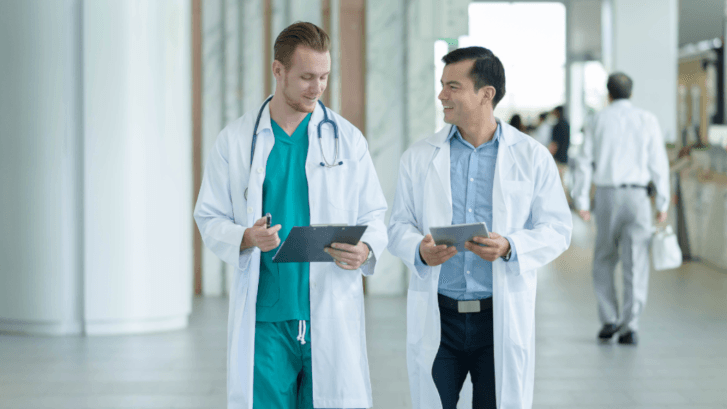
In the consultation room, doctors often only get a limited picture of how a patient is doing. A patient might talk about the pain they’re feeling today, but not mention how well they were doing just last week. The young medical technology company Orikami has come up with a solution to this. Doctors can now measure how a patient is really doing.
Objective
Nijmegen-based Orikami specialises in developing digital biomarkers for healthcare. The first products have been on the market recently. You can ask someone if they are tired or in pain. But you can also measure it through a test. These so-called digital biomarkers measure various indicators that tell how someone is doing. "For example, whether someone is tired, whether they can still walk well or whether their cognitive abilities are up to par," says Bert Seegers. He is one of the three owners of Orikami. "We have developed tests that take reliable and objective measurements very easily."
Walk test
The results are shared with the patient and the medical team. As a concrete example, Seegers cites a system for MS patients, MS Sherpa: “With this condition, there are two key indicators: mobility and cognition. We have developed tests that specifically measure how these are faring. For example, how far someone walks in two minutes. You don’t do a test like that every day, but you do it every week or every two weeks.” The aim of digital biomarkers is to provide both the patient and the doctor with more information about the course of the disease. This makes it possible to predict the progression more accurately, thereby giving patients greater control over their lives.
Pilot in hospital
More than five years were spent developing and approving the medical device. A pilot with Orikami's product recently started at the Jeroen Bosch Hospital (JBZ) in Den Bosch. "We see that the pressure on healthcare is increasing. In the future, it will even become unsustainable to provide all care. We therefore want to move more care home," says Hanneke van Heijst. "Orikami's app fits perfectly within our strategy. You keep more track of someone's health, without someone having to come to the hospital for it. Orikami had already developed the product further and was ready for the market. That is quite something, because these are long-term processes that are subject to heavy regulation. Of course, we are curious to see how patients and doctors experience the app in practice. That is why we are holding a three-month pilot."
A few times a year
Normally, a doctor sees the patient perhaps once or twice a year. Otherwise, the healthcare provider has to make do with the necessary subjective information and the patient's story in the consulting room. With biomarkers, it is likely to be clearer and more objective to see how a patient or the clinical picture is developing, Seegers expects. He emphasises that the measurements cannot only help (chronically) ill patients: "Think, for instance, of the large group of seniors living at home. You can also monitor them, so you have better insight into how someone is doing at home. For each target group, you can deploy specific tests that have clinical value. We are now discussing this with the Geriatrics Department of the Radboudumc, among others."
Better affordable
Through digital applications and data science like Orikami's, it is possible to keep healthcare more affordable and still of good quality. Seegers: "The downside, however, is that in the Netherlands we are not yet ready with how to implement these kinds of systems in healthcare practice. The financing has not yet been arranged. We are now consulting with a health insurer, for example. However, that is not yet a long-term solution. Rather, we would like to see this fall under reimbursed care."