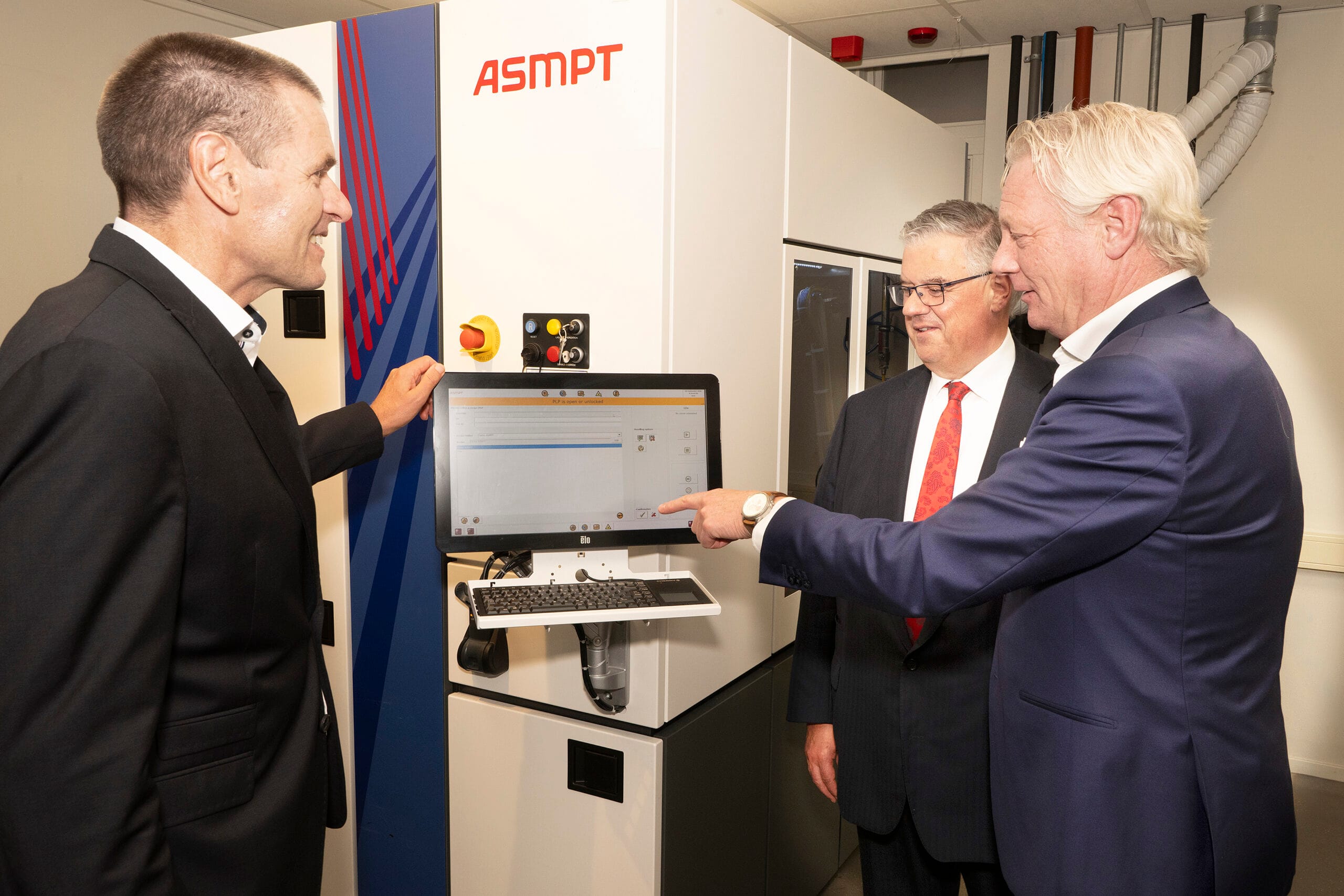
Not a single car leaves any factory in the world without at least one chip from the NXP factory in Nijmegen. A nice little fact. But at the same time, it also illustrates the enormous importance of that large, innovative company on Gerstweg. Nevertheless, the semiconductor sector is under pressure, say Doeco Terpstra, director of NXP Semiconductors Netherlands and a member of The Economic Board, and Jan van Dellen, director of The Economic Board Arnhem-Nijmegen Region. Together, they are taking up the fight. ‘More investment is needed to keep this sector on track.’
The Netherlands, the United States and Japan are the only countries in the world with a complete semiconductor industry within their borders. It is therefore both positive and important that the previous government announced last year its intention to invest 2.5 billion euros in the so-called Beethoven Plan, which provides funding for national talent development, housing, accessibility and the business climate for the wider semiconductor industry.
However, relatively little of that money is available for the Arnhem-Nijmegen region. Terpstra: “Nationally, 450 million euros is available for the Beethoven Plan to be spent on talent recruitment. We’re pleased about that – don’t get me wrong – but to further strengthen the Nijmegen and regional parts of the semiconductor sector to capitalise on the opportunities offered by the growing market, sustained investment is needed.”
Largest chip factory in the Netherlands
The semiconductor sector is of great importance to the economy of today and tomorrow, and therefore to the Netherlands’ earning capacity. It is necessary to invest more in a favourable business climate for the whole of the Netherlands, and not just in the Brainport region (Eindhoven), according to Van Dellen. “In Gelderland, we have over 50 (large) companies with a combined turnover of 3.5 billion euros, which together provide around 7,000 jobs. We are the largest region in the Netherlands for the development and production of chips.”
Terpstra adds: “NXP is the largest chip factory in the Netherlands, having supplied billions of chips worldwide for decades. All Dutch chips are produced in Nijmegen, but this is a fact that is virtually unknown even among the city’s own residents.”
High level of innovation
In terms of turnover and jobs, the Arnhem-Nijmegen region accounts for over 10 per cent of the total semiconductor sector in the Netherlands. Van Dellen: “This makes us the second-largest region after Brainport Eindhoven. And given that the semiconductor sector makes the largest contribution to the high-tech sector, the high-tech sector – with over 10,000 jobs – is a vital economic sector.”
Of the five frontrunners in the semiconductor sector, three companies have their largest sites in our region: NXP, Nexperia and Besi. In addition, there are major international players here, such as imec, Ampleon, Infineon, Neways and Trymax.
Van Dellen: “The level of innovation in our region is high. But if we do not invest enough, this will not simply continue. We must keep developing and attract talent to do so. That is how we can maintain the level of expertise. Moreover, we must invest in new materials, and we must invest in new production methods.”
'Smartening up' society
More and more chips are needed because all the electronics in our lives are becoming ever smarter and more connected. From laptops to fridges, and from your bank card and your drone to your car. Terpstra illustrates this with an example. “Old petrol cars contained around a thousand chips; new electric cars contain between three and five thousand. For new cars, we produce chips suitable for edge computing. These work faster and ensure that the smart sensors can process all the information the car receives locally. For example, if they detect a pedestrian. If that is processed locally, there is no delay and you reduce the risk of hitting the pedestrian.” If chips are found everywhere, this naturally presents a major opportunity for the semiconductor sector, for the Nijmegen tech campus and for NXP in particular.
However, says Terpstra, (cyber) security must be up to scratch. “That is the foundation of everything we do. As society as a whole becomes ‘smarter’, we must take great care to ensure that everything is and remains secure. And that is exactly what we are ensuring.”
Consortium for talent development In the Lifeport Arnhem Nijmegen Region, various companies, knowledge institutions and the government have formed a consortium and drawn up a comprehensive plan to develop talent. Van Dellen: “Last September, we submitted our contribution to the National Microchip Talent Strengthening Plan to central government and Brainport Eindhoven.
Since then, the consortium has been working hard to further develop our plan. We aim to implement it in collaboration with the central government, the Brainport region, the Twente region and the wider semicon ecosystem.” The aim is to begin implementing the first initiatives in the first quarter of 2025. At the same time, there is close contact with the government and Brainport Eindhoven to strengthen the region’s position as the Netherlands’ second-largest semiconductor region.
International students needed
To strengthen the business climate, the relationship with HAN University of Applied Sciences and Radboud University is particularly important. They attract a great many people and are a good talent pool for NXP. Terpstra: “But we must ensure that this appeal is maintained.
Attractiveness for new talent, but also for talent approaching retirement. We won’t be able to meet this challenge with Dutch talent alone. We also need international students for this. NXP is a global company and the Nijmegen site is home to over sixty nationalities. The Arnhem-Nijmegen region is the only region in the Netherlands where chips are manufactured. We want the best people here, and we recruit them from all over the world, so let’s offer them something attractive.”
You don’t do that by banning higher education institutions from recruiting international students, as the current government wants to do, says Van Dellen. “That is a particularly bad development that is currently underway. And if you then go on to make university education in Dutch compulsory, you’ll drive even the last remaining international students out of the country. It’s disastrous, because that also means the loss of hundreds of potential innovators.”
Terpstra: “And once they’re gone, you won’t just get them back here.”
Developing chips = writing history
Incidentally, as far as the two gentlemen are concerned, recruitment should not be focused solely on an international audience. There is also plenty of potential talent within the Netherlands. Van Dellen: “As far as I’m concerned, we should be teaching children as early as primary school that a career in technology is a very good choice.” You could do that, for example, by showing them that in the technical sector – particularly the semiconductor sector – you’re helping to shape history.
Terpstra: “For example, we’ve developed chips for solar panels that can detect whether a shadow is falling on the panel, so that only part of the panel is switched off rather than the whole thing. That increases the efficiency of the solar panels. Or take the chips that have ensured a TV’s standby mode uses less energy. With billions of TVs worldwide, that represents a huge saving. I think we can safely say that anyone working on chips is working towards a better future.”