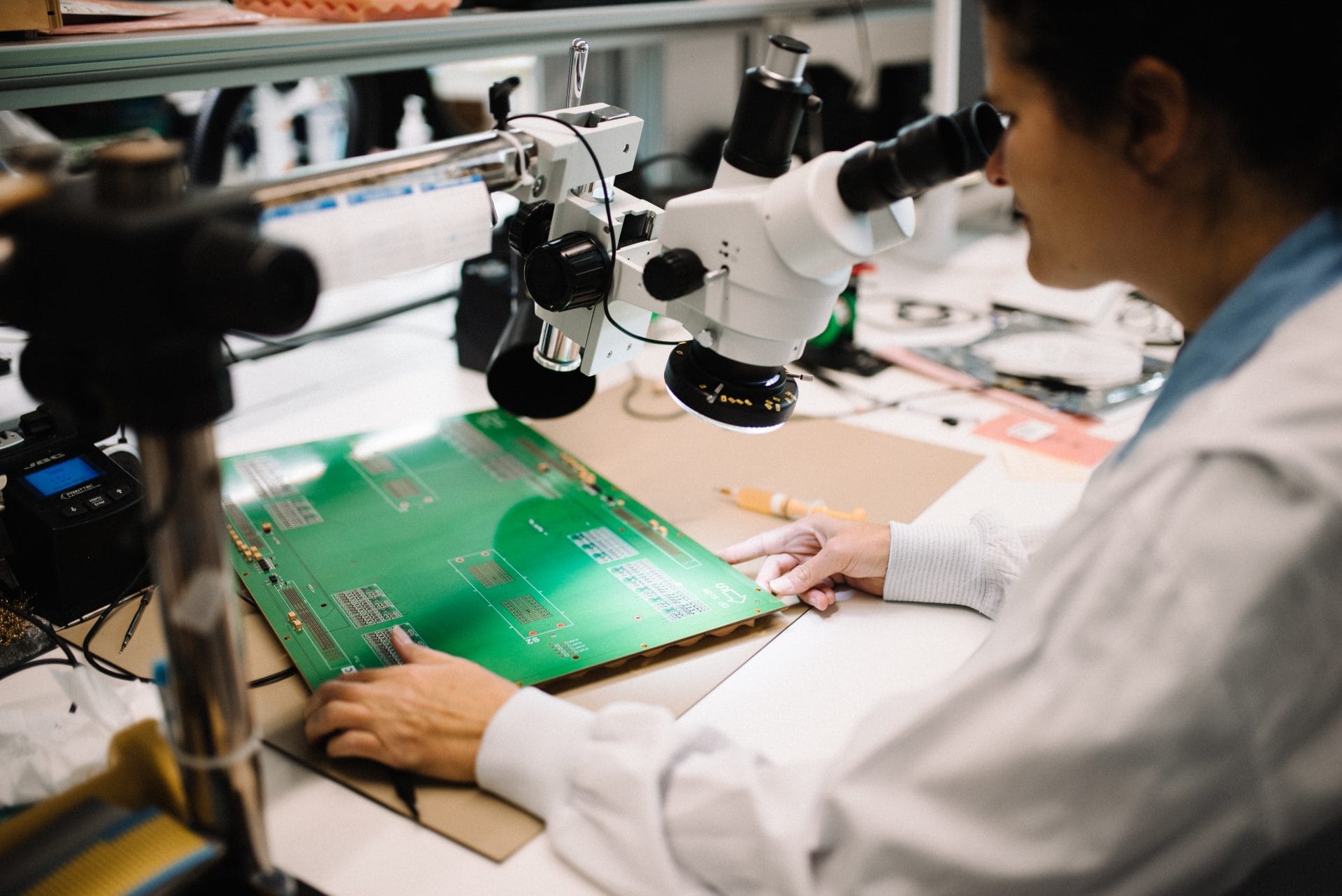
With the design, development and production of semiconductors (microchips), Lifeport Regio Arnhem Nijmegen is the only region in the Benelux to have the complete value chain of the semicon sector. Globally active companies like NXP Semiconductors, Nexperia, Ampleon and Besi work here together with specialised technical manufacturing companies and super-innovative start-ups.
We spoke to Maurice Geraets, executive director of NXP Netherlands and Erik-Mark Huitema, general director of High Tech NL about the strength of the semicon sector in this region.
Left Maurice Geraets and right Erik-Mark Huitema'In addition to the cooperation between companies, we also work closely with governments and educational institutions,' says Geraets. 'Within NXP worldwide, this sets us apart in the Netherlands. These intensive collaborations help us to develop increasingly innovative and efficient chips.'

Long-term plan
High-tech companies, both large and small, local authorities, the province of Gelderland and research institutions have joined forces in the Lifeport Semicon 2026–2034 Long-Term Plan: The future of chips in Lifeport.
The aim is to work towards doubling the size of the semiconductor sector by 2034. This will require 1.1 billion euros in private and public investment. Growth in the chip sector means greater economic growth, increased employment and greater prosperity in the region.
Semicon ecosystem
Lifeport Regio Arnhem Nijmegen houses an extensive 'semicon ecosystem', which, with some 50 companies, over 10,000 employees and an annual turnover of around €3.5 billion, is the second semicon region in the Netherlands after Brainport Eindhoven.
Lifeport stimulates the functioning of the semicon ecosystem by connecting companies, high-tech companies as well as the manufacturing industry, with educational and knowledge institutions and governments.
'As NXP, we are part of The Economic Board Regio Arnhem Nijmegen. In addition, as the Dutch semicon sector, we sit at the table with four different ministries in the Dutch Semicon Board. That's special,' says Geraets. 'Within NXP worldwide, this also sets us apart in the Netherlands. These intensive collaborations help us to develop increasingly innovative and efficient chips.'
Importance of the investment agenda
NXP’s global headquarters are in Eindhoven, whilst its largest Dutch site – comprisingresearch and development facilities and the chip factory – is in Nijmegen. ‘NXP is the world’s largest supplier of chips for the automotive industry. We also manufacture a great many chips for other applications. An average car contains around a thousand chips,’ explains Geraets. ‘At our R&D department in Nijmegen, nearly a thousand people are working on, amongst other things, the development of innovative chips for electric cars. The automotive industry is constantly evolving. R&D is very important to us. That is why the Lifeport Semicon investment agenda is so important.’
Chip industry in the Netherlands
Together with Brainport Eindhoven, particularly strong in building machines for the production of chips (ASML) and the Twente region, particularly specialised in chip design, Lifeport Regio Arnhem Nijmegen forms the hub of the Dutch semiconductor industry. Companies and knowledge institutes in and around Nijmegen work on the entire production chain of chips, the development of smart applications of chips, such as chip-packaging and building machines for the chip industry.
'Lifeport is a beautiful, innovative region, especially when it comes to semicon. Many innovations are being developed, with chips becoming smarter and smaller. Think of chips for robotisation, the energy sector and for use in factories,' says Erik-Mark Huitema.
This trade association for the Dutch high-tech industry drives innovation by connecting companies and knowledge institutions and representing the interests of high-tech companies, especially in the semiconductor industry.
Chips basis modern society
The development and production of (micro)chips form the basis of our modern society. They are indispensable for the operation of virtually all electrical devices we use every day. Among other things, semiconductors control energy flows in devices. Chips are also indispensable in all kinds of industrial processes. Think of the car (industry), robot hoovers, electric toothbrushes and shavers to the proper functioning of the power grid and diagnostic equipment in hospitals.
Medical chips
'A chip consists of a very small piece of silicon with a huge number of electronic circuits on it. That sounds simple, but chips are becoming increasingly sophisticated. NXP also produces special chips for medical diagnostic equipment, such as X-ray photography,' explains Geraets. 'We also make chips for smaller medical devices, such as hearing aids. In Leuven in Belgium, for example, we have developed a special chip. This chip can send sound on the side of the ear you can no longer hear to the hearing aid in your other, still functioning ear. With this, we improve the quality of life.'
Strengthening a leading position
The Netherlands, particularly Eindhoven and Nijmegen, has traditionally played an important role in the development of the semiconductor industry, as Philips focused on the design and production of chips from the middle of the last century.
Philips Semiconductors changed to NXP in 2006 and in 2017, NXP split off their Standard Products Division, which continued as Nexperia. 'We also have key technology companies in the Netherlands, which make machines for the chip industry worldwide, such as ASML, ASMPT and BESI. There are not many of those in the world,' Huitema notes.
He stresses that the Lifeport Semicon investment agenda is important to strengthen that leading position of semicon in the region, but also in the Netherlands and Europe. 'In doing so, it is necessary to support innovative developments, but also to renew the existing semiconductor industry,' says Huitema. 'Simple chips, so to speak, like those Nexperia makes for shavers and cordless drills, for example, remain important and are also becoming increasingly efficient in their power management.'
Innovative chip packaging
Lifeport is at the forefront of innovations such aschip packaging, on which CITC-TNO is working. This Chip Innovation Technology Centre conducts research into and tests innovative technologies to provide chips with a protective layer (packaging) that enhances the chip’s functionality and also adds new features. ‘Goodpackaging ensures that chips operate as efficiently as possible. It’s great to see that a company like ITEC in Nijmegen is responding to this need and has developed an automated system for chip packaging,’ notes Huitema. ‘This means we no longer need to rely on China for this, and we are no longer vulnerable to international trade restrictions in this area. That strengthens the Dutch economy and is good for employment.’
Huitema points out that the chip industry is not only an economic factor worldwide, but given the tensions between superpowers such as the United States and China, it also has increasing geopolitical significance. 'Therefore, it is good to have key elements in the value chain of the semiconductor industry in Western Europe.'
Cooperation with education
To enable the growth of the semiconductor industry in the Netherlands and in the Lifeport region in particular, considerable investments are also made in the cooperation of companies and education. This explicitly involves education from mbo to Radboud University. 'Actually, you should introduce children, boys and girls, to the possibilities of chips, engineering and technology as early as primary school,' says Geraerts. 'Fortunately, this is happening more and more.'
Lifeport Semicon Talent Plan
Part of the Lifeport Semicon 2026 - 2034 Long-Term Plan: The future of chips in Lifeport, is the Lifeport Semicon Talent Plan, in which investments are made in various ways to train young people as well as adults (Life Long Development) to become technical and technological professionals. It involves developing and introducing special education modules, setting up laboratories and carrying out multidisciplinary projects. The government is investing 2 million in this in the first phase, rising to 6 million in the coming years.
NXP and Radboud University
NXP has been working for several years with the three technical universities in the Netherlands, but also increasingly with ROC Nijmegen, the HAN University of Applied Sciences, ARTeZ Hogeschool voor de kunsten in Arnhem and Radboud University Nijmegen.
'Some 60 researchers, who are in the process of obtaining their PhDs, work for us and eight part-time professors,' Geraerts says. 'It is great to see that Radboud University is also taking an active role. We are looking at how we can better match our own research questions with research the university is doing.'
Among other things, Radboud University is conducting research into a new, more efficient generation of chips and computers, such asneuromorphic computing. In this approach , computers function more like the human brain. Other research at the university focuses on photonic (memory) chips, which operate using light rather than electricity.
The cooperation between companies and educational and knowledge institutions ensures that education becomes more attentive to companies' questions. And vice versa: that companies become more socially involved. Geraets is convinced of this: 'It helps for the connection if you don't meet once every three months, but just work together daily. That stimulates innovation.'