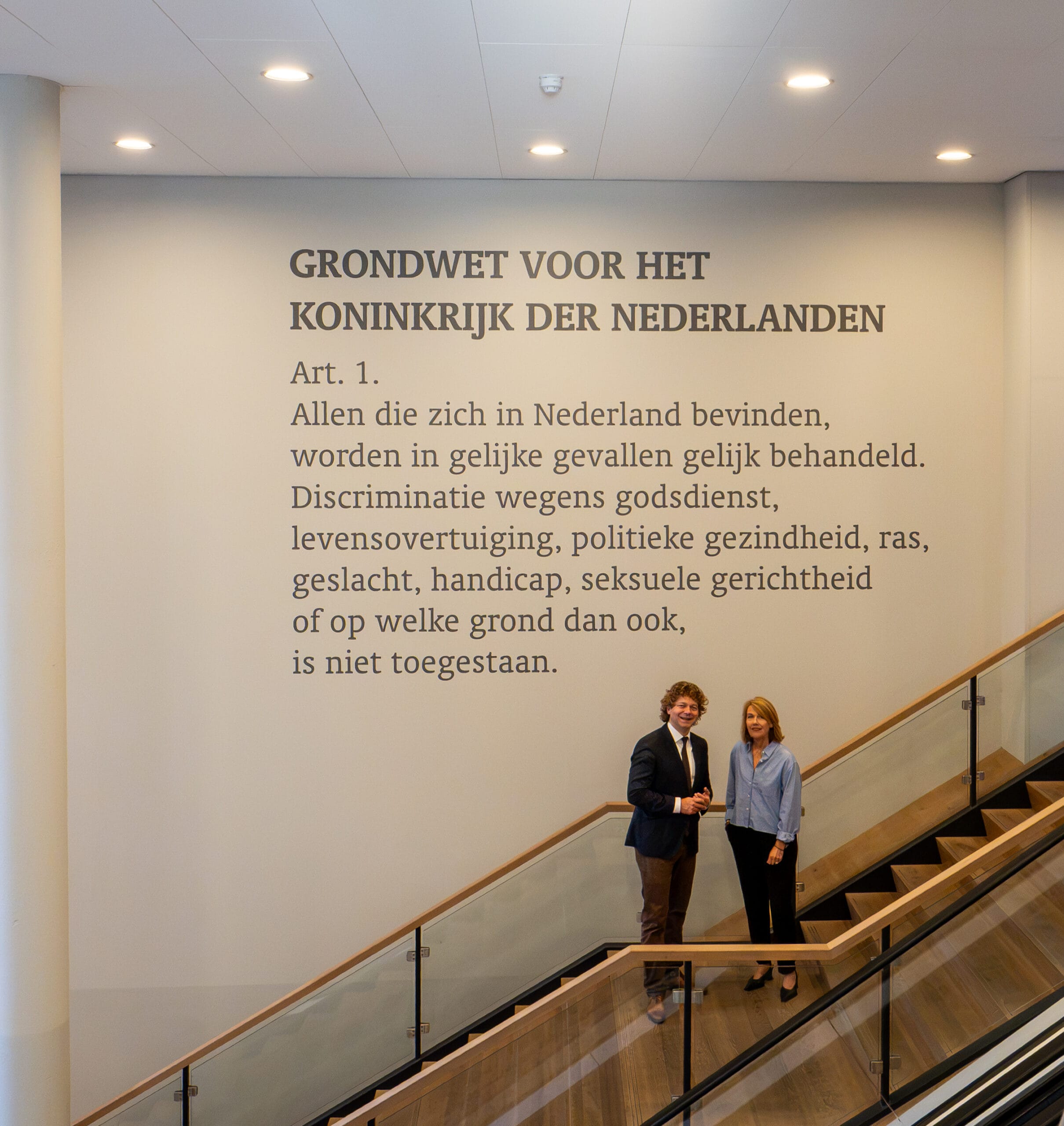
The Economic Board is the lead partner for the Regio Deal project
‘Working Together Towards a Labour Market That Works’. Over the next three years, a specially assembled team will work on driving forward and scaling up projects centred on training, upskilling and retaining talent in the Arnhem-Nijmegen region. This Regio Deal project forms part of the implementation of the Human Capital Agreement.
Adam Galijašević is the programme manager coordinating the project and overseeing its implementation. Adam explains what this project focuses on and what sort of activities are planned.He is working on this project alongside two project leads –
Ruth Klein for Energy and
Kim Hooiveld for High-tech – a communications adviser, a support officer and two strategists, Renate Bouwman and
Corine Bos, who are both available one day a week from their respective organisations.
Regio Deal project
As project coordinator, you will ensure that the project is implemented and managed responsibly. This involves overseeing the development and scaling up of various projects in the region, covering themes such as lifelong learning, attracting and retaining talent, and utilising untapped labour potential. But you’ll also handle practical matters, such as ensuring the state aid assessment is carried out, monitoring progress and reporting to the provincial authorities. Galijašević explains: “On top of that, I have to keep everyone on the same page, because everyone here has an opinion on this. There are a great many partners and organisations who sometimes think: ‘I’ll just do it myself.’ So you have to take the lead and ensure that people work together. There are lots of plans; lots of organisations want to do something on their own. How do you ensure they look beyond their own interests to the common good? Many companies have their own training programmes from a business perspective, but if we want to achieve the necessary scale, we really need to join forces. Let’s make sure that one plus one equals three. I’m convinced it’s possible. At IPKW, for example, we see that applicants who aren’t selected by one company are referred to another, where the match is much better suited. That’s how you work together to make the most of every talent.”
Shaping education together with companies
Galijašević explains that the Regio Deal project will implement the region’s Human Capital Agreement, concluded last year (see box below).
One of the pillars of that agreement is Lifelong Learning. “The question is: which skills will we still need in ten years’ time, and which might be less relevant? So how do you ensure that you become and remain relevant in your profession? It means you may need to develop different skills. And some professions will simply disappear. Retraining for careers in health, energy and high-tech is therefore essential. That is why we are committed to involving businesses in shaping education. For an educational institution, it can easily take four years to revise the curriculum. So you really need to move towards a system in which you continuously reflect together on which skills are (or will be) needed and how to organise this in a flexible and modular way. A system in which universities of applied sciences and universities also make greater use of practical assignments, so that students know what is required in the workplace.”
The knife cuts both ways
With regard to the ‘Untapped Labour Potential’ pillar, Galijašević notes that it actually involves two distinct issues. Sometimes it concerns people who are on the sidelines and out of work. But it often also concerns people who are already in work and wish to develop their skills or find employment elsewhere. If you give these people the opportunity to develop themselves, they benefit from this as individuals – by gaining greater job security and a better income – whilst at the same time achieving the desired effect of enabling them to fill many of the roles for which there are currently too few people.
Coalitions and projects
“We do not carry out projects ourselves. However, we do help to build the necessary coalitions, draw up plans or secure funding for them. Or, if such coalitions already exist, we can provide them with a budget to set up a long-term project or run innovative initiatives. We drive this forward by deploying trailblazers, expanding the network and helping existing projects to scale up.Take ROC Nijmegen’s
Junior Technovium, for example. There, hundreds of children get to experience what it’s like to work or study in the technical sector. That’s a winning formula. We’re now scaling that up to Wijchen, where a new Technovium has just been launched. With funding from the Regio Deal, we can cover part of the start-up budget. We’re doing this in partnership with local businesses. Another example is the
Energy Practoraat, which ROC Nijmegen and RijnIJssel are setting up together. The practoraat is intended to give a boost to technical training programmes focused on the energy transition. This will be achieved by identifying the current challenges faced by the companies involved, determining what innovations are needed, and reforming the curriculum.
“We are now going to fund a project manager. They will draw up a plan. And with that plan, they will submit an application to the regional investment fund in The Hague. The aim is to set up this practoraat using funding from businesses and central government.
We’ll ensure this plan comes to fruition, and once that’s done, ROC Nijmegen and RijnIJssel will roll out the practoraat. Those educational institutions have the expertise; we don’t. So we’ll ensure they can do their job. Or, to put it more strongly, that initiatives are set up which they consider important, but which they are unable to undertake due to a lack of capacity.”
Contact
Please contact Adam Galijašević: +31 6 18 33 02 03 or
a.galijasevic@theeconomicboard.comAbout the Human Capital Accord
The Regio Deal project is based on the three pillars of the Human Capital Agreement and focuses on the three regional clusters: Energy, Health and High Tech.In 2023, The Economic Board, the Green Metropolitan Region, the province of Gelderland and dozens of partners from the business and education sectors signed the Human Capital Agreement (HCA) to tackle challenges in the labour market.The agreement defined three pillars:
1. Lifelong Development
This centres on retraining and upskilling workers so that their skills remain up to date or so that they can retrain as career changers.
2. Attracting and Retaining Talent
This involves ensuring that people from outside the region come here to work. It also involves ensuring that people who have been educated in the region stay here to study and work, and retaining those who are already working in the region.
3. Untapped Labour Potential
On the one hand, this concerns people who currently do not have a job, and on the other hand it gives people more perspective on the labour market.