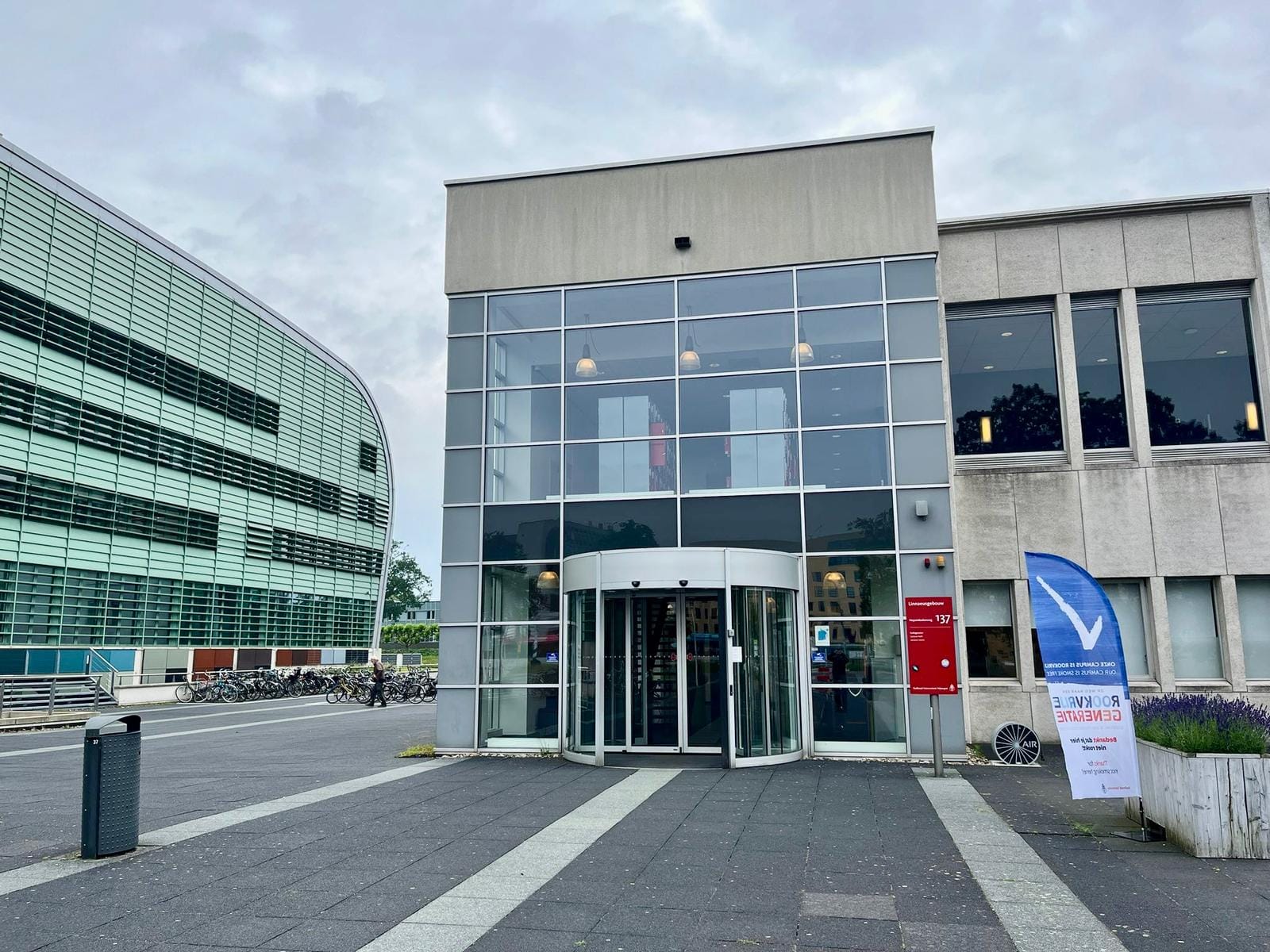
Two years ago it was in the newspaper: the Linnaeus building on Nijmegen's Heyendaal Campus is to be demolished. Radboud University has since decided not to demolish, but to transform. To this end, the RU's facilities company made contact with Via-T, the new innovation centre for the built environment. Frank Croes, Programme manager Circular Economy at the HAN and involved in Via-T, explains why this is such an interesting choice.
"This building is actually a modern monument, the brutalist style has a certain beauty. Can we preserve the beauty of the past and add new value here in the future? The building is now used exclusively for lectures, there are many large lecture halls but hardly any facilities. So we started an exploratory study with the question: from the concept of multiple value creation, what are the starting points for a sustainable transition to a future-proof and multifunctional Linnaeus building?"
Multiple value creation
Croes explains that multiple value creation is not just an economic concept. "We want a building that is sustainable, cost-effective and pleasant and comfortable for its users.
Ecologically, it should be CO2-neutral as much as possible, both during renovation and in future use. Furthermore, we want to connect symbiotically to the surroundings, including the natural environment of Park Brakkestein. We want to work with new insights around biophilic design (a design philosophy focusing on the use of natural elements such as plants, wood, water and natural light), as well as bio mimicry and biobased material use.
And you can think of using ten hours a day for fifty weeks a year for multiple user groups, instead of the current four hours a day for forty weeks. That, in turn, ties in nicely with our idea of an open campus, where, for example, theatre or lectures can be visited by all Nijmegen residents.
"And it combines well with the fact that of course it has to be financially viable, both the investment in the transformation and the operation. To sum up: multiple value creation is steering for profit without loss."
"In this way, you can create something beautiful that initially seems more expensive than new construction, but in the long run is actually more sustainable in use and provides a smaller footprint. At the same time, comfort and ease of use are increased."
Design thinking
A wide range of people have already studied the possibilities for the transition to a sustainable building. From stakeholders from the business community, sustainable builders and developers, to the municipality of Nijmegen, and from campus management of Radboud University to students from various courses in the region.
With the design thinking they came up with all kinds of new possibilities for transforming the building to make it more valuable for the RU and others.
Croes: "Instead of high-tech investing, one of the trends in sustainable building is now biophilic design, which is low-tech. You can already achieve a lot climate-wise with the choice of materials and the use of greenery, so you don't have to adjust and regulate with hardware and installation technology. That is fantastic in the long run, because you write off hardware and it requires energy and you can reduce that in this way."
A summary report of this brainstorming phase is input for the next phase, the tendering process, in which an architect is commissioned for a new design, with all functionalities.
Learning and connecting
Many students have been involved in the design process. In all subsequent phases, too, students and pupils will be watching, discussing and co-building. From drafting the tender document, looking at the drawings and planning aspects to realisation and renovation.
This involves students from the entire range of education: from vmbo to wo and from HAN, RU, Van Hall Larenstein to ROC.
And not only students learn from it, but also companies involved and the courses themselves come into contact with each other and discover opportunities for cooperation. Croes: "Connecting all ranks in the world of education has synergetic added value, the institutes learn to find each other better, it creates a sense of pride for the region, we don't just make beautiful reports, but also work together on sustainable transition of the built environment."
Presentation on 10 October
On 10 October, Via-T is organising a major event in the Linnaeus Building itself to present its own plans and agenda to all relevant stakeholders.
The results of the Linnaeus project will be shown here for the first time in scent and colour.
Via-T
Croes explains why he is involved in Via-T, Centre for Craftsmanship, Innovation and Sustainability. "Via-T stands for a future-proof living environment, in which we do not simply build on, but create more functional value in the existing environment, and restore biodiversity, and prevent heat stress, and create a healthy living environment where people can live in green surroundings, and work and recreate, and all this in increasingly scarce space. By combining things smarter and making use of linking opportunities, we can get much more value out of that existing space."