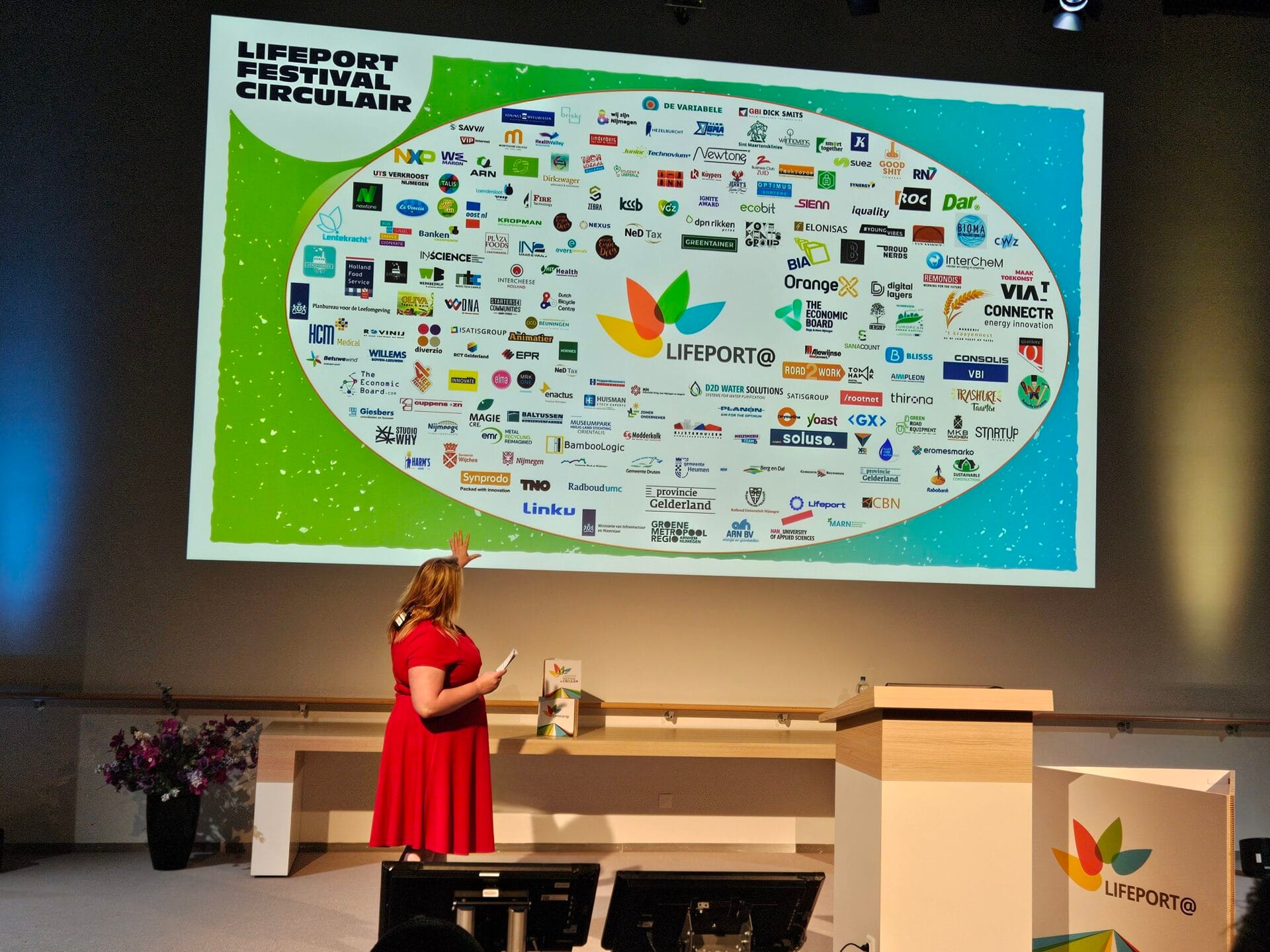
The Lifeport Festival Circular is an annual network meeting for SMEs, young talent, education and government to share circular knowledge and gain cooperation partners, and this edition was also excellently organised. Interest was so great that the organisation added partial sessions at the last minute. The Economic Board was also present, programme manager Ruth Klein tells.
"There was clearly a lot of energy: the network and the movement are growing! You notice that there is an increasing focus on sustainability and the transitions that go with it. SMEs are also getting more involved."
Sustainable developments
Marije Klomp is programme director Sustainability At Radboud University, she spoke about the campaign You are needed. It appears that 86% of students say they want to make a social impact. She gave a few examples of ways in which Radboud University is working on sustainable development.
For instance, the idea arose to transport energy and heat left over from new buildings on campus (such as data centres) through pipes to the older and less insulated buildings (such as the Erasmus building). Another example is the plan to use AI to measure with cameras what is left on the plates in the Refter, which are handed in for washing up. This will allow you to match portioning to demand.
Klein then attended the partial session with Merijn Neeleman, on collaboration in a circular community. He explained how Lifeport@ is setting up this community with companies and educational institutions to find solutions to sustainability issues together.
The group split into four teams to jointly devise a specific challenge and identify which stakeholders should be involved.
"In my group was a marketing and communications agency, which told me that companies are not at all concerned yet with the environmental impact and CO2 emissions of marketing and associated data storage. To illustrate: Apparently, a ChatGPT job costs as much CO2 emissions as going to Milan by car. Companies may want to be aware of this, but have no idea. It seemed to me that advising on this could be a unique selling point for a marcom company. For instance, can you make your website much lighter? In the Lifeport Campus Circular community, students might be able to figure out how much CO2 everything costs, from webshop to facebook advertising. And how it can then be lighter/with less emissions. Or where other benefits can be achieved."
Product park
Klein was also on behalf of The Economic Board with a stall at the Product Park, where circular companies presented themselves. There, she spoke to a number of companies about their product.
For example, Synprodo (part of Isobouw) produces circular and modular polystyrene foam that can be slotted together and taken apart. “What I found great was seeing connections form on the spot, in this case, for example, with Via-T. When I spoke to Synprodo about the polystyrene foam and whether it could be taken apart again, he told me about a problem they’re facing. Namely, that there is as yet no solution for its use in ground insulation. Styrofoam is laid on the ground, followed by a layer of concrete, which eats into the foam, making it impossible to separate them again. He wondered whether it might be possible to do it the other way round – Styrofoam on a concrete slab – as that would make it easier to reuse. I told him about Via-T and how they’re working on research there with students, and he immediately got in touch with them.”
synprodo.nl
Klein also spoke to Green Road Equipment, a company that converts traditional machinery into electric machines, such as road rollers used to smooth roads. These do not yet exist in an electric version, as there is insufficient demand. Diesel-powered machinery is still used in the construction industry. However, there is a growing demand for electric machinery due to the nitrogen problem and increasingly stringent tender requirements. That is why Green Road Equipment converts the machinery in much the same way as you would convert an old classic car. Sometimes with a fixed battery (if it lasts a day), but often with a replaceable battery, which you can swap halfway through the day. The machines are also available for hire.
greenroadequipment.nl
Greentainer makes frames for on top of containers, containing plants growing in sheep's wool. So the whole thing is light and absorbs water well. The frames are movable; they can also be placed on temporary school buildings, for example. Among other things, the company is in talks with municipalities about bus shelters.
greentainer.co.uk
BambooLogic was recently on the NOS news. The principle: Farmers can switch to growing raw materials for bio-based building materials, such as hemp, flax and bamboo. That all grows fine here. For this, BambooLogic enters into contracts with farmers for decades of guaranteed purchase. In the first five years, farmers have no income because the plants have to grow, but after that you can harvest for up to 100 years. As a solution for those first five years, the company sees a solution in selling the CO2 rights the farmers have on their land to, for instance, governments that buy off the CO2 impact of a construction project with this. Then the farmer would also have income in the first few years and the municipality would have biobased building material after a few years, reducing the CO2 impact of construction projects.
bamboologic.eu/en/
"This was just a sample of the wide range of beautiful circular companies. And every year this movement is growing!"
Circle awards
At the end of the afternoon, the winners of the two Cirkel Awards were announced.
Read it on LinkedIn