The economy in the Arnhem-Nijmegen region lags behind that of leading regions such as Eindhoven and Amsterdam. The Economic Board Regio Arnhem Nijmegen believes this needs to change. Among other measures, a fund – into which entrepreneurs are also expected to invest millions – is being used to chart a path to growth.
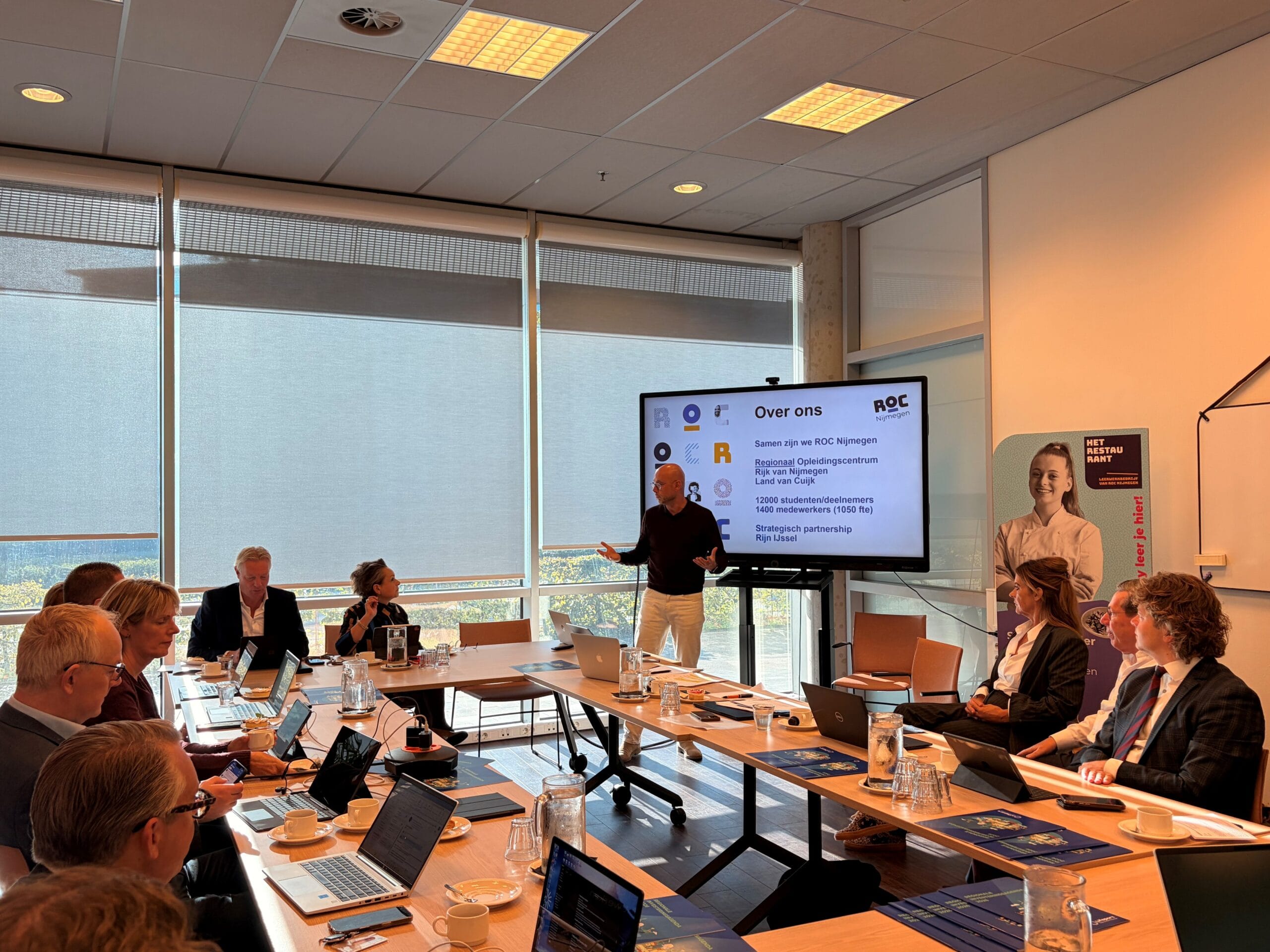
The Economic Board Regio Arnhem Nijmegen has been in existence for ten years and is a partnership between local authorities, businesses and the education sector. In Eindhoven, such an alliance has led to significant economic growth. In the Arnhem-Nijmegen region, this has been less successful so far, and a new attempt will be made in the coming years to achieve this.
“We want to ensure, at the very least, that growth is not below the Dutch average, but above it,” says Alexandra van Huffelen, Vice-Chancellor of Radboud University. She was recently appointed chair of The Economic Board Regio Arnhem Nijmegen, succeeding Arnhem’s mayor, Ahmed Marcouch.
Achieving that goal will be difficult, as there are quite a few obstacles. Talent trained here is moving away to the Randstad. Furthermore, problems with the electricity grid and nitrogen emissions are hampering growth in the region. Investment by businesses in the region is also lagging behind.
Marcouch does not believe that nothing positive has happened over the past ten years. When he took office as mayor, Arnhem and Nijmegen were much more often at loggerheads, he says. “That’s now a thing of the past. When I first arrived here and was lobbying for something in The Hague, the question was often: ‘And what’s Nijmegen’s stance on this?’ I don’t get asked that question anymore.” There is a first glimmer of hope. The region is set to receive 6 million euros from The Hague for education until 2030. That money will be invested in training programmes for the semiconductor industry. The aim is to retain talented students in the region. Gelderland has a cluster of dozens of companies in Nijmegen that are active in the semiconductor industry.
The problem is that at its heart are two companies whose future in Nijmegen is far from certain. NXP is set to build a large chip factory in Singapore to replace the one in Nijmegen, and Nexperia is involved in a global trade dispute with an uncertain outcome.
“That is why it is important that we expand that cluster with other companies. It must not be dependent on just a few companies. That potential is certainly there,” says Van Huffelen. “For example, Radboud University is working on energy-efficient chips. These are very much needed, given the high energy demand in the tech sector.”
A new investment fund, to which companies contribute, is also intended to provide a fresh impetus. The aim is to raise 200 million euros for this fund over ten years. This sum should encourage the government to invest more money as well.
Brainport Eindhoven
It is the task of Jan van Dellen, director of The Economic Board, to make this happen. “We’ve been working on this for a few months now,” he says. “And we already have thirty companies willing to contribute. In total, they’ve contributed a few hundred thousand. That’s not a bad start. In Brainport Eindhoven, which we like to look to for inspiration, they have a total of forty.”
There is still a long way to go, however. The first question companies ask is: ‘But we already pay tax, don’t we?’ Van Dellen: “And that’s true, of course. We’re specifically asking for funding for four areas: housing, innovation, talent development and infrastructure. These are all areas where companies themselves also get something in return.”
Article from De Gelderlander, Rob Berends