Artificial Intelligence (AI) is rapidly transforming various sectors, including education, healthcare and business. However, with the growing influence of AI, questions are arising about trust and ethical issues.
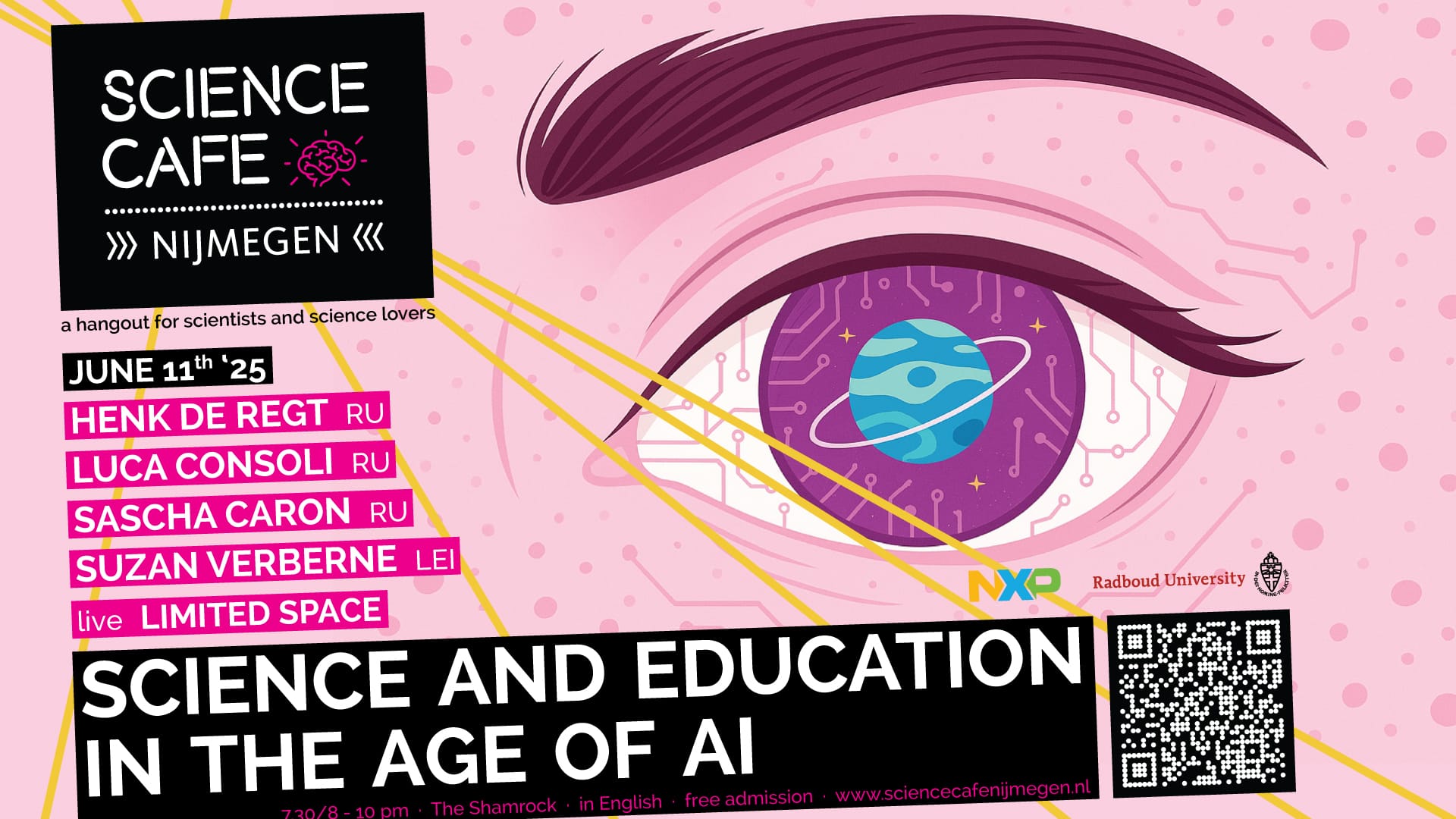
On 11 June, an interesting event on artificial intelligence took place, entitled ‘Science and Education in the Age of AI’, organised by Science Café Nijmegen. Prof. Dr Sascha Caron (Radboud University), Prof. Dr Suzan Verberne (Leiden University), Prof. Henk de Regt and Prof. Luca Consoli (Radboud University) gave short presentations on AI in science (physics and language models) and the ethical and societal implications of AI’s growing role in knowledge creation and dissemination.
We spoke to Dr Consoli, Associate Professor of Ethics of Science at Radboud University Nijmegen and the Institute for Science in Society, about developments in AI, ethical issues surrounding its use in education, and the complexity of human capital in the labour market. 
Prof. Dr Luca Consoli
Understanding AI
What exactly is AI and who develops it? Consoli explains that AI encompasses a wide range of technologies, from recommendation systems online, on TV or on social media to generative AI such as ChatGPT and Microsoft Copilot.
“The common factor is that these systems behave in a way that appears intelligent and thus often mimic human interaction.” From talking to customer service (often starting with a chatbot), to automation in businesses or marking an assignment, we all come into contact with AI these days, whether we like it or not.
Generative AI in Education: responding to a fast-growing trend
Generative AI, such as that found in large language models, has had a noticeable impact on education. Consoli emphasises that the use of AI in education did not originate from educational institutions but rather from the students themselves, who use AI programmes to (help) complete their assignments or as search engines. “Students have quickly embraced these tools, which has forced educational institutions to respond.” The challenge in education lies in integrating AI responsibly whilst remaining independent of big tech, an area where issues often arise regarding the safeguarding of privacy and compliance with laws and regulations. This has led to higher education institutions now developing their own AI systems.
Consoli is not opposed to the use of AI in education, but advocates for its responsible use and deployment. Furthermore, education has an important role to play: teaching students critical skills. How do you apply this in an age where students think they can trust everything generated by AI? For Consoli, the key lies in learning core skills such as critical thinking, so that students can critically assess the accuracy of AI’s output. Consoli: “That is why more and more courses on digital literacy are being offered to both students and lecturers at universities.” The hope is that this will raise awareness.
Responsible handling of AI
When it comes to who the frontrunners are in the field of AI development in the Netherlands, Consoli’s answer is: “Everyone and no one. Big tech (Google, Microsoft, OpenAI) currently holds the largest market shares in this field.”
Smaller companies with significantly smaller budgets cannot yet compete with what big tech has to offer. “Educational institutions, businesses, healthcare organisations and so on face difficult choices: integrating big tech AI into their sensitive systems – which involves choosing between ‘cheap’ options that may pay little heed to GDPR rules, or opting for very expensive options where privacy is guaranteed. Or choosing smaller AI systems that may still be in their infancy.”
The National Education Lab for AI (NOLAI) for primary, secondary and special education in the Netherlands, funded by the National Growth Fund, develops and researches responsible educational AI. Collaboration between the education sector, the business community and academics is central to this. Consoli says: “Educational institutions feel an ethical obligation to use AI responsibly in education, by conducting thorough research into which AI systems are being used and under what guidelines.”
Trust and explainability
Trust in AI is multifaceted. It encompasses reliability—ensuring that AI performs tasks as expected—and explainability—understanding how AI reaches its conclusions. Consoli notes that the ‘black box’ nature of many AI systems makes it difficult to trust them fully. Transparency and the ability to explain AI decisions are crucial for building trust.
Ethical considerations: can AI completely replace humans?
The social impact of AI extends beyond education. Consoli discusses the possibility that AI could replace certain jobs, particularly those involving repetitive tasks. “Certain jobs will be lost. Take customer service, for example, which is largely being replaced by chatbots. But AI cannot completely replace humans.” His ideal solution is to use AI to free people from monotonous work, so that they can focus on more creative and meaningful activities.
However, the ethical implications of AI, particularly generative AI, are significant. Consoli emphasises the importance of ethical considerations in the development and deployment of AI. Issues such as privacy, sustainability and bias are crucial. The challenge in the labour market now is that employees must develop new skills to prevent job losses. “New professions will be created so that humans and AI can work together,” says Consoli.
An important role
As AI continues to develop, ethical considerations and trust remain paramount. Consoli believes universities, knowledge institutions, companies and other parties could play a crucial role in promoting awareness and guiding responsible AI use. He says, "By addressing ethical challenges and promoting transparency, we can harness the potential of AI while mitigating risks."