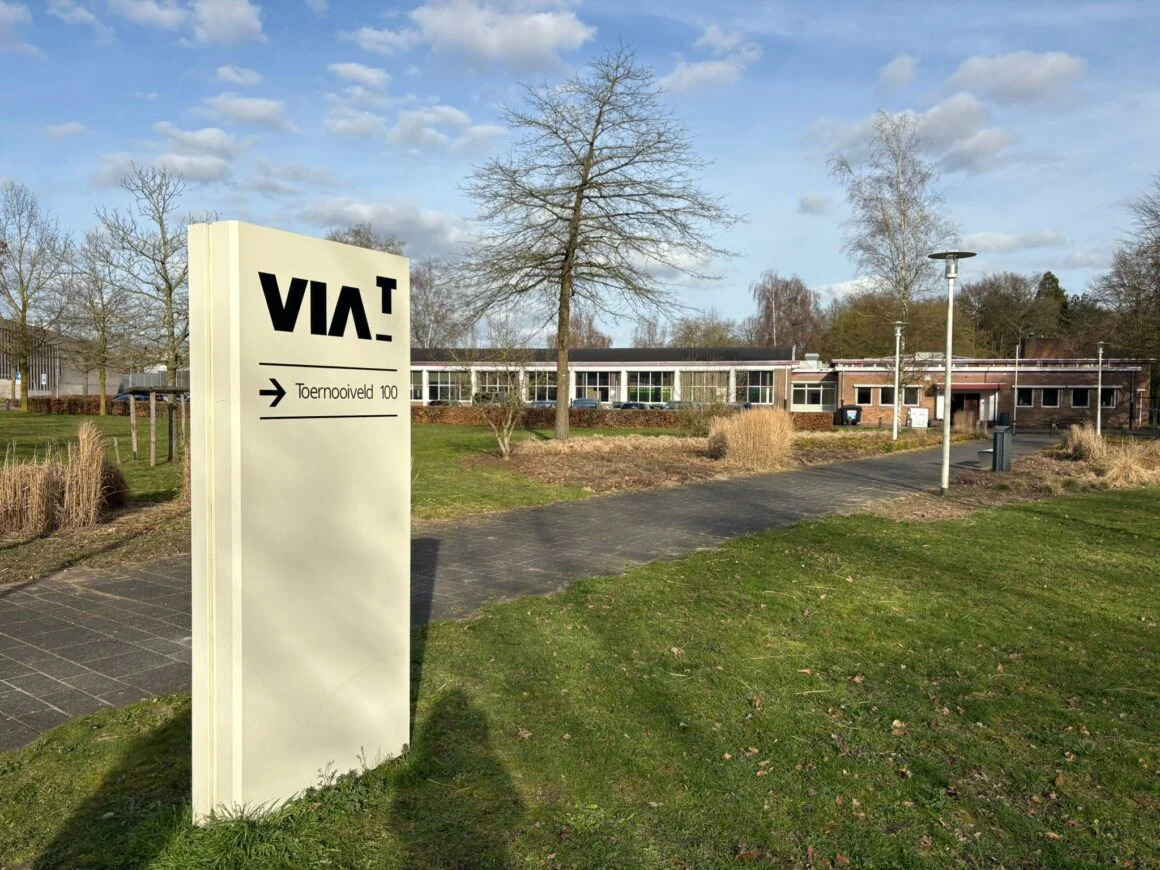
Imagine you’ve developed a new water technology and you know how it works in the lab, in a test tube or in a five-litre vessel. But you don’t know how it will perform on a much larger scale and 24/7. That’s when you need to make the transition from the lab to full-scale research, and that’s where the Innovation Workshop at the InnoFase site in Duiven comes in.
Dennis Roes is a corporate account manager at the Rijn en IJssel Water Board and has been involved in this workshop, which launched in 2022, from the very beginning. He knows exactly what entrepreneurs in this sector need and how their innovations can in turn lead to new developments in water treatment.
Scale
Roes says: "What you see particularly here in the region is that the lab facilities are there, but that next scale to do tests around waste water, sludge or biogas, there are hardly any facilities for that. That is why we said together with AVR, the province of Gelderland and Duiven municipality: we are going to build a location for that. Here, initiatives can rent space to carry out tests."
Licences
It took a while to sort out the permits for the workshop, but that has now been finalised and the third test is already underway.
Roes: “It’s very convenient that the permit requirements have already been sorted out. If you wanted to work at a different location, you’d have to amend the entire permit. These days, that’s no mean feat with the PAS. For example, the additional transport movements aren’t covered by the standard permit, so you’d have to sort that out. It’s all sorted here.”
Participants are, however, responsible for obtaining the necessary environmental permits themselves. “Because, of course, we don’t know exactly what they’ll be doing there or what materials they’ll be using. But they sort that out together with Duiven Council and the Environmental Agency. So, for example, if you use ferric chloride, it must be placed on a drip tray – you’ll have to arrange that yourself. If you say you want to do something involving gas, it must be within the EX zoning. You’ll have to sort that out yourself as well. If you’re only working with waste water, then there’s actually nothing you need to do.”
The facilities
Roes explains what you can expect at the workshop: “It’s on our own secure site, which has an office space, a warehouse serving as a covered test area, and plenty of outdoor space to accommodate a container as well. So, in principle, two initiatives can run simultaneously – one indoors and one in the space outside.
You’ll have various raw material streams at your disposal: raw wastewater, pre-settled wastewater, treated wastewater and sludge. These are all available on site and you’re free to use them.”
Cost
Is this affordable for start-ups? Roes explains that the rate depends on how close the test site is to the water treatment plant. “If you’re developing something that benefits us too, the rate will be lower than the commercial rate.”
As the municipality, the province, AVR and the water board have all contributed to the set-up, interested parties only need to pay the rental costs and utility charges.
Available
Three studies have already taken place: one by Byosis and two trials by Nijhuis Watertechnologie. Universities of applied sciences in the region have also expressed an interest.
However, companies from outside the sector are also welcome at the Innovation Workshop.
“If another company comes along and says, ‘I want to try something different’, we’re simply open to that.”
Developing business
Roes: “I’m trying to do business with companies in our area. To facilitate them, but also to develop things together. This includes, for example, sustainable energy, biogas and water supply. Water is becoming the new bottleneck. So I’m in discussions with Vitens and the Province of Gelderland to see if we can offer businesses in our catchment area alternatives to groundwater extraction.”
One example is the trial carried out by Byosis using various techniques to strip nitrogen to produce ammonia. “That was, in fact, the reason why the water board decided to incorporate this technique into the expansion of its sludge digestion facilities and possibly also to invest in a full-scale plant to supply the ammonia to waste incineration plants (Waste Incineration Plants, such as the AVR) which can use it in flue gas cleaning. And we are also looking for other market opportunities. For us, this represents a certain degree of social commitment. And we want to stimulate, promote and facilitate the market, with a view to the challenges that lie ahead.”
Legislation and regulations
Laws and regulations often get in the way of developing these kinds of new technologies and scaling them up. Roes: "If you encounter this, it does indicate that you are working on innovation. The moment you present something to the ministry and it says: that has already been regulated, it is no longer innovation, so it is also a nice incentive. That you think I am working on something new. Because otherwise the laws and regulations would have been there already."
Partners
Partners participating in the Innovation Workshop: HAN, Groene Allianties de Liemers, Wageningen University & Research, OostNL, Greenhouse – IPKW, Rijn en IJssel Water Board, AVR, Van Hall Larenstein, RCT Gelderland, Core Chemistry/Eindhoven University of Technology, NX Filtration,
Nijhuis Industries, University of Twente, Mineralz, Municipality of Duiven
Information
Would you like to find out more about the Innovation Workshop?
Please contact Dennis Roes: d.roes@wrij.nl