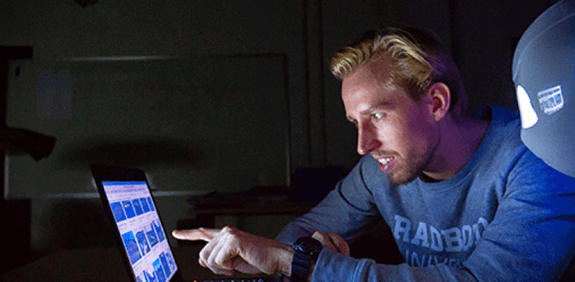
Keeping master students in the region is the goal of Tom Heskes, professor of Computer Science at Nijmegen's Radboud University. "For AI-trained students, there are plenty of interesting jobs in this region. Together with the companies, we need to make these highly visible."
Tom Heskes is professor of Computer Science at Radboud University (RU). Nationally, the RU is a heavyweight in Artificial Intelligence (AI) and Data Science. Strong in so-called human-centred AI. "You often see AI being part of computer science. In Nijmegen, the programme actually originated from cognitive sciences. From how brains work and how psychology works. This gives us a strong profile in social sciences and the technical side of computer science.
"In causality, we are developing new methods to identify cause and effect. How to extract from 'dumb data' what is the cause and what is the effect." Working with the Radboudumc, he conducted research on ADHD. "The question we wanted to get answered is whether attention problems lead to hyperactivity or whether it's the other way around, that hyperactivity leads to attention problems. The computer algorithms found a causal relationship running from lack of attention to hyperactive, impulsive behaviour."
Causality in ADHD
The AI programme is linked to the Donders Institute for Brain, Cognition and Behaviour at Radboud University in Nijmegen. Together with his research group, Heskes conducts research in two areas: causality and deep learning."In causality, we are developing new methods to identify cause and effect. How to extract from 'dumb data' what is the cause and what is the effect." Working with the Radboudumc, he conducted research on ADHD. "The question we wanted to get answered is whether attention problems lead to hyperactivity or whether it's the other way around, that hyperactivity leads to attention problems. The computer algorithms found a causal relationship running from lack of attention to hyperactive, impulsive behaviour."
"We teach deep neural networks to analyse images in a better way than humans can. For endless application, from medical science to astronomy"
Deep Learning in image recognition
Heskes applies deep learning in speech and image recognition. With deep learning, you teach artificial intelligence new things. “If you have enough data, labelled by humans, you can train deep neural networks to analyse images more effectively than humans can. We use this, for example, in image recognition, interpreting X-rays and scans in medical science.” Deep learning is also used in astronomy. Heskes: “For instance, our department is collaborating with astronomers to classify images – to determine whether or not we can see a supernova in the images.” A number of successful spin-offs have emerged from the AI programme in the Arnhem–Nijmegen–Wageningen region. New companies such as Novo-Learning, Orikami and Resnap. This is partly thanks to the support of Radboud University’s Mercator Launch programme. The programme encourages and supports entrepreneurship among students, with the aim of offering career prospects and bringing knowledge from the university to the market.Increasing visibility of AI in the region
Students on his AI course are also finding interesting jobs. Much to Heskes’s regret, these are often outside the region. “There are many interesting jobs here in the eastern Netherlands, but this isn’t yet sufficiently visible to students. As a result, students focus on the Randstad and often move there during their final six months because they believe that’s where the jobs are to be found.”Heskes points out that universities also struggle to attract good researchers. Large, interesting companies like Google and Microsoft beckon. "To continue beautiful developments in the region, we need to get going. It is up to us, the university and companies in Arnhem - Nijmegen - Wageningen to do something about it. Pooling knowledge and expertise, for the region."