This year, Holland Food Service won the Cirkel Award for its pioneering circular food supply chain. In doing so, it helps its customers throughout the supply chain to become more sustainable. The Wijchen-based company produces meals in its own production kitchen and supplies everything related to food and drink to care institutions throughout the Netherlands. In an interview, branch manager Giovanni Pili explains more about what this commitment to circularity entails.
Holland Food Service prepares and delivers around 25,000 meals a day to care homes. In doing so, it aims to support its customers in making the food supply chain more sustainable.
Three pillars
“Our commitment to circularity is based on three pillars: preventing food waste, the protein transition, and reducing and recovering plastic packaging. These points emerged from research we carried out among our customers. We were looking to identify the main challenges customers face, and the obstacles to implementing sustainability measures.” Holland Food Service took action in response to this.
Based on these three key areas, the company has developed various concepts over the past two years to help its customers.
Customisation and network
“We look specifically at each client’s individual needs. One client may already be well advanced, for example in preventing food waste, whilst another has yet to get started.
Based on this, we offer services and tools to support them. And we also use the best practices we’ve gained to help new clients get started. Good market examples bring clients together. And so, in a way, we’re also a network that connects clients and ensures they help each other move forward.”
To this end, the company has developed a website where customers can ask all sorts of questions. These questions are answered by others who have already been through a similar experience and can offer advice.
Furthermore, Holland Food Service’s account managers hold one-to-one meetings with clients. During these, they provide the in-house developed concepts that the client can utilise.
The company can also provide bespoke solutions, whereby, for example, it takes over part of the communication, such as training staff.
Pili explains: “In the care sector, there’s often a lack of time for this sort of thing, because, understandably, caring for clients is the top priority. And as a result, other matters sometimes get neglected. We feel it is our duty to provide support in this area too.”
“As a meal supplier, we recognise that we must also take responsibility within the supply chain.”
Own concept against food waste
The rate of food waste in the Netherlands is around 30 per cent. The company has developed a concept to combat food waste, achieving an average reduction in waste of around 10 per cent.
For example, the online shop features tools where customers can enter how many clients they have and the portion size per client. The system then automatically calculates the quantities required: for that number of people, you need so many kilograms of potatoes, so many kilograms of vegetables and so many portions of meat.
In addition, Holland Food Service carries out waste measurements within the care home. Leftovers are collected and measured in the dishwashing area. As you know what has been served, you can determine the waste percentage.
“You then investigate what the cause might be. For example, is red cabbage on the menu, which people might not find quite as tasty? And are the portion sizes set on the website actually correct? The cold storage is also checked to see if too much is being stored there, based on the idea that it’s better to have a little too much than a little too little.
And you want to discuss this with everyone; I understand that a customer doesn’t want to run short. But if you stick to these figures, you won’t run short and you won’t need to order that extra box, which might end up in the bin the very next day.”
Protein transition
Holland Food Service has developed its own daily menu in which, two days a week, the animal protein component is replaced by a plant-based alternative. Some customers choose to run that menu exclusively. Others prefer to use their own menu but are looking at ways to reduce the animal protein components.
“And, for example, in elderly care, a lot of ‘à la crème’ dishes are ordered, such as endive à la crème and leek à la crème. In these, we have replaced the milk with a plant-based product. This means the protein transition is already underway, without clients noticing that the product is any different. So these are also things we’re already implementing through our product development.”
Plastic packaging
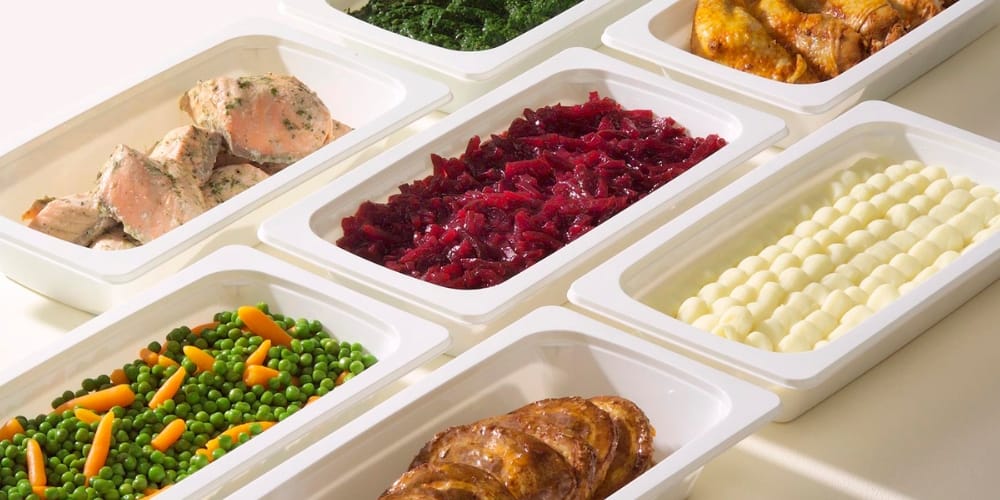
Customers receive their meals in plastic containers, in which the food can be stored and reheated. This helps to minimise the amount of washing-up. The containers are quite sturdy, and Holland Food Service collects them again. Last month, 1,500 kilos of plastic were collected. Customers are free to leave any leftover food in the containers. Both the plastic and the leftovers are recycled.
“The containers cannot be reused due to food safety legislation, which stipulates, for example, that packaging must consist of virgin material as far as possible. This is understandable, of course, as you don’t know what else they might have been used for. For all we know, someone might have stored it in a garage somewhere to keep some crude oil in.”
At present, the packaging is shredded and processed into granules, which are sent to various processors. The company wants to try to ensure the plastic is processed to an even higher standard. That will take a little more time, as the plastics market is still very much evolving.
Sustainable mission
Holland Food Service does not particularly benefit from helping customers throw away less food at the moment. "Then they also have to order less of course. But we just see it as our responsibility to contribute to sustainability. And in the long run, it might offer customers so much extra that they choose us anyway."