At HAN University of Applied Sciences (HAN), sustainability is not an afterthought, but an integral part of education, research and collaboration.
Karin van Haren is Programme Leader for Circular Economy within the Sustainable Energy and Environment (SEE) programme. In this role, she works every day towards a cleaner world.
Her mission: every graduate should know how they can make a difference in the field of sustainability, regardless of their discipline.
Connecting is the key word
Inspiring, connecting and accelerating form the core of its approach. “Inspiring is the starting point: inspiring, motivating and helping people to integrate sustainability into their work. But it goes further than that. Connection is essential – between disciplines, between education and research, and between HAN and the professional field.”
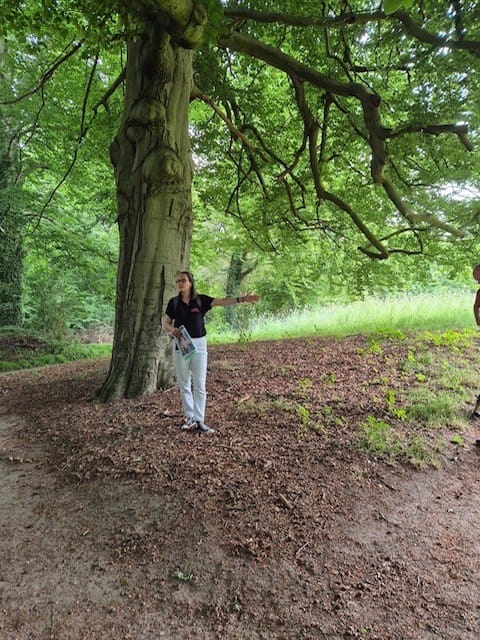
And one special way of connecting is the Deep Time Walk. Karin is trained as a facilitator for this 4.6-kilometre walk, which symbolises the Earth’s 4.6 billion-year history. “You walk slowly, experience evolution, and realise just how recent our industrial impact is. It’s an experience that literally brings people closer to nature. I think circularity – which you see everywhere in nature – becomes second nature when people feel more connected to nature.”
Sustainability in health care
A concrete example of this acceleration is freeing up time and resources for lecturers who wish to integrate sustainability into their teaching. For instance, a Nursing lecturer was given the opportunity to work on a future-proof curriculum. “You can apply circular thinking in healthcare too,” explains Karin. “Take the use of materials in acute care, for example. At present, six plastic bags are often opened, but in the end only a few items are actually used. The rest is thrown away.”
Thanks to these efforts, sustainability is becoming an integral part of the learning outcomes. Every nursing student is taught this, not as an extra, but as a natural part of the course.
“Nobody knows exactly what knowledge will be needed in the future. But by working together, you learn together. And that is exactly what we do here.”
Campus as a lab
HAN uses its own campus as a testing ground for research into sustainability. One example is the mobility transition: how do students and staff get to campus, and how can this be made more sustainable? Other examples include switching off escalators and engaging with staff about their choices in the canteen.
In this context, researchers and students are working together on solutions, such as behavioural interventions.
Creative interventions have also taken place: parking spaces were temporarily occupied by trees in mobile crates, donated by Arnhem City Council. “People weren’t happy,” laughs Karin. “But it shows just how much we take certain things for granted. It makes you think.”
This year, the campus is actually being greened with the trees, based on the students’ design. “That’s wonderful, of course – that you’re actually putting something into practice.”
Another creative example is Untamed Kombucha, which makes a bag from kombucha by-products, developed by researchers at HAN University of Applied Sciences in collaboration with the company. “It’s not leather, but it looks like it. A wonderful example of bio-based leather in practice.”
The InfraWall
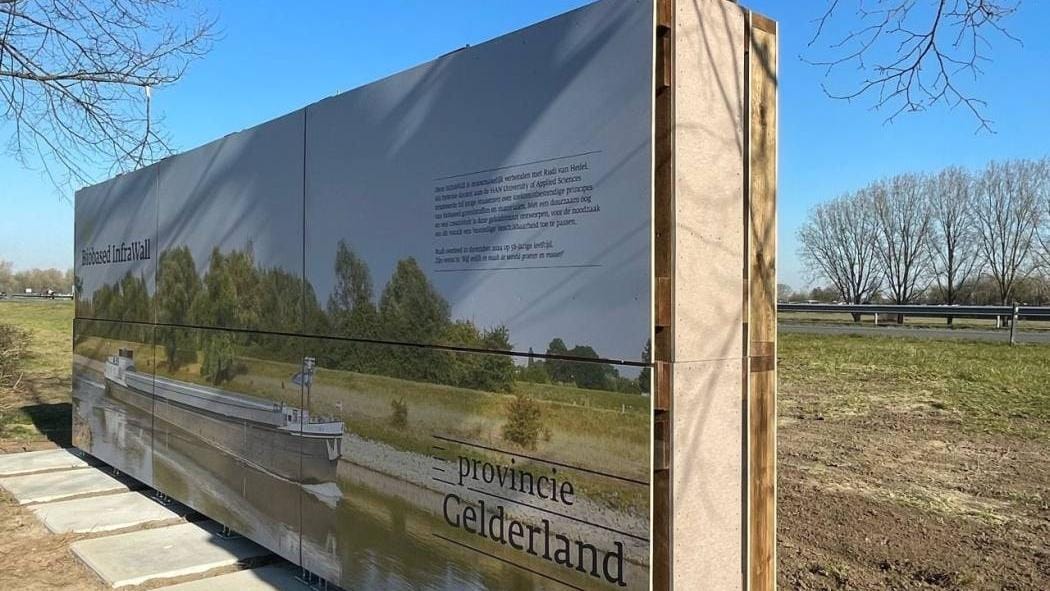
One of the most visible outcomes of circular education and research is the InfraWall along the A348. This multifunctional noise barrier, designed by HAN students, does more than just block out noise. It collects water, enhances biodiversity, generates solar energy and provides cooling. Made from bio-based materials and constructed using a modular design, it is a prime example of circular innovation.
“The great thing is that students from various degree programmes worked on it,” says Karin. “From industrial design to mechanical engineering, civil engineering and biology. And it’s actually there. You can go and have a look at it.” HAN University of Applied Sciences collaborated with Sweco and other companies, and the project was realised thanks to support from the province of Gelderland.
Circular in education
Sustainability is woven into virtually all teaching. Karin compiled a list of courses that cover circularity. In the School of Architecture, for example, there is a series of knowledge sessions on future-proof construction, covering topics such as bio-based and passive construction. “Passive construction means that a building regulates its own temperature – keeping itself warm or cool – without the need for extensive technical systems. That saves energy.”
HAN offers these courses to professionals in the field, such as local authority policymakers and architectural consultants. “We want to bring about change now, not in four years’ time when the first students have graduated.”
For students who wish to explore the subject further, there are minors such as Biobased Innovations and Circular Economy. “Almost every discipline has a specialisation that allows you to contribute to a cleaner world through your profession.”
Advocacy
HAN is also active at the level of policy and advocacy. The university of applied sciences recently became a member of the Dutch Circular Economy Association, a lobby group for companies that wish to operate in a circular manner but face obstacles due to legislation and regulations.
“We are the second higher education institution to become a member, alongside the Amsterdam University of Applied Sciences. That is quite remarkable. We want to take responsibility and contribute to the transition to a circular economy.”