Our world faces a host of challenges. Take, for example, climate change and the energy transition. These are much-discussed topics, but something that receives far less attention is the crisis surrounding biodiversity and soil degradation. This is an issue to which Bob Klein Lankhorst of HAL24K Agri is fully committed.
Soil health is at an all-time low. This has a direct impact on our food supply: crops are becoming less nutritious and food security is declining. Farmers are finding that their soils are less resilient and retain less and less water. Moreover, all of this poses a threat to biodiversity.
To tackle these issues, HAL24K Agri is developing new monitoring solutions for soil life and crops. Together, these solutions form the ‘Soil Health Suite’.
Better measure is more know
Bob studied environmental science and subsequently set up his own company: Bodemliefde. It was here that he discovered that soil life plays a major role in soil health. But Bob also realised that existing measurement methods are not comprehensive enough. For example, you can analyse the soil using chemical or physical methods: what elements are present in the soil? And what is the pH level?
Then there is also the biological method of measurement: looking at soil life. In practice, this is still only done in a very general way. For example, there are methods that measure biomass. This involves looking at how many bacteria are in the soil, for instance. This measurement is very crude: you end up with numbers, but you cannot distinguish which species are present in the soil. On the other hand, there are DNA-based methods. These provide insight into genetic codes, but quantifying the codes is difficult. So you have two measurement methods, but you cannot really use them together effectively. Bob realised there was a gap in the market here. So he started thinking: what, then, is a suitable way to analyse the soil in greater detail? 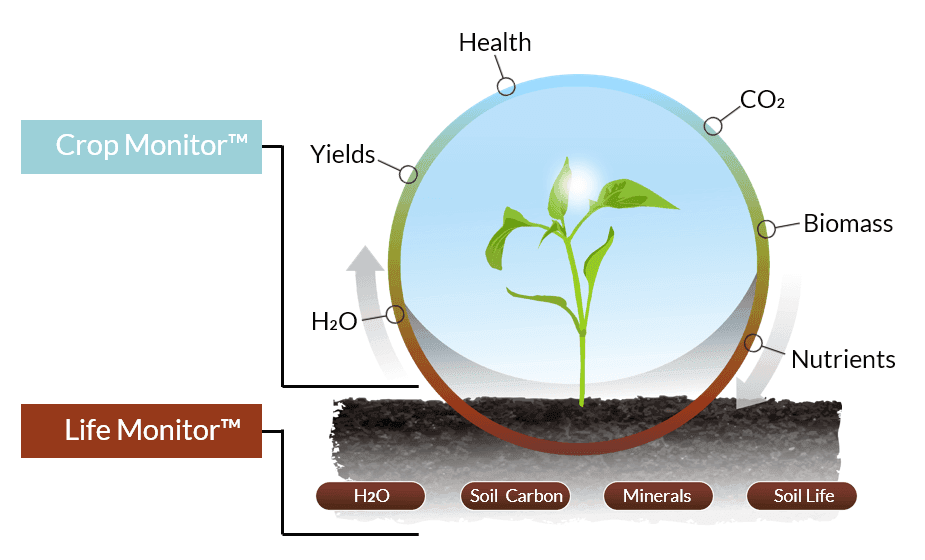
Learning from observation
“Actually, you really do need to observe,” Bob emphasises. “You can learn a great deal about soil life simply by looking at it. Soil life is tiny, so there’s a huge amount of it in just one square metre of soil. That’s why I investigated whether we could automate microscopes using AI. This would allow us to take photos or videos of the soil quickly and accurately at the correct magnification. You can then characterise those images, enabling you to analyse large amounts of soil efficiently through observation.”
“Because you want to know what’s in your soil, how much of it there is, and what impact it has. The principle here is: what you see is what you get. Soil life, after all, reveals a great deal about soil health. If you extract the right information from your soil, you can refine your soil management. In this way, we can ultimately improve soil function. This ensures your soil remains healthy, retains more water, increases biodiversity and provides your plants with the right nutrients.”
Measuring biodiversity
But how exactly do you measure biodiversity? People often do this by, for example, counting the number of trees or birds. But this doesn’t really do justice to the diversity of smaller life forms. The fascinating thing about soil life, according to Bob, is that you can find an incredible amount in just one square metre of soil. That is why HAL24K Agri is developing specific models for very tiny creatures: nematodes, also known as roundworms.
Bob: “It’s actually the most common animal species on Earth. Did you know that around 4 in 5 animals are nematodes? And that’s why nematodes are ideal for monitoring: they’re very site-specific in the soil and have life cycles lasting a few weeks, months or years. What’s more, they’re found in all soils on Earth, even in heavily polluted or nutrient-poor soils. If you can measure their populations even in polluted soils, then the nematode populations there also tell us something about the condition of the soil. This is because healthy soils contain more nematodes and other organisms than unhealthy soils. So, based on the type and number of nematodes, you can say a great deal about soil quality. Moreover, nematodes have been studied extensively and for a long time in scientific research. These tiny creatures are an excellent ecological indicator of soil conditions.”
Accessible measurements
The measurements are easy to carry out. Bob explains: “You take a soil sample and send it to our lab. Compared to other methods, it’s incredibly quick. Our hardware is portable and the protocols are simple. Depending on the conditions you set for the measurement, you can, for example, carry it out in a company van. The results are then available on our platform. It’s particularly interesting if you take measurements over time. I therefore always recommend starting with a baseline measurement and then building up a series of readings. This makes it easy, for example, to see the differences in soil health across different fields. But later, after several measurements, you can also start making predictions. The software is getting better and more accurate all the time.”
Together towards healthy soils
Bob has now noticed that there is a great deal of interest in this innovative method of measurement. Their new system is attracting attention not only from the agricultural sector, but also, for example, from the scientific community and major agri-food companies. In addition, organisations such as local councils and government bodies, which wish to classify soil quality, are enthusiastic. “Any organisation with a connection to the land in one way or another can use our technology. It is accessible and more effective than alternatives.”
On his journey towards healthier soils, Bob has also benefited greatly from Briskr and the Business Angel Network Nijmegen (BANN). “Briskr helps us with advice, networking support and connections with relevant partners. This has enabled us to grow more quickly,” says Bob. “The BANN also offers access to funding and strategic advice from experienced investors, who share not only capital but also expertise and guidance. Thorough preparation for the BANN was therefore essential: with a clear pitch, a well-structured business plan and financial projections, we were able to effectively convey our vision and ambitions. The positive feedback and interactions with investors are helping us take concrete steps towards our strategic growth and further development.”
Global standard
HAL24K Agri’s long-term goal is clear: “We will become the global standard for measuring functional biodiversity and ecosystem services, so that we can make better decisions for our soil and human wellbeing on planet Earth. Because by understanding what happens at a microscopic level, we can better align our actions with the natural world around us. If we are aware of all the flora and fauna and the negative impacts we regularly have on them, we can learn from this. Because the restoration of biodiversity offers hope: you can see how life forms respond to restoration, or when they are given the space to flourish once more. If we work together, we can repair the damage we’ve caused and make it more beautiful than it has ever been!”
This article is brought to you by Briskr.