You wake up, make coffee, grab your phone, open the fridge, start the washing machine, check your public transport card or get into your car. Without realising it, you will have used dozens of chips by then. Not the edible kind, but tiny bits of technology that make everything work. And a surprisingly large proportion of these come from Nijmegen.
They are found in mobile phones, tablets, laptops, debit cards, ID cards, washing machines, dishwashers, fridges, solar panels, smart meters, watches, hearing aids, pacemakers, MRI scanners, X-ray equipment, blenders, thermostats and, of course, in cars. “Every car in the world has at least one chip from our factory,” says Marcel Rijnsburger, Senior Director of the Corporate AI Literacy Programme at NXP. “It’s almost impossible to think of a device that doesn’t contain a chip. Without chips, it would be dark, cold and silent.”

Marcel Rijnsburger
Biscuit factory
In Nijmegen, close to the Noviotech Campus, stands a striking light-blue ‘box’ with yellow funnels. The architect deliberately designed the factory to resemble a scale model of a semiconductor – commonly known as a chip. Because here, at NXP, the chips that power our modern world are manufactured.
The factory in Nijmegen works like a big biscuit bakery, with different recipes for different types of semiconductors. Marcel: "But then this is an exceptionally clean bakery. The products made here contain structures more than 100 times thinner than a human hair. Even a tiny dust particle can cause a chip to malfunction. This is why everyone in the factory wears special clothing to prevent dust from getting onto the products.
We have recipes for biscuits, for flans, for cakes. And within the biscuit category, we can make chocolate biscuits or shortbread again."
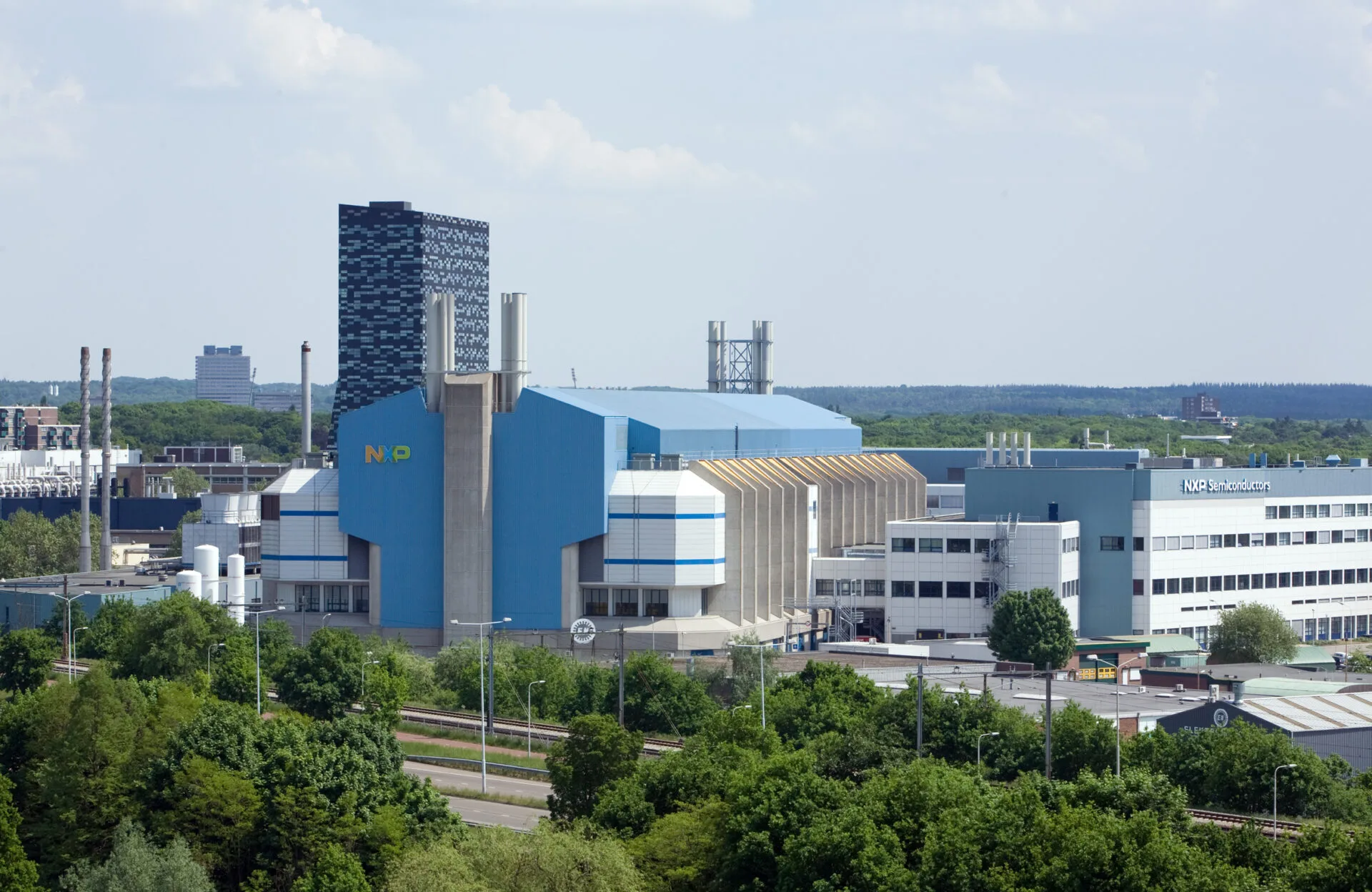
NXP Semiconductors Nijmegen
Lego bricks
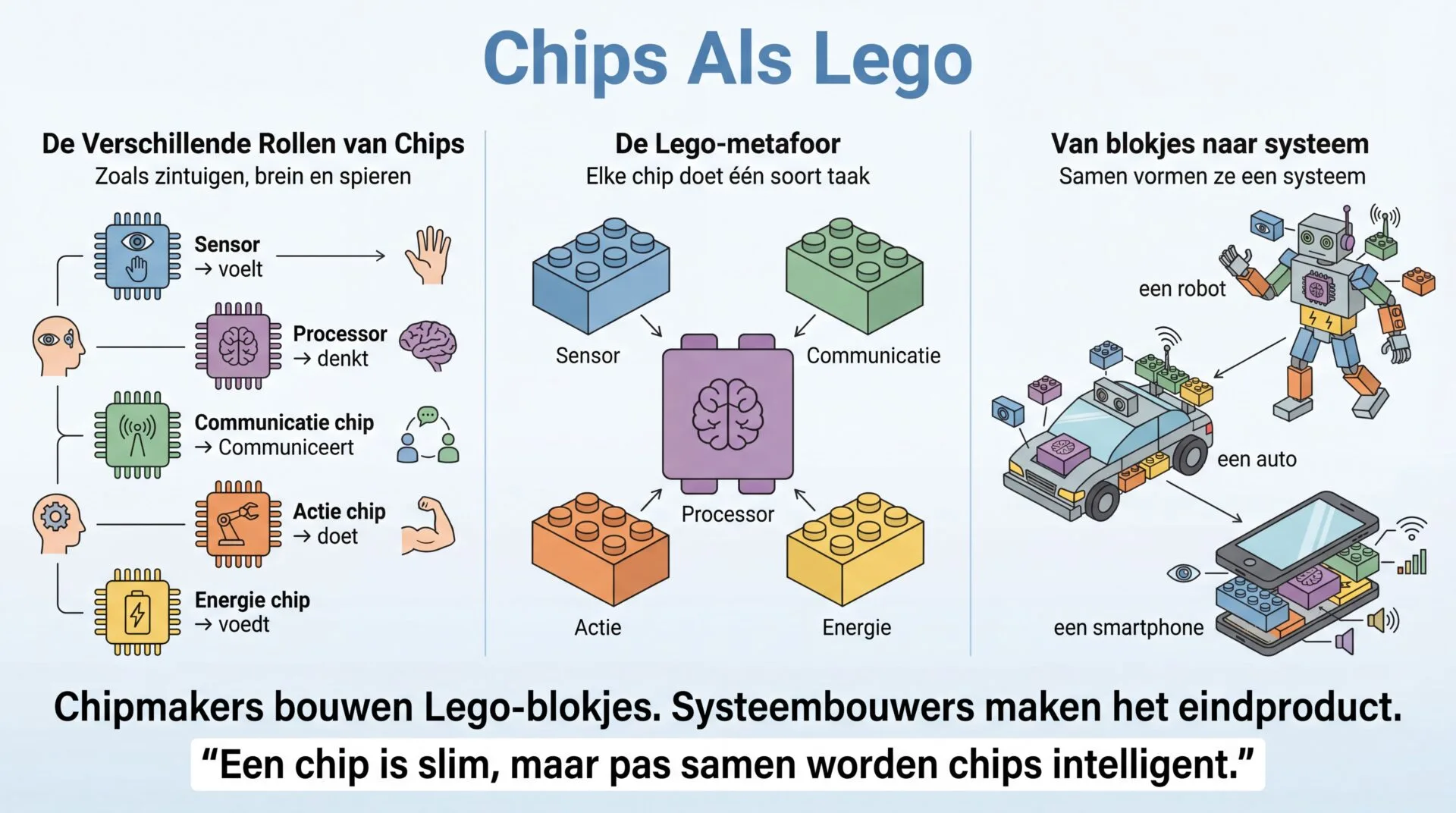
But what exactly is a chip? A chip, also known asa semiconductor, is a tiny fragment cut from a large round slice of silicon, known as a wafer. On this fragment, minuscule structures are built layer by layer, which together form a mini-factory. A chip can measure, calculate, communicate, regulate energy or control components.
"You can think of them as Lego bricks," Marcel explains. "Each building block has its own function. By combining those blocks, you can build a car, a robot, a phone; whatever you want."
Car of the future
Designing a semiconductor can easily take several years. Testing it takes another six months. And then the car manufacturer still has to fit it into the vehicle. That, too, can take one to two years. In short: NXP is currently working on the car of 2035. “We are indeed working on the cars of 10 to 15 years’ time,” says Marcel. “Most of our semiconductors are standard products, though some are bespoke. You can order them straight from our catalogue, like off-the-peg items. But we also producehaute couture. And always with extreme precision.”
Vulnerability of the chain
The corona crisis highlighted how vulnerable the chain is. The long lead times caused an acute chip shortage. Marcel: "Initially, we saw the market slump. Customers let us know they didn't need chips for the time being. But only a few months later, working from home created extra demand for laptops, devices and phones. And because people no longer wanted to use public transport, sales of cars increased."
The complexity of production means it cannot be scaled up overnight: "Lead times can sometimes be as long as 35 weeks. Factories only run profitably when they are producing at full capacity," says Marcel.
"During the crisis, we were faced with difficult dilemmas. There was a shortage of microprocessors for medical applications. Sometimes human lives depend on that. Then you get ethical discussions: which sector gets priority?"
Key role for Lifeport
Geopolitical tensions also show how dependent Europe is on chips from Asia. In that context, Lifeport Regio Arnhem Nijmegen plays a key role: Nijmegen and its surroundings form one of the most important European clusters, where knowledge, innovation and production come together.
Its foundations were laid by Philips just after World War II. "What started small grew into a complete ecosystem," says Marcel. "You don't make a chip on your own: you need software, high-tech equipment, specialised suppliers and well-trained people."
Many of them come from the region. Thanks to Radboud University and local expertise, Nijmegen has grown into a knowledge centre that strengthens the region economically and shapes its own technological future.

Clean working
Life-saving technology
NXP employs 2,500 people. Add Nexperia, Ampleon and suppliers and the impact becomes clear. "Directly or indirectly, almost everyone in this region deals with the semiconductor sector," says Marcel.
Sometimes it is about much more than commerce or technology: "We know examples of children of employees who were involved in a car accident. Thanks to chip technology, their airbags went off and they got away without significant injuries. Semiconductors are also vital in MRI scanners, pacemakers and X-ray equipment."
Future-related themes
"I find it fascinating that we are working on future-related topics," states Marcel. "Semiconductors can help solve grid congestion. Making devices more energy-efficient or allowing them to use energy only when there is enough supply. And when soon there won't be enough care workers, smart devices and medical technology can make a difference. Then chips will be needed for care robots and home monitoring, for example, to treat patients more efficiently."
Marcel, in conclusion: