How can you change the environment in such a way that you encourage – or sometimes even compel – people to be more active? And how does that contribute to their health? The Regio Deal project Build4Health was recently launched with these research questions in mind. It is a multidisciplinary project operating within the environment–behaviour–health triangle.
Maria Hopman is a professor at Radboudumc and represents the ‘health’ pillar in this project. She talks about the studies currently being set up.
A broad scope
Hopman trained as a doctor specialising in physiology, and she takes a very broad view of the subject. “I find so many things interesting, which is why this project suits me well; it’s broad in scope, encompassing multiple scientific disciplines and perspectives.
From a health perspective, for example, we use wearables – in this case, a sort of sticker on your thigh – which measures all sorts of data over the course of a week: how much someone has moved, what their blood pressure was during that time, and so on. After that week, the participants hand in the sticker and we then read the data here at the UMC.”
This type of data is combined with urban planning and sociological knowledge, such as the walkability index – how ‘walkable’ an area is, how appealing it is to walk there, whether there is greenery, suitable paving, whether it is safe, and so on.”
Evolutionary
Hopman explains why we tend to default to a state of rest. “Most people are aware that exercise is good for your health. But, evolutionarily speaking, we aren’t actually programmed to take action. We’d rather be lazy than tired. And that was actually very useful from an evolutionary perspective, because it meant you could rest – which was necessary as you’d have to go out and hunt for food again. Of course, none of that is necessary anymore.
But that preference for being lazy rather than tired has remained. And we’re seeing major health problems as a result, such as chronic diseases.
And you can’t get everyone to go to a gym, nor can you get everyone out running in the woods.
So there’s a growing belief that we should look for solutions within the local community for a very large group of people.”
What I like about this project is the ingraining of movement into everyday life, such as walking a bit from your car to the front door, climbing stairs, getting up from your chair more often.
A different kind of environment
“Over the past 50 years – perhaps even longer – we have designed our environment in such a way that you don’t actually have to move. There are car parks right outside the door, you bump into the lift, the remote control – you name it. Yet we’re now increasingly realising that we need to keep doing as many things as possible. And we can keep doing them for a very long time, because that’s how our bodies are designed, but if we stop doing them, there comes a point when we simply can’t do them anymore.”
There’s a lot that can be done to the environment to encourage people to be active.
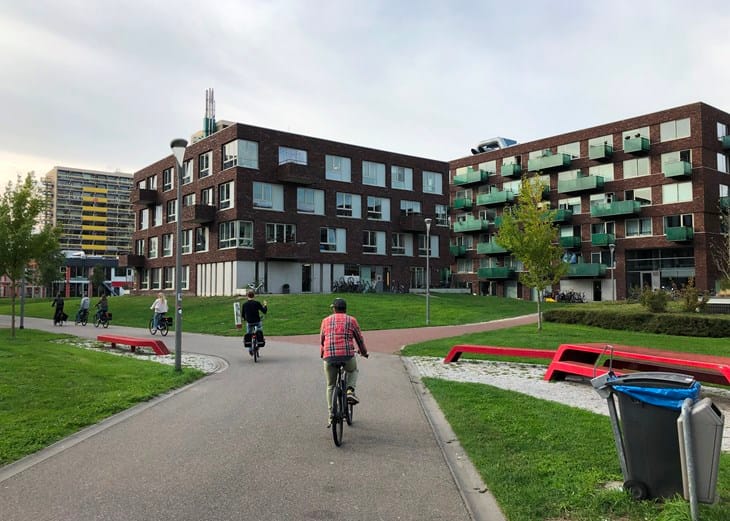
For example, you can encourage people by incorporating more green spaces, which invite them to get moving. Facilities within walking distance mean people are more inclined to pop out on foot to do a bit of shopping, walk to the library or head to the café on foot. Safety is also an important factor that makes people more likely to walk or cycle somewhere.
Five projects
Five projects have been launched within Build4Health, in areas where changes are set to take place in the coming years. These environments, where construction plans are already in place, are of particular interest for this research, not least because of the project’s duration, which runs until the end of 2027.
The projects are very different in nature, but they are all related to construction and urban planning.
Hopman: “In these projects, on the one hand, we are contributing ideas on what is currently possible; we call this the ‘Living Lab’. In two of the projects, this allows us to contribute to the process and apply the knowledge we have already gained from research and the literature. On the other hand, we are also conducting research with Radboudumc (medicine), Radboud University (sociology and urban planning) and the research agency Uum, which focuses on the process.
There are also many other partners involved in the project, such as housing associations, construction companies, care complexes, local authorities and the province of Gelderland.
The projects are:
Nijmegen Canal Zone
Here, research is being carried out into how best to contribute to a healthy living environment when restructuring a residential neighbourhood. Researchers will also examine the effect of a small-scale intervention in sports and play facilities in a neighbourhood park.
Arnhem East
Here too, as part of the integrated redevelopment of neighbourhoods, research is being carried out into how best to take residents’ health into account through interventions in the living environment.
Liemerije in Zevenaar
In a residential and care complex due to be refurbished, researchers will examine how building interventions in the outdoor space contribute to improved well-being among residents, and whether this leads to increased physical activity and improved health among staff.
New-build projects in Arnhem and Nijmegen
How can the construction of a new residential estate contribute to a healthy living environment, both for new residents and for residents of surrounding existing neighbourhoods? There is a great deal of interest; to what extent do people use the green spaces, and how much does this ultimately contribute to their level of physical activity?
Veluwe-Waalpad
The Veluwe-Waalpad cycle route is also the subject of research. Who uses it? And what are the effects of a new cycle route on physical activity and health?