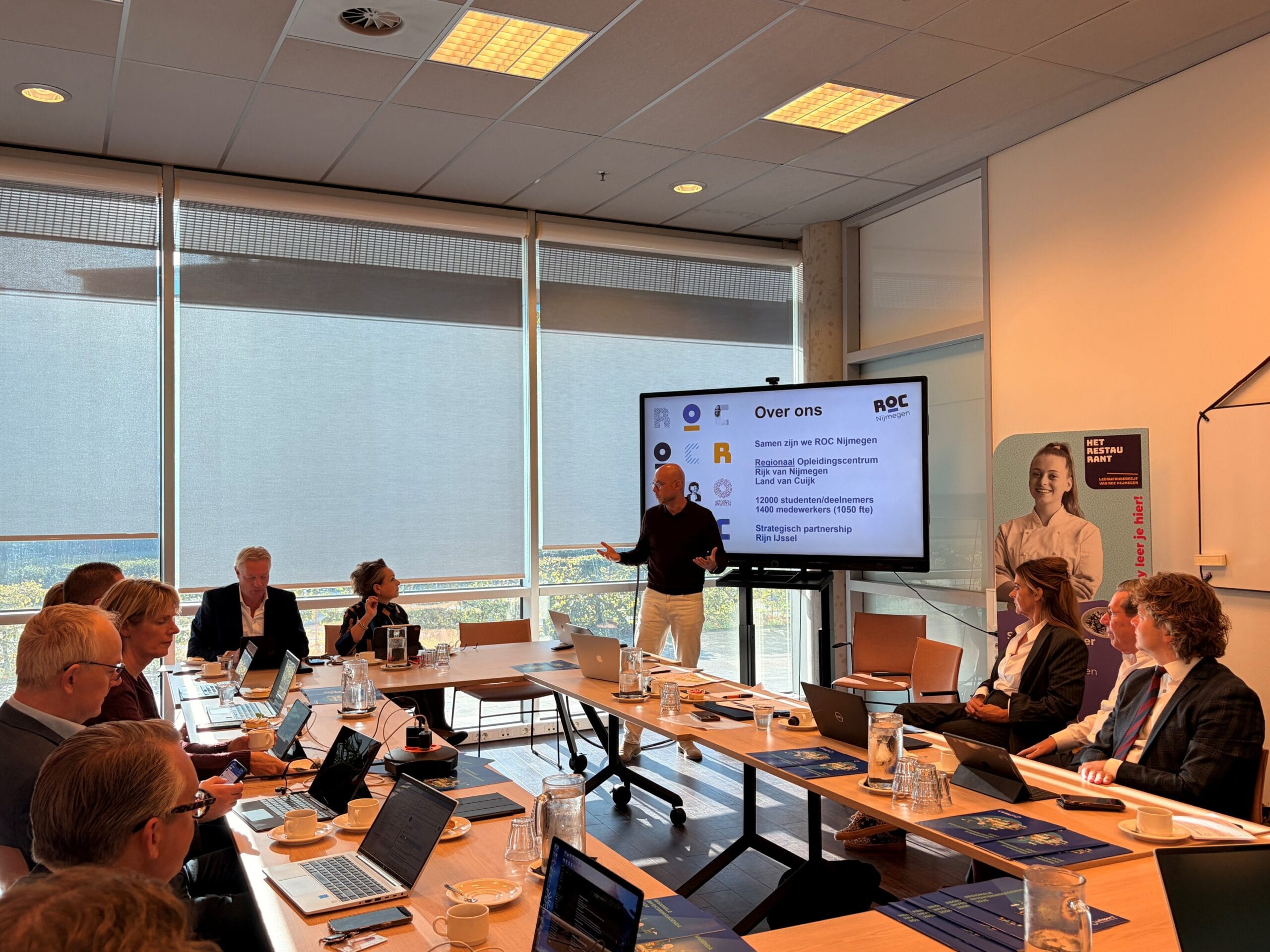
How can we make better use of the talent in our region? How can we accelerate the circular economy? And how can we strengthen the links between our campuses and innovation ecosystems? These questions were the focus of the Board meeting from The Economic Board member at ROC Nijmegen on 18 September. With an eye to 2027 and beyond, the Board members discussed key regional developments in the field of Human Capital, circularity and innovation.
A warm welcome at ROC Nijmegen
ROC Nijmegen provided the venue for the Board meeting. Students from the Bakery course ensured a warm and tasty welcome. Peter van Mulkom, Chair of the Executive Board of ROC Nijmegen, gave the Board members an insight into the educational institution.
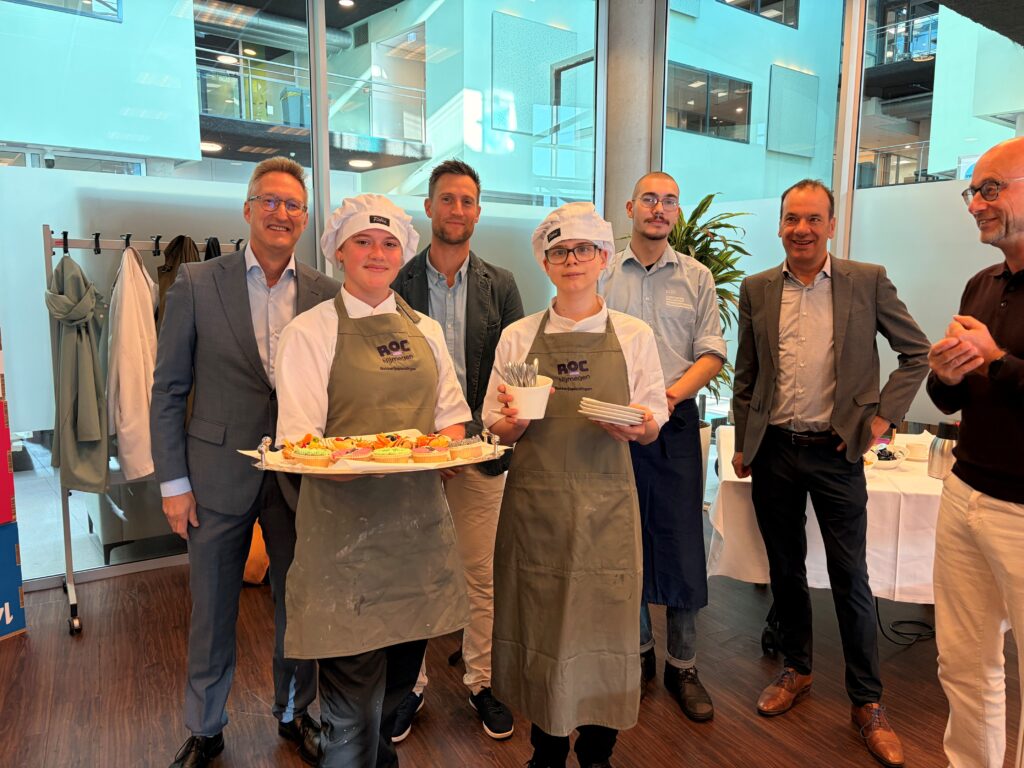
Students from the ROC will be providing the refreshments
With around 12,000 students and 150 courses, ROC Nijmegen plays a key role in training young people and adults to become qualified and sustainably employable professionals. This is a challenge that is becoming increasingly urgent due to staff shortages and issues surrounding equal opportunities. As such, ROC Nijmegen was a fitting venue for a meeting centred on talent development and the region’s economic future.
In addition to The Economic Board’s annual plan and budget for 2027, three key regional developments were on the agenda.
Human Capital Agenda 2027–2030: making better use of talent and working smarter
The current Human Capital Agenda expires at the end of 2026. Adam Galijašević, programme manager for the Human Capital Agreement, presented the proposed strategy for 2027–2030. This has been developed on the basis of an evaluation of the current agenda and discussions with regional partners.
The new agenda focuses on three programme areas:
- Making better use of talent and increasing mobility: supporting people to make the most of their talents and improving labour market mobility.
- Attracting and retaining talent: keeping the region attractive to current and future employees.
- Working smarter and differently: increasing labour productivity and addressing staff shortages through new ways of working.
Human Capital This is a unifying task within the region’s economic focus on Energy, Health and High Tech. By linking talent development, the labour market and economic ambitions more closely, the region strengthens its competitiveness and future-proofing.
Lifeport Resource Programme: circular opportunities for entrepreneurs
Raw materials are becoming scarcer and international supply chains more vulnerable. This calls for a smarter use of materials, new production methods and closer collaboration.
The Lifeport Resource Programme (LRP) aims to better connect existing knowledge, initiatives and networks in the field of circularity. Suzanne Westrik from Lifeport MKB explained the programme, following an introduction to ‘Smart Sustainability’ by Jan van Iersel.
The programme focuses on circular education and research, supporting public authorities with circular policy, and promoting circular innovation within businesses.
A great deal is already happening in the region in the field of circularity, but initiatives do not always manage to connect with one another. This is precisely where the opportunities lie. By enabling entrepreneurs, the education sector, research organisations and public authorities to work more closely together, existing knowledge can be utilised more effectively and circular solutions can be developed and implemented more quickly.
For example, the Lifeport Resource Programme contributes to the ambition to develop Lifeport into a model region for the circular transition.
Lifeport Campus: strengthening regional innovation capacity
The Lifeport region boasts strong campuses, research institutions, innovative companies and specialised ecosystems. Through Lifeport Campus, the region aims to better connect these existing strengths within Energy, Health and High Tech and position them collectively.
The ambition is to further strengthen knowledge development, innovation, talent and economic activity, and to make the region more attractive to public and private investment.
During the Board meeting, it was emphasised that the strength lies in building on what already exists. Existing campuses and organisations retain their own identity and responsibility, whilst working together to raise the region’s profile.
Cooperation between campuses and links with businesses, knowledge institutions and spatial and economic developments were also discussed. Examples of collaboration elsewhere provide inspiration in this regard.
Through Lifeport Campus, the region is working towards 2035 to build a more closely connected innovation ecosystem, in which locations and organisations complement one another and jointly enhance the region’s innovative capacity.
Working together on the region’s future
These three developments demonstrate how closely talent, circularity and innovation are interlinked. Whether it is a question of making better use of talent, accelerating circular solutions or strengthening collaboration between campuses: progress requires a joint effort by entrepreneurs, the education sector, research organisations and public authorities.