Bringing your newborn baby home is a moment of joy and relief for most parents. But for parents of babies with neonatal jaundice, it can quickly become a stressful time. Medtech start-up bilihome is changing that with its portable light therapy, which allows babies to be treated safely at home and close to their parents.
“This isn’t just about innovation, but about human connection,” says CEO and co-founder Margret Huenerbein. “Holding your child shouldn’t be a privilege. It should be part of the treatment.”
Huenerbein’s background lies in biomedical technology and international business management. After years of experience at companies such as Dräger and Philips, she began to reflect on the real impact of her work. “In large companies, you no longer work for the patient or the doctor, but for the sales department,” she says. “I wanted to reconnect with the people we’re trying to help.”
Through the European healthtech incubator NLC, Huenerbein came across bilihome, at that time still just an early idea from Rick Wielens. The idea arose from Wielens’ personal experience following the birth of his twin sons. One of them required treatment for jaundice in an incubator under blue light. Wielens was shocked by how isolated and invasive the treatment was – his son lay alone, without any human contact. It made him wonder if there wasn’t another way.
As an expert in neonatal care and with experience of premature birth in her own family, Huenerbein began as a consultant. The more she learnt from maternity care organisations and her international network (such as EFCNI, Uppsala University and FIGO), the more strongly she came to believe in the idea. In 2020, she became CEO and developed the bilihome concept. In 2021, she joined forces with a leading Dutch fashion-tech designer and a medtech partner to kick-start development. Four years later, Wielens returned to focus on business operations, his area of expertise.
Portable light therapy for babies
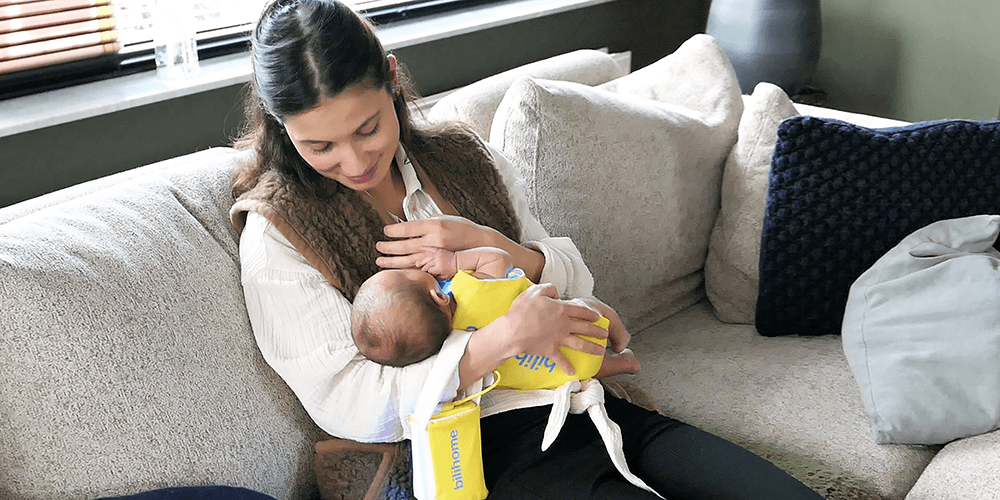
Bilihome is a portable phototherapy device: a soft, baby-sized bodysuit fitted with medical-grade blue light to treat jaundice. With this innovative garment, babies can undergo therapy without having to be separated from their carers.
“Phototherapy breaks down bilirubin, a substance that builds up in babies after birth. The standard method is still to place babies in incubators under blue light, undressed and wearing an eye mask,” explains Huenerbein. “We want to combine medical effectiveness with emotional care.”
Bilihome has also developed a companion mobile app for parents. The app assists with self-monitoring and remote support, helps keep track of feeds and nappy changes, and provides relevant information on managing jaundice. It supports parents whilst ensuring that hospital staff can focus on more urgent care; a significant advantage given the current shortage of nurses.
Importantly, Bilihome is also transforming the clinical care pathway. As symptoms of jaundice often only appear a few days after birth, many babies are already at home by the time treatment is required. The portable device enables home care, thereby preventing hospital admissions or readmissions. This ensures that the bond between parent and child is not disrupted, and improves outcomes across the board.
Clinically ready and on its way to the market
Since 2020, bilihome has developed its product from concept to a clinically ready device. Having completed intensive development and testing phases, the start-up is now on the verge of CE certification, which is expected within a few months.
As soon as certification is finalised, bilihome will begin its commercial roll-out in the Netherlands, Germany and Sweden. “This is an exciting and crucial moment,” says Huenerbein. “We are now preparing for production, operations, sales and implementation. Medical hardware is different from software; in addition to complex regulations, it requires physical production and multiple suppliers. That is why smart investment support is essential at this stage.”
Support from Briskr and beyond
As a spin-off from Radboudumc, bilihome receives support from Briskr. Huenerbein emphasises the value of Briskr’s in-person workshops, for example on business valuation and sales.
“Briskr creates the right environment for start-ups at every stage,” she says. “Their sessions aren’t just theoretical. They’re practical, affordable and a great way to meet other founders. That support is hugely valuable for a hardware start-up, where every euro counts.”
Scaling up with global impact in sight
In the coming years, bilihome aims to expand across Europe, with the United Kingdom in its sights. There is also strong interest from hospital networks in the United States, and in the longer term, the team also wants to expand into regions in Asia and Africa – where jaundice is more common, but access to care is limited.
“Globally, more than 14 million babies require treatment for jaundice every year,” says Margret. “But only a fraction of them live in Europe or North America. The real impact lies beyond these regions. That’s where we want to go.”
But first, the focus is on a successful launch in the home market, breaking even within three years, and building strong partnerships with healthcare providers. “We’re not just selling a device,” Margret emphasises. “We’re changing the way care is delivered. And that requires collaboration.”
A brighter start for babies and their families
Bilihome stands for more than just medtech innovation. It is about reinventing care for newborns from the perspective of the child and the parent. By ensuring that treatment and bonding go hand in hand, Bilihome takes both health and humanity into account. “It’s not just about the light – it’s about loving closeness. That’s what really makes the difference.”
This article was previously published in English on the Briskr website