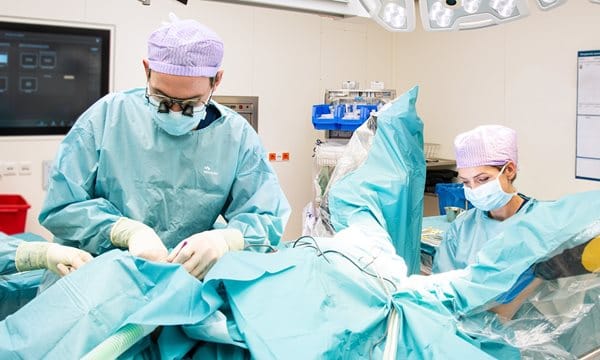
If a baby is in distress after birth – for example, in the case of a premature birth or a severe lack of oxygen – the medical team must act quickly to save the baby’s life. A new tablet with smart software can help with this. It was developed by ARNE, a spin-off from Radboudumc.
The first minutes are essential for a baby with a bad start. "Of course there are guidelines that tell you what to do," says Tim Antonius, neonatologist at Radboudumc Amalia Children's Hospital. The Newborn Life Support (NLS) guideline provides an overview of how to act when a baby is born in bad shape. "But in an acute situation, there is no time to calmly review such a guideline," says Antonius, who is also an NLS trainer.
"When a baby has no heartbeat, an awful lot happens at once. You have to resuscitate, administer drugs and insert a drip. You also have to coordinate the team and anticipate the next steps. There is cognitive overload, so to speak, no matter how experienced you are as a team in caring for critically ill babies." In more than half of such situations, a step is sometimes skipped. Sometimes time is lost from sight, or the guideline is deviated from in some other way, several studies have shown.
ARNE has long been used in a simulation setting at Radboudumc. The study done shows that the team deviates from the guidelines less often and, more importantly, fewer essential steps are missed. ARNE has now also been approved for use in patients.
→ You may also be interested in:
Surgeons at Radboudumc perform more precise operations with the Anatomy Projector
The first minutes are essential for a baby with a bad start. "Of course there are guidelines that tell you what to do," says Tim Antonius, neonatologist at Radboudumc Amalia Children's Hospital. The Newborn Life Support (NLS) guideline provides an overview of how to act when a baby is born in bad shape. "But in an acute situation, there is no time to calmly review such a guideline," says Antonius, who is also an NLS trainer.

An impression of ARNE, via Innovation Origins.
"When a baby has no heartbeat, an awful lot happens at once. You have to resuscitate, administer drugs and insert a drip. You also have to coordinate the team and anticipate the next steps. There is cognitive overload, so to speak, no matter how experienced you are as a team in caring for critically ill babies." In more than half of such situations, a step is sometimes skipped. Sometimes time is lost from sight, or the guideline is deviated from in some other way, several studies have shown.
ARNE provides guidance
To optimise care for this target group of babies, Antonius developed a tablet with smart software that guides the team through the guidelines: ARNE. An algorithm uses the newborn’s vital signs to determine the next step the team should take. These vital signs include, for example, heart rate and blood oxygen levels. “ARNE makes the care process clearer. The software does not take over decision-making, but it does provide guidance and shows what the next step is.”ARNE has long been used in a simulation setting at Radboudumc. The study done shows that the team deviates from the guidelines less often and, more importantly, fewer essential steps are missed. ARNE has now also been approved for use in patients.
To the market
ARNE recently received funding from Oost NL and venture builder NLC to further develop the ‘Electronic Decision Support System’ and bring it to market. Oost NL is providing the investment through ION+, an innovation fund for SMEs in Gelderland. NLC has been involved with ARNE since 2019 as a co-founder of the company. NLC had previously provided the initial funding during the start-up phase via its Momentum fund.→ You may also be interested in:
Surgeons at Radboudumc perform more precise operations with the Anatomy Projector