Nijmegen students Job Sluiter and Daan Verlinden have a goal that extends beyond their next exams. They want to show other students that the region has many great places to work. This has already led to several successful projects, including one with The Economic Board.
“We want to build a bridge between students and businesses in the region,” explains Job Sluiter (26). “We do this by having students carry out IT or AI assignments at companies. This allows them to gain practical experience. At the same time, it enables companies to connect with talented students at an early stage.” Daan Verlinden (22) adds: “In doing so, we’re boosting companies’ IT capacity. Students are brimming with new IT and AI knowledge, fresh ideas and plenty of motivation. They want to contribute to the digital transformation we’re currently in the midst of.”
Job is studying Entrepreneurship and Retail Management at HAN University of Applied Sciences, and Daan is studying Artificial Intelligence at Radboud University. A year and a half ago, they set up the company IT Student Lab, which is also their final-year project. Through this, they help other students find great part-time jobs alongside their studies. Usually, IT Student Lab places these students in small teams with a client. Daan: “We prefer to put together teams combining students from universities, universities of applied sciences and vocational colleges. They’re all studying a technical IT or AI course, but naturally every student has different skills. We try to put the teams together in such a way that each project is assigned a team with the skills required.”
Strengthening the region
Job explains how the projects work. “We always start with a proof of value, where we assess a project’s feasibility and identify the opportunities. At that stage, companies can decide whether to proceed straight away or perhaps at a later date. This is followed by an action plan. Based on that, the students can start programming. We can help large companies with an IT department, but also smaller businesses without an IT team that want to discover where their opportunities lie.” Daan: “It’s with those kinds of SMEs that we can make the biggest difference.”
As well as helping companies with their digital transformation, IT Student Lab has another major goal. Job: “We want to strengthen the region by ensuring that students find work here after they graduate. We’ve noticed that, during the final stages of their studies, they’re often already being approached by all sorts of recruiters from the Randstad. That’s why they often start their careers there.” Daan: “It strikes me that they often know very little about the great companies based here. They aren’t even aware of some of the really big companies, or they don’t know that they have an IT or R&D department there too. That’s a real shame.”
Dashboard
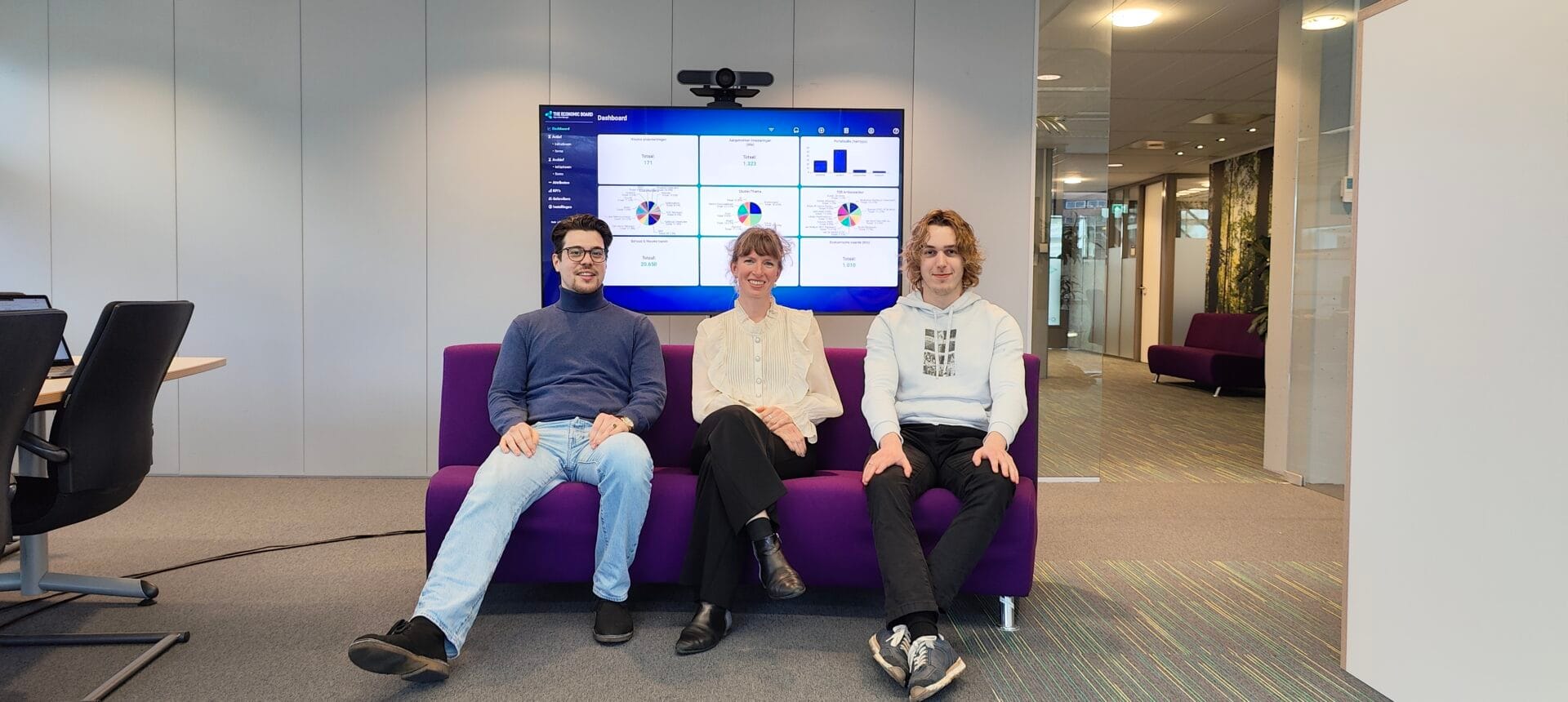
IT Student Lab is supported by two established software companies. It has an Advisory Board comprising experts from Radboud University and specialists in HR and triple helix collaborations. There is also a foundation with three board members. IT Student Lab received a start-up grant under the Human Capital Agreement. This was followed by its first assignment with The Economic Board. “We wanted to gain a better understanding of the projects we undertake and the impact we make,” says programme manager Nicky Hogenkamp. “As we are primarily connectors and catalysts, we sometimes lose sight of the implementation side of things. We wanted a clear dashboard where everyone could enter data in a user-friendly way, from a single central location. Before we started this, we were working with a huge Excel file.”
Three students from the IT Student Lab set to work on the project. The dashboard is now complete and provides insights into, for example, the total number of projects and the number of people who have been helped into work. This is useful information for The Economic Board, particularly when drafting an annual report or a presentation. For Nicky, there was also another important reason for the project. “This led to us, as a team, having many discussions about exactly what we want to track, but also about how we select projects. It has ensured that our own processes have been streamlined and that we can more easily decide what we do and don’t take on.”
She therefore looks back on the process with great satisfaction. “It was really nice that the programmers didn’t start building straight away, but that we first had a discussion about exactly what we needed. Only then did the students get to work on the software development. In hindsight, we might have been able to involve them even more within our organisation. I would certainly advise other companies to do the same.”
Staying connected
Following the project with The Economic Board, IT Student Lab undertook assignments for companies such as soil research firm Royal Eijkelkamp and charging point specialist ElaadNL. There is also a collaboration with Soil Valley. Job: “Royal Eijkelkamp has a vast amount of soil data around which they are building a major AI project. Two of our students are involved in this, and it is now being taken forward.” That is the ideal scenario for IT Student Lab, says Daan. “We’d love to see students stay on with the client after a project. That’s why we have quite a rigorous selection process; we’re looking for students with talent, but also with the right motivation.”
The two men are ambitious. Daan: “Our ambition is to help many more companies in the region with digital transformation and discovering the opportunities offered by AI. We’re raring to put our students to work.”