From more accurate forecasting of production times to the analysis of medical images: artificial intelligence (AI) is increasingly being put to very practical use in the Arnhem-Nijmegen region, through collaboration between businesses, students and research institutions.
“Students are solving problems that businesses have been grappling with for some time.”
At EKI in Nijmegen, the rubber and foam manufacturer which recently received the ‘Purveyor to the Royal Household’ designation, they built an online shop where customers can order fully bespoke rubber and foam products in exact quantities. A configurator was developed for this purpose. However, due to the endless possibilities, it became almost impossible to predict in advance how long it would take to produce an order.
Yet that is precisely what customers want to know: how long will it take before I receive my goods?
Simon is a master’s student at Radboud University. Through MKB Datalab-Oost, he was matched with EKI. He applied an AI model to the problem and ensured that it became possible to calculate the production time.
Director Bart van der Tol explains enthusiastically: “He used just three elements for this. Simon taught us that the trick is to keep it as simple as possible. We now use Simon’s model every day to calculate delivery times.”
Making a difference
It demonstrates that AI is not just for large tech companies. “Many businesses often have a lot of data available, but they frequently don’t really know what they can and want to do with AI,” explains Tom Heskes. “This is where students from the SME Data Lab can contribute.” Tom is a professor of Data Science and is involved with SME Data Lab East.
According to Bart, a company can set itself apart from its competitors by utilising AI. “In the past, it was enough if you were very good at making, let’s say, coasters. But now it’s also about helping cafés with automatic restocking or responding to current events. That’s where AI can help!”
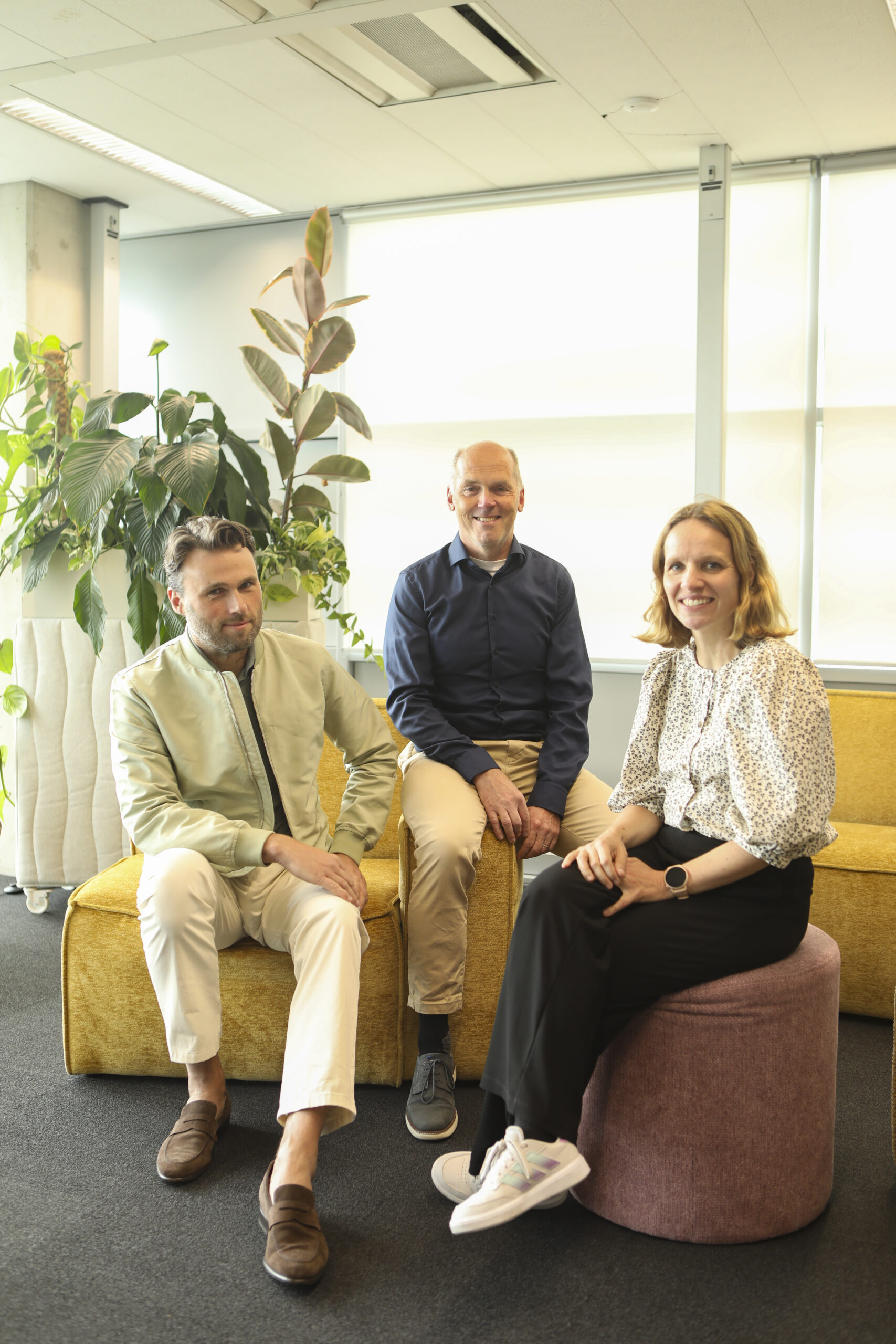
(L-R) Bart van der Tol, Tom Heskes and Eva van Rikxoort
Photo credit: Youri Brouwer
Health
Another notable example from the region is Thirona, the international AI company founded by Eva van Rikxoort. Thirona’s technology supports doctors worldwide in diagnosing lung and brain conditions more quickly and accurately. With advanced AI solutions for medical image analysis, the company helps healthcare professionals make diagnoses earlier, tailor treatments more effectively and improve the quality of care.
“We work a lot with students and with data, particularly CT scans,” says Eva. “To make use of them, we first need to know what can be seen and annotate those images properly. We work with students to do this. How cool is it for a student to get involved in real medical issues, to solve real problems?”
Making an impact
According to Tom, this is precisely where the strength of Lifeport Arnhem-Nijmegen Region lies: AI is not only developed here, but also directly applied in sectors in which the region excels, such as health, energy, technology and industry. This makes it attractive to both students and businesses.
He also recognises that the atmosphere and the type of students in the region play a part in this. The focus is on themes such as human-centred AI and digitalisation, with an emphasis on social impact. “You can really see that in our student body. They want to do something about energy and grid congestion, or health, for example. They want their work to make a real difference. That creates a dynamic that fits perfectly with our region. It’s happening right here!”