Yellow Riders, based in Arnhem and Nijmegen, develops games and apps for people with acquired brain injury (ABI). Not to help them recover, but to teach them how to compensate for the loss of function caused by the brain injury.
Whilst traditional care still often relies on paper and face-to-face contact, this company is working with Radboud University, the Donders Institute and the Klimmendaal care organisation to develop digital solutions to help people train.
In this article, co-founder and partner Stephan Aarts talks about Karman Line, a series of games and apps, and how these tools are transforming patients’ daily lives.
From IT consultant to social pioneer
Aarts comes from the IT sector, but became involved in an initiative with Siza, a healthcare organisation that focuses on people with disabilities. Aarts and his team designed a game to address sensory overload, with the aim of training cognitive skills. Although the game was well received by scientists at the Donders Institute in Nijmegen, they pointed out an important difference: “This was functional training,” he explains. “They wanted to train compensatory strategies.”
At the suggestion of Professor Luciano Fasotti and Professor Dirk Bertens, Aarts’s company, Yellow Riders, became involved in a project focusing on acquired brain injury (ABI), in collaboration with Klimmendaal Rehabilitation in Arnhem.
“That enabled us to secure a grant, and Karman Line was able to get off the ground,” says Stephan. It was a significant step, as the way healthcare, science and technology come together here is unique. “That’s also why we moved the company to this region – because of these collaborations.”
Practice for everyday life
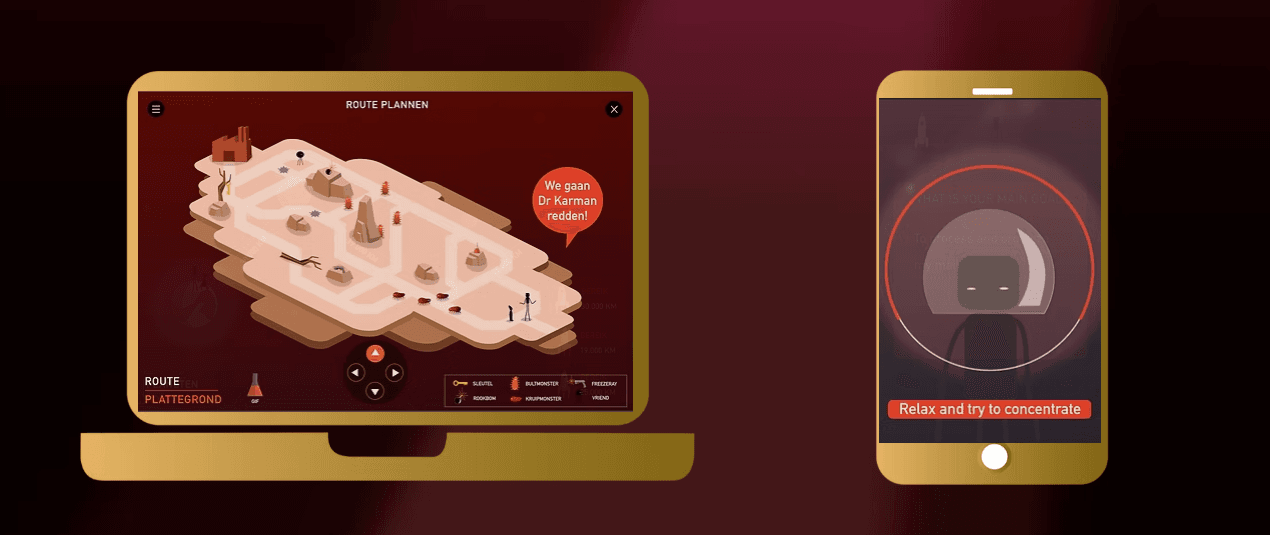
The result is impressive: Karman Line consists of 50 training games and four accompanying apps, developed in collaboration with Radboud University, the Donders Institute and Klimmendaal. Whereas job-specific training focuses on the repeated practising of specific skills, Karman Line focuses on compensating for cognitive limitations.
This translates into concrete, recognisable exercises.
Such as cooking, for example: planning, preparing ingredients, time management and preventing fires.
Or when travelling: how do you get from point A to B in a simulated environment, taking into account traffic lights, petrol stations, distractions and unexpected obstacles.
Other planning and goal-oriented tasks are also covered, in which the user chooses a goal, for example: buying bread. This is followed by step-by-step guidance, from taking your keys with you to choosing the bread and paying for it.
The four apps target specific cognitive domains: planning skills, carrying out tasks under time pressure, energy and resilience, and memory.
The integration of AI is unique: “We personalise training sessions,” explains Aarts. “Our apps predict when someone might give up due to overstimulation or fatigue. The AI assistant issues a warning at the right moment and provides coaching when mistakes are made.” For example: there’s no butter on a slice of bread. Where a therapist would normally intervene, the virtual assistant offers alternatives, such as oil or simply the filling alone, so that the user can make an appropriate decision independently rather than waiting for help to arrive.
A large group of patients can now be helped
Aarts is convinced that there is still a world of opportunity for a large, often invisible, group of people who, due to time pressures or a lack of suitable care, are currently not seeking help.
“There are many people with mild acquired brain injury (ABI) who experience ongoing difficulties with planning, coping with time pressure, fatigue or memory. For this, Karman Line offers an accessible and effective therapy that can easily be followed at home.”
From paper to digital
Previously, paper was the norm. Patients would be sent home with stacks of A4 sheets – modules on executive functions, time pressure, memory and energy management. But Aarts acknowledges: “It takes an acquired brain injury (ABI) patient half an hour just to read a single A4 sheet, without being able to remember what’s on it.”
That is why the company is digitising the ‘stop-check’ scheme developed by the university. What used to be a piece of paper that patients put in their pockets is now in the planning app. You set your goals, work through the steps, and it’s always at the ready. “People lose the piece of paper, and it doesn’t remind them automatically,” says Stephan. “The app does.”
Nevertheless, paper remains available for those who prefer not to use a smartphone, although take-up is low. “Most people already use their phones,” explains Aarts. And for anyone still in doubt: “If you’re too old or unable to use one, there are still paper alternatives.”
Proven impact and implementation in practice
Two PhD students investigated the effectiveness of the digital training programmes. “We know exactly which people benefit from them – both those with mild and more complex cases,” says Aarts. Around 850 people are now using the tools across 11 rehabilitation centres in the Netherlands.
The digital approach also saves healthcare professionals time. “For every 10 consultations, we save an average of two sessions,” says Stephan. And if the patient can work independently outside the clinic, this reduces the time spent on supervision by as much as 50–70 per cent. That’s a significant time saving for both therapists and patients. What’s more, these sessions can be followed digitally, via phone, app or video call.”
This makes the therapy hybrid: one live session a week combined with two digital training sessions a week. This approach is now embedded in the care pathway at Klimmendaal, which uses Karman Line as a formal form of therapy in rehabilitation care. And there is even financial scope: “Hours that patients complete at home can now be coded and claimed. It’s an administrative challenge, but it works.”
Wider
Aarts sees a broader future outlook: “Cognition remains our starting point; we also want to look at Alzheimer’s, dementia, ageing, the aftermath of cancer and burnout – all focused on the same core principles: planning, memory, time pressure and energy.
With eleven partner centres across the Netherlands, Yellow Riders operates nationwide and is ready for further expansion. A strong network and new technologies enable the scaling up of services to new target groups.
The aim? One of the participants summed it up: “If I’d had this sooner, I could have been back at work a year ago.”