With creativity, precision and technical insight, this CAD draughtsman from ROC Nijmegen designs the machines of tomorrow.
Everyone ultimately sees the machine. Guus Kramer (20) sees, above all, what goes into it.
A blank screen. An idea. A sketch. Another sketch. Hesitation. Refinement. Starting afresh. Only when everything is just right does the computer get to work.
“If you haven’t thought it through properly, it won’t work in the end.”
For this Technical Engineering student at ROC Nijmegen, precision is not a mere detail, but the starting point for everything. As a CAD draughtsman, he translates ideas into digital designs that ultimately form the basis for machines and technical installations. With this combination of technical insight, creativity and accuracy, he will represent Team Netherlands at WorldSkills 2026 in Shanghai.
In a world full of smart software, Guus believes one thing remains irreplaceable: the human brain.
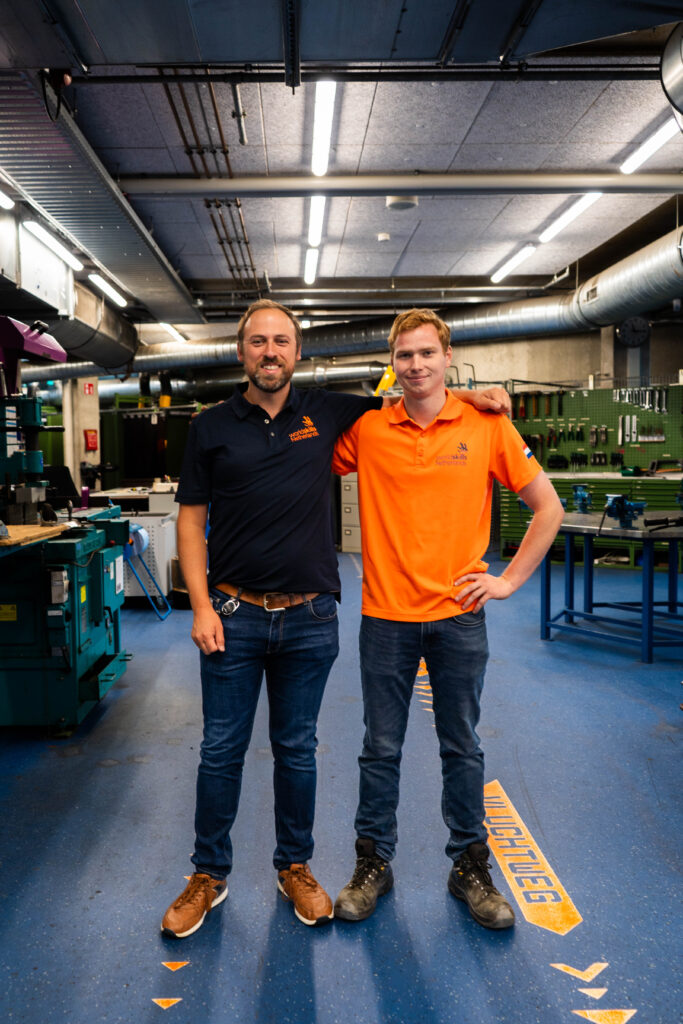
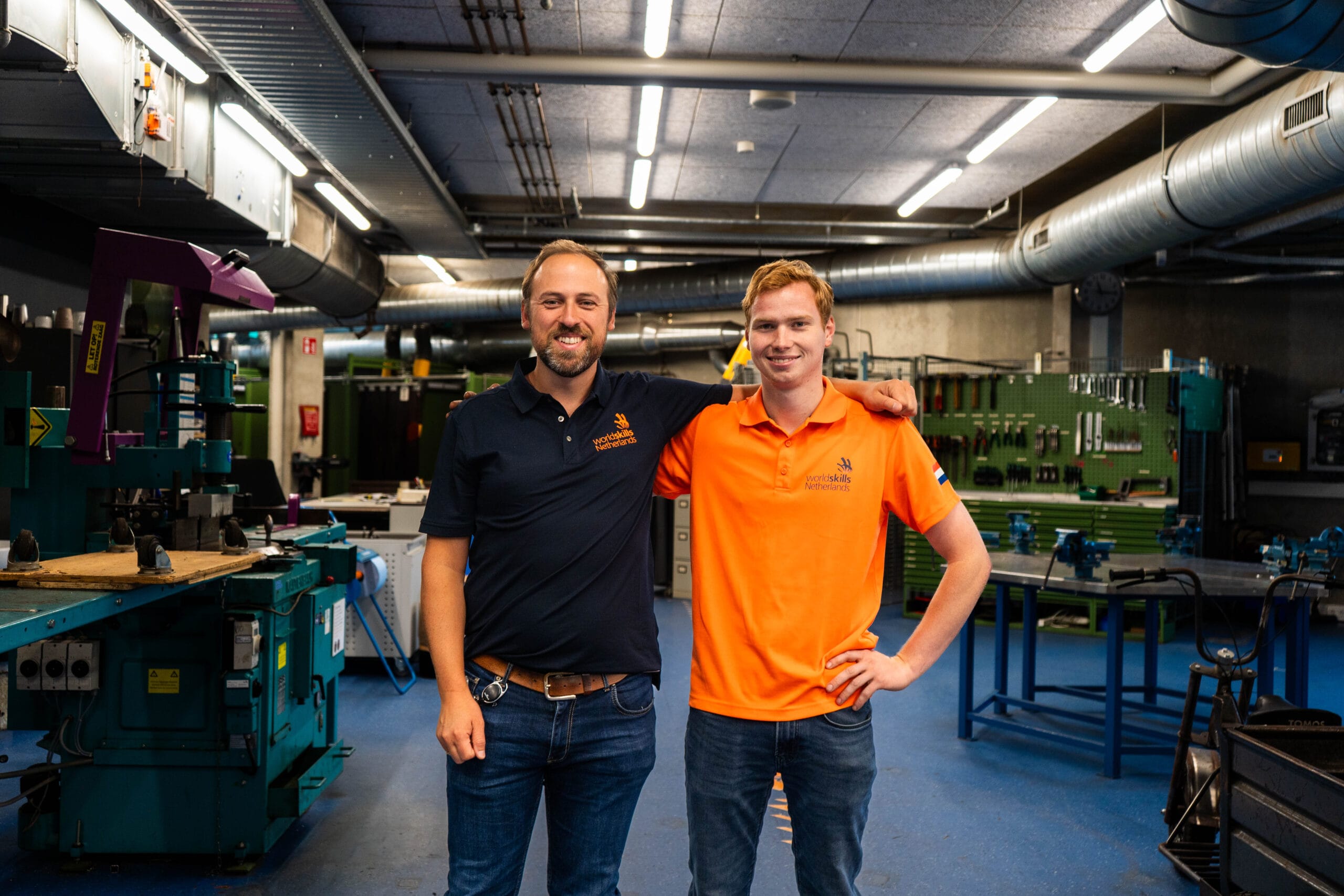
Guus (right) with his mentor Matthijs (left) in the workshop at ROC Nijmegen
More than just a drawing
As a child, Guus loved nothing more than making things. But before he started anything, he first wanted to work out how it would work. That has never really changed. It’s just that the projects have become bigger.
“I enjoyed making and coming up with things,” he says. When he started looking into further education, the Technical Engineering course at ROC Nijmegen turned out to be the perfect fit for that curiosity.
When you hear the term ‘CAD draughtsman’, you might picture someone sitting in front of a computer screen all day drawing lines. According to Guus, that image couldn’t be further from the truth.
“You’re not just drawing,” he explains. “Above all, you’re thinking.”
Before a single line appears on the screen, it must first be clear exactly what problem a machine is intended to solve. Only then does the design process begin. First come the sketches, followed by the creation of a 3D model, and finally, a check to ensure that everything actually works. Only then can a machine be built.
It is precisely this process that Guus finds most rewarding about his profession: coming up with something that didn’t exist before, working step by step towards a solution, and ultimately seeing an idea become a reality.
“That’s certainly something to be proud of.”
Smart software requires smart people
Technology is developing at breakneck speed. Guus, too, works with advanced software every day and uses AI as a tool. Yet he does not see technology as a replacement for his work.
On the contrary. “Computers are very good at maths,” he says. “But you have to come up with the design yourself.”
According to Guus, this is precisely where an engineer’s strength lies. A computer can perform calculations, but it does not understand why a machine needs to be built or which solution works best in practice. That requires creativity, technical insight and the ability to look beyond what software can calculate.
That is precisely why people remain indispensable in an increasingly digital world.

Every millimetre counts
That combination of technology and precision will also be on display at WorldSkills in Shanghai. For four days, Guus will be set a new task every day. Sometimes he will design a complete machine; at other times, he will have to digitally reconstruct an existing component using a 3D scanner. Time is limited and every detail counts.
“You can spend a very long time trying to make a single component perfect,” he explains. “But sometimes it’s smarter to complete four components well than to have just one that’s absolutely perfect.”
During his preparations, Guus is not on his own. Together with his coach Matthijs van Vliet and Gert Jan van den Berg, he is constantly honing both his technical skills and his competition strategy. When do you refine something to perfection? When do you move on? It is precisely these choices that can make all the difference at WorldSkills. He is also learning a great deal from expert Gerben Zwart, who has previously competed in WorldSkills himself and is keen to pass on his experience.
Just keep creating
Anyone who speaks to Guus will soon realise that he prefers to talk about his work rather than about himself. He remains modest even when talking about the future.
In five years’ time, he hopes to still be doing the same rewarding work he does now, preferably at RAM Engineering, where he already works and is gaining a great deal of practical experience.
His advice to young people who are unsure about pursuing a technical course is just as down-to-earth.
“Just give it a go. Make things. Think things through, but sometimes just get started. Ultimately, you learn the most by getting stuck in yourself.” Perhaps that is the most valuable lesson to be learnt from his story.
Behind every smart machine, every technical feat and every innovative solution, there is ultimately someone who once started with a blank screen and a good idea.
That is precisely why technical talent is indispensable to Lifeport in the Arnhem-Nijmegen region. The innovations of the future do not happen by themselves. They begin with curious professionals like Guus, who dare to think before they act.
And that is precisely where the technology of tomorrow begins.
Lifeport Human Capital Agreement
Guus’s story illustrates what the Lifeport Human Capital Agreement stands for. Under this agreement, educational institutions and entrepreneurs work together to produce well-trained professionals capable of meeting tomorrow’s challenges. By identifying talent early on, challenging young people and forging close links between education and the business community, a region is created where people can develop and businesses can continue to innovate.
Further information on the Lifeport Human Capital Agreement can be found at: Human Capital Agreement.