Are there materials that can function like the brain? This is the central question of the research being conducted by Professor Alex Khajetoorians at Radboud University Nijmegen. He is head of the SPiN lab, part of the Institute for Molecules and Materials within the Faculty of Science. ‘We are working on materials for a new generation of computers that operate just as efficiently as our brains.’
As professor of Scanning Probes in Nijmegen (SPiN), Alex Khajetoorians works, among other things, with a microscope with the highest resolution in the Netherlands. With this microscope, he can investigate the electronic and magnetic properties of materials down to atomic level. 'We are trying to understand yet undiscovered material properties and use them for new computer technologies,' says Khajetoorians.
As a professor of Scanning Probe Microscopy, Khajetoorians was one of the speakers at the Lifeport Semicon Event on 27 January 2026. He led a parallel session in the Disruptive Technologies track entitled ‘National Efforts in Neuromorphic Computing’.
Neuromorphic computing
Research into the new generation of computers is based on the architecture and functioning of our brains, also known as neuromorphic computing. ‘We need to make computers more efficient, because at present they require energy-guzzling data centres,’ explains Khajetoorians. ‘If we need more computing power for AI – think of self-driving cars and other future applications – then that is a dangerous path to take. By way of comparison: it already takes more energy to train an AI system for a self-driving car than it does to build the car and get it moving.’
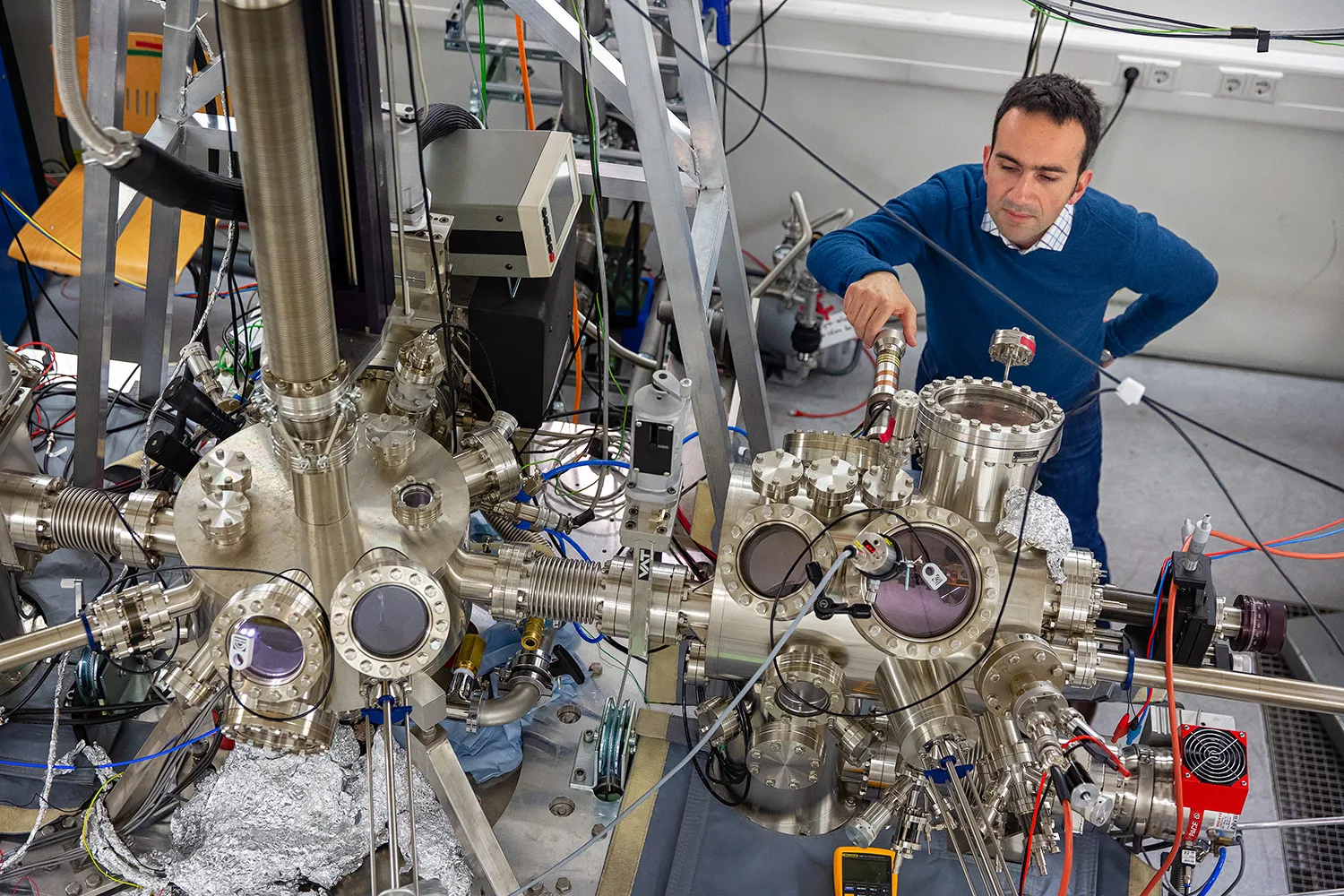
Alex Khajetoorians
Lifeport Semicon Event
As the second semiconductor region of the Netherlands, Lifeport Arnhem Nijmegen plays an important role in the development of innovative semiconductors (chips). 'Everyone immediately thinks of ASML and the Eindhoven region when they think of semiconductors, but here is an extensive network of semicon companies, scientific research institutes at Radboud University, innovative startups, governments and educational organisations,' Khajetoorians argues.
He emphasises the importance of the first Lifeport Semicon Event, which was held on 27 January at the Goffert Stadium. ‘This allows us to showcase what is happening here in the field of semiconductor technology and enables us to engage in dialogue about solutions to current and socially relevant issues.’
Social issues
Besides energy, safety and independence from tech companies in America, for example, or China, when it comes to specific raw materials, are also important arguments to put a strong focus on research and development of the new generation of self-thinking computers, Khajetoorians believes. 'These are big issues we are facing and need solutions. We need to move towards more autonomy by working on a different AI technology, for example, so that we are less dependent on companies like Microsoft.'
Neuromorphic NL
According to Khajetoorians, collaboration between scientific researchers, the business community and public authorities in the Netherlands is vital for achieving breakthroughs in these societal issues. To this end, his team in Nijmegen has taken the lead with the publication of the white paper *Neuromorphic Computing in the Netherlands*.
This initiative has been embraced by the national government’s Top Sector ICT. This has resulted in an action plan designed to strengthen the Netherlands’ international position in the field of computer technology – based on the functioning of our brains – by accelerating the development of this next generation of computers. In this context, Khajetoorians refers to the research question ‘Materials that learn and how we can use them responsibly’; this forms part of the new NWA ORC 2026 programme of the NWO (Netherlands Organisation for Scientific Research) within the framework of the National Science Agenda (NWA).