For a few years now, this organisation for circular and biobased building has been building. VIA-T is in full swing, moved to new premises and had a new director as of August. We talked about it with outgoing quartermaster Wouter van der Burg and brand-new director Erik Willems.
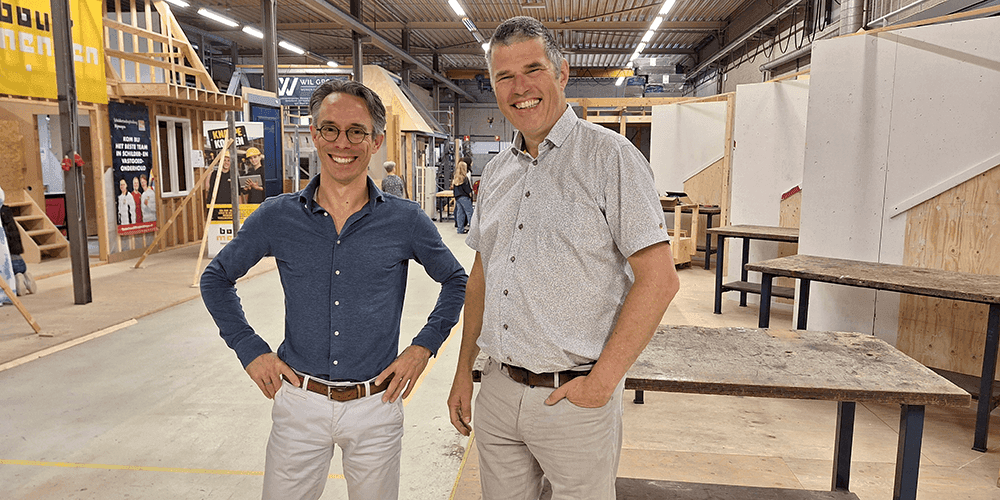
Wouter van der Burg is no stranger to the region; he was also involved in the founding of CITC and Connectr. The role of building something from the ground up suits him well, and now that VIA-T is a fully operational organisation, he is happy to hand over the reins to Erik Willems.
Willems comes from the business world and brings a wealth of experience in technical and industrial processes. Furthermore, he pioneered the construction of his own home using bio-based and recyclable materials, employing a technique that was previously unknown in the Netherlands. He therefore knows exactly what challenges you face when you want to build differently.
Origin at secondary schools
Companies are struggling to find technical staff. So the question was: how do you get young people excited about a career in technology? To achieve this on a national scale, there is the ‘Sterk Techniekonderwijs’ programme.
Van der Burg explains: “How do you introduce young people in secondary education to technology? It’s tricky to do that within your own school building, in that traditional school setting. That’s why all the secondary schools in the region have joined forces to create a number of these ‘hotspots’, where they aren’t all trying to deliver high-quality technical education within their own school buildings and with their own teachers. No, together with businesses and at a third location – neither a school building nor a business premises – that’s where we’ll be doing it together.
This began a few years ago at the Hubertusschool in Nijmegen, and it proved to be interesting and left us wanting more. So the first seeds of VIA-T were sown by those schools that wanted to collaborate with the business community at a different location. At the moment, almost all secondary school pupils in the region come here at least once to complete an educational module for a day or part of a day.”
We walk to the workshop, where a few secondary school classes are taking part in programmes. The teenagers are busy hammering, measuring and discussing; it looks as though they’re really enjoying themselves.
Willems adds, “We want to take a step towards equipping the new generation to build the future. How do we want to build, and with what innovations? And ultimately, you end up addressing all those societal issues, from the reuse of building materials and shortages of raw materials to labour shortages. And all this with the idea: can we somehow bring all of this together with businesses and the government, and with all the points of contact that exist? That’s what VIA-T is currently working out.”
Adult lateral entrants
And this approach is not only suitable for young people, but also for those halfway through their careers who wish to change direction.
Van der Burg: “I see VIA-T as a collection of modular building blocks that can be used for different programmes and target groups. I was here recently on a guided tour with someone who used to be a chef; he was in his mid-thirties and now had a family. His life in the hospitality industry no longer suited his situation very well, and he wanted to find out whether a job in engineering might be something for him. And there are all sorts of people like that who are reorienting their careers to do something different. That lateral entry is important for companies in the engineering and construction sectors. And you can use the same sort of modules for that.”
“These career changers walk around this very same hall on taster days to get a feel for whether they’d like to do this sort of work. If they choose to go ahead, they’re offered a training programme here, during which they simply work for a few days whilst also being taught the skills needed to work on a building site.
The WILgroep is a company that offers work-based learning programmes to bring people who are not yet suited to construction work up to that standard within a year. We’re already referring people to them.”
VIA-T also wants to reach new adult target groups, such as status holders and ex-prisoners – people who need to, and want to, participate in society.
Next step: integrating higher education
VIA-T, together with HAN University of Applied Sciences’ Architecture programme and the Centre for Multiple Value Creation, is exploring these alternative approaches to construction. For example, rather than demolishing a building completely, harvesting and reusing materials. The university students are already applying this conceptual approach to the projects they are working on.
“And we want to bring those two worlds together here too. So that, in future, you’ll have projects where the approach devised by a university student doesn’t remain just a theoretical solution on paper, but is actually put into practice with vocational or secondary school students. Just give it a go: can we make that happen?
“We’re a centre for practical implementation; this is where you can do it and where you can see it. Here, you can access knowledge, materials, examples and inspiration.”
Woonwijzer shop
We walk through the building to a large room that is still empty. This is for the Woonwijzer shop that is under development. People who want to (re)build their homes sustainably will soon be able to come here for knowledge and information. It should become a kind of shop with displays where you can discover what kind of insulation materials there are, or what types of heat pumps.
Companies and innovation
Many innovations originate from companies in the sector, as well as suppliers in the construction and engineering industries. They develop, for example, new roof tiles or insulation materials. But that’s not the end of the story. Firstly, people need to become aware that this new material exists, and secondly, further down the supply chain, construction firms or installers need to learn how to work with it.
Willems: “If we can be the place here where you can say to such a company: ‘You’ve come up with the technical solution, so come here now and we’ll get to work on it together.’ Organise a few training afternoons here, to which you invite companies from the region. Just to build a section of wall or something similar. And once they’ve completed the training, they’ll also receive a certificate confirming they can work with the new material. Because what we need to do is train people specifically in circular construction.”
Van der Burg adds: “The societal challenge surrounding circular construction is a major one; if you want to get to grips with it, you need to take a close look at what companies actually need right now. There are a number of them keen to lead the way in this transition, so we can already take steps forward with them.”
Cooperative
In the spring of 2024, the cooperative was officially established in which members can, for example, benefit from the talent pool at VIA-T and highlight and try out new products. They can also participate in regular events, which take place not only at VIA-T, but also at construction and repurposing sites in the region.
Future
Van der Burg: “I think it would be great if, in two years’ time, we were to walk around here, look around us and say: ‘Hey, isn’t that funny – there’s a group of third-year vocational students working on an innovative and sustainable house. And the design for that was the result of a project by those higher vocational education students. And on Fridays, a class of secondary school pupils will also be taking part. The supplier of those new building materials will be providing them free of charge. And the supplier can then use the house as a demonstration site to show their customers. I’d think that sort of cross-pollination would be absolutely brilliant…”
Willems: “That’s the vision, yes. And organising activities a few times a year where members can come along to see the latest innovations, to get to know one another, meet suppliers, discover new products and explore new horizons. That horizon keeps shifting, and it’s happening fast. It’s all about bringing everything together at VIA-T.”