After 41 years in the semiconductor sector, Robin Stal is making a remarkable career move. Since 1 October, he has been working at ROC Nijmegen as a Semiconductor Education Development Adviser. His mission? To bring the world of semiconductors closer to students and to forge stronger links between education and industry. Because, according to Robin, there are plenty of opportunities.
“Semicon is a vast, dynamic world. It’s just that many people don’t yet realise what lies behind it all.”
The fact that Robin ended up in the semiconductor sector was actually a matter of chance. After completing his LTS and MTS qualifications, where he studied electronics, he secured an internship at Philips. That later became NXP. He started out in maintenance and held various roles in the years that followed, including that of team leader. For the last eight years, he was manager of the sample centre. He found himself increasingly drawn to working with and developing people. And although he worked for the same organisation throughout those years, it certainly didn’t feel as though he’d been doing the same thing for 41 years. “In the semiconductor industry, you can have a very varied career over a long period. There are endless possibilities.”
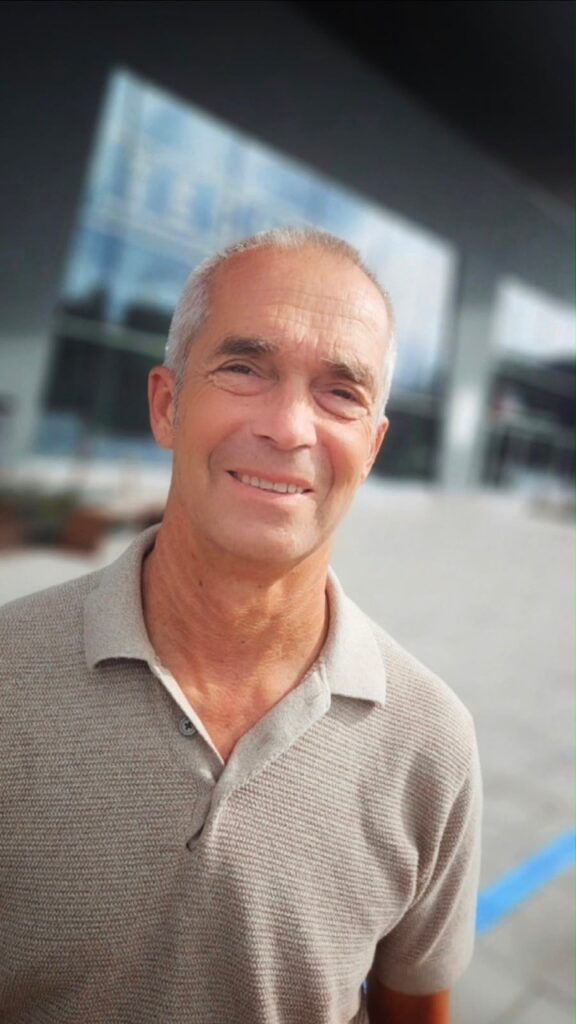
Robin Stal
A world that’s much bigger than you think
What has particularly stayed with Robin over the years is the dynamism of the sector. New technologies follow one another in rapid succession and the work has a global character. He himself has worked with colleagues in Asia, Europe and America. “It’s great to be able to work on things that really matter – on new developments, on a global scale.” AI is also playing an increasingly important role in this. Robin does not see AI so much as a replacement for the actual work, but primarily as a tool to work smarter and faster and to continue to grow.
At the same time, he sees a major problem: many people have hardly any idea what the semiconductor industry actually entails. When people think of semiconductors, they might think of chips, wafers and staff in protective suits in a factory. But behind that lies a much bigger world. Chips do not just need to be designed and manufactured. Machinery, materials, software, plant, tooling, tools and all manner of other specialist disciplines are also required to make this possible.
That was precisely what Robin noticed when he gave guided tours at NXP. As soon as visitors could see how a chip ultimately becomes a usable product, they were filled with wonder. “You could see people thinking: is all this behind it? They went home and said: ‘Isn’t this brilliant!’” According to Robin, that is exactly what is needed to get more people excited. To show them what the semiconductor industry is really all about.
For creators, thinkers and doers
This also involves broadening the perception of who can work in the sector. Because, according to Robin, the semiconductor industry is certainly not just about technical engineers. “The industry needs people at all levels. From fitters, operators and technicians to software developers, researchers, analysts and managers: the variety is vast. And in addition, there are countless people working for companies associated with the chip manufacturers themselves.”
According to Robin, that is precisely what makes the sector so appealing to young people. There are many different ways to get started and then to develop your career further.
“Show students how they can progress within a company. What steps they can take. There’s so much happening in this sector. You could work there for forty years without a single day being the same.”
A new chapter at ROC Nijmegen
From NXP to ROC Nijmegen
Since 1 October, Robin has been applying his many years of practical experience at ROC Nijmegen as a Semicon Educational Development Adviser. He sees his role primarily as that of a connector. He knows the business world, has a large network in the region and, drawing on his practical experience, understands exactly what knowledge and skills companies need.
His move fits in well with the developments set in motion within Lifeport Arnhem-Nijmegen Region through the Semicon Talent Plan. Partly thanks to the financial boost from Project Beethoven, additional investment is being made in the region to train, attract and retain talent for the semiconductor sector. A key part of this is strengthening the collaboration between the education sector and industry, so that study programmes are better aligned with real-world practice and more students are introduced to the opportunities within the semiconductor sector.
And according to Robin, that connection is sorely needed. When he first walked around the technical training centre at ROC Nijmegen, he was absolutely amazed. “The first thing I thought was: I should have come here ten years ago.”
He saw knowledge, equipment and opportunities that he could have utilised much earlier in the business world. Conversely, he sees courses and skills that are an excellent fit for the semiconductor industry, but which students do not recognise as such at all.
Learning by seeing and doing
According to Robin, work placements, company visits, guest lectures and practical assignments are therefore essential. It is not just students who need to get to know companies better; companies also need to be much better informed about what is happening within the education sector.
In doing so, it advocates open and structured collaboration. Not just the occasional one-off visit or project, but a situation where the education sector and the business community are in constant dialogue and work together to develop concrete projects.
That is also a key reason why Robin is enthusiastic about his new role. “I really want education and the business world to become much more intertwined. I want to see more collaboration and more joint projects. There needs to be a much smoother transition between the two.”
A chip region full of opportunities
Robin sees plenty of opportunities for this in Arnhem-Nijmegen in particular. The region and its surroundings are home to a high concentration of companies, each of which is responsible for a different part of the semiconductor supply chain – from chip production to machinery, tooling and other specialist technologies. Yet, according to him, many young people are barely aware of everything that is happening right on their doorstep.
He wants to change that. Not by making the sector more complicated than necessary, but by making it visible and tangible. By showing what is being produced, who works there and how many different opportunities there are.
What is his message to students who have never considered a future in semiconductors?
“There’s a truly wonderful, dynamic world waiting for you here. It can be technical, but it can also involve all sorts of related areas. There are so many possibilities.”
And it is precisely this world that Robin hopes to make visible to many more students.