Bob van den Berg had just graduated as an innovation scientist from TU/e (Eindhoven) when he was approached with a good idea: a way to make a positive impact on mobility, health, independence and sustainability.
“I definitely wanted to commit to that,” he recalls. “I’d always wanted to do something ‘good’. So I seized this opportunity with both hands.” The result: Tworby. 
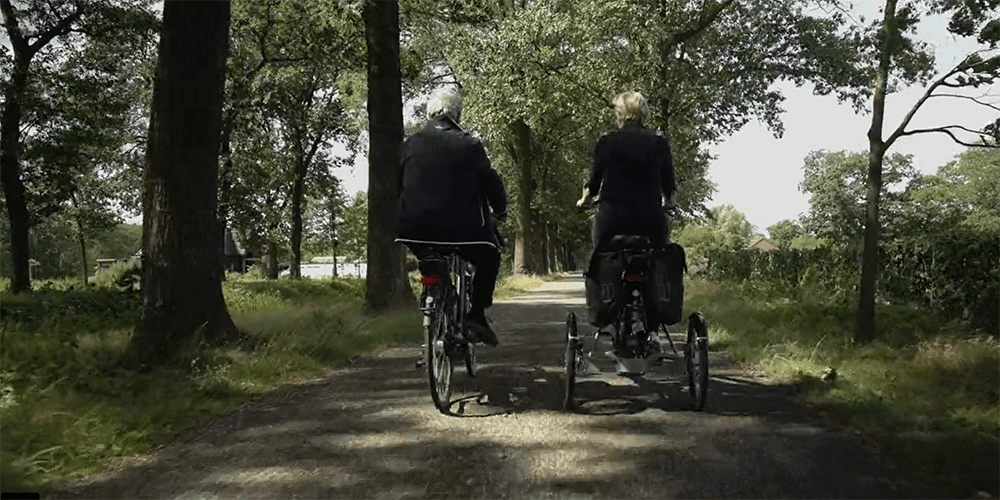
With Tworby, you can have an existing (electric) bike converted into a stable tricycle. This helps people remain independent, mobile, active and healthy for longer. And those aren’t the only benefits of this product. You don’t need to buy a new bike. So your own bike lasts longer. And Tworby is committed to promoting employment: the product is assembled by people facing barriers to the labour market at De Voorwerkers. “Tworby really does kill many birds with one stone,” says Bob.
'Talking brings you even closer to your target group'
Helping customers switch
Bob’s entrepreneurial journey began in 2019 with the development of the product. This also means that Tworby was launched during the pandemic. “Difficult in any case, but certainly for an older target group,” Bob acknowledges. “We’ve learnt a lot from that. For example, we now sell through bicycle repair shops and we connect customers with occupational therapists to help them get to grips with this new way of cycling. We’ve got better and better at guiding customers through the transition, offering them the right support and answering their questions.”
One way Tworby does this is by providing plenty of transparent information. “For example, we write lots of blog posts explaining in which situations a Tworby is the right solution and when it isn’t. That might also mean a customer doesn’t choose us. But we’ve still helped someone, and in the long run, that’s more beneficial.”
Bob also invites customers to trial days at bike shops, which often take care of the assembly. He’s noticed that for some older people, there’s a stigma attached to tricycles. “That’s already becoming less of an issue, because people keep their own bikes with our solution. But existing customers also come to the test days, acting as ambassadors to share their stories. That helps to lower the emotional barrier to trying it out.”
'Broadening means less deepening'
Bob says that in recent years he has come to understand much better who Tworby's customers are and how the company can best support them. A lot of testing and research preceded this. "For example, we engage with people who haven't chosen us, that's how we keep honing." New product ideas also emerge from time to time, but for now it remains to fine-tune Tworby. "Broadening is often less deepening. There are still many ideas on the shelf, but for now we are keeping the focus."
Training in pitching and talking to investors
Bob recently attended a Briskr event to pitch Tworby. “Three years ago, I was invited by programme organiser Martijn Kriens to the Business Angel Network Nijmegen, a meeting for investors. Two weeks ago, I spoke to that same group about the journey we’ve been on over the past three years.”
A platform to deliver his pitch and speak to investors for the first time: for Bob, it was a completely new experience, and the training provided by Oost NL and Briskr came at just the right time. “I gained a lot of insights there: what should you pitch? What questions can you expect? And ultimately, I also came into contact with investors. I’m still in touch with some of them.”
Cycling like a two-wheeler, with the support of a tricycle
The near future has two focal points for Bob: the further development of his product and getting even closer to the wishes and needs of the customer. "For example, when developing our product we try to involve test subjects who also participate in studies at Radboud University." He wants to get the product to the point where it moves towards two-wheelers in terms of 'bike feel', but with the stability of a tricycle.
Guidance from an occupational therapist
When it comes to providing the best possible support and staying close to the target group, Bob also sees plenty of opportunities. “We already strongly advise customers to practise under the supervision of an occupational therapist before setting off on their own. That will remain the case, even if the user experience perhaps comes even closer to what people are already used to.”
Because it’s not just about getting used to a new way of cycling, Bob explains. “Many people have also become afraid of cycling, perhaps because they’ve had a fall or haven’t cycled for a while. There’s also an emotional aspect to it, and by working with occupational therapists, we can offer them the best possible support.”
That requires intensive preparation, Bob noted. “But we’re seeing that customer satisfaction is still rising. It’s really true – people now feel that we’re thinking alongside them.”
This article was previously published in English on the Briskr website .