A lot is happening in the healthcare sector. One of those developments in elderly care is that the elderly are living at home for longer and longer. But how do you properly support the elderly from a distance?
Inn4cure has the answer: the company aims to make the monitoring of older people’s health transparent through digitalisation. They do this by measuring vital signs using a smartwatch.
After all, we are living longer and longer in the Netherlands. As a result, care is becoming more intensive and more expensive. This needs to change, according to Inn4cure. Why not work towards a preventive health policy, so that we can help prevent illness among older people?
Full Home Package
This health policy is currently being implemented through the ‘Volledig Pakket Thuis’ scheme. This means that all the care elderly people need is provided at home by a single care provider. This enables older people to continue living at home with the right mix of nursing, personal care, support and treatment. To qualify for this, older people need an assessment under the Long-Term Care Act (Wlz).
Inn4cure and its partner Eurocom support Wlz organisations that provide nursing, treatment, support or personal care to people at home, as part of the ‘Volledig Pakket Thuis’ scheme. In this way, they help to enable older people to live at home for longer.
Doing with digitisation
How does inn4cure tackle this transformation in elderly care? Director and founder Pieter van Weijen explains it clearly: “We measure vital signs at home using a smartwatch. The smartphone sends this data to our inn4cure platform. Here, the readings are compared against personal reference ranges. If there is an anomaly, an alarm is triggered for the care providers and someone contacts the client.”
inn4cure works with trend analysis. Vital signs are then compared with threshold values over a longer period. This allows health trends to be monitored remotely in an objective and transparent way. You know when something is wrong, so you can take immediate action. This brings peace of mind to the elderly, their families and the care provider. No signal means all vital signs are normal.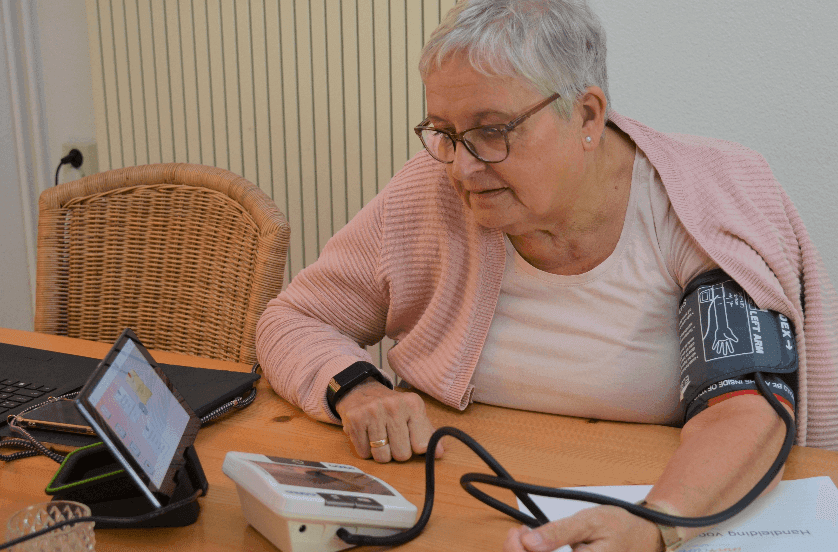
Innovation in health care
Inn4cure believes in the power of digitalisation. There are significant cuts being made to healthcare spending, whilst the number of elderly people is set to double over the next few years. This calls for innovative approaches to care provision, such as the solution offered by Inn4cure. They are currently offering their solutions to both private and public sector clients, such as care homes for the elderly. In doing so, they have noticed that digitalisation still represents a major transition for the healthcare sector.
“That’s why we’re working to help people currently working in the care sector discover how to deal with digitalisation,” says Pieter. “We’ve developed an e-learning course on telemonitoring in collaboration with HAN University of Applied Sciences. This enables healthcare staff to gain a thorough understanding of the subject. Armed with these insights, they can then bring about positive change.”
Together for Health
inn4cure certainly has a clear vision for the future. They would like to roll out their services nationwide in the future, in the form of a shared service centre. With such a centre, a residential care facility could then also support older people still living at home in the same neighbourhood. And all of this digitally: the nurse at the residential care facility receives an alert if there is anything amiss with the resident’s vital signs. They can then immediately make a video call to the elderly person to check that everything is alright. The same applies to support from a GP or a dietitian.
“We’re working with major, national partners to develop this vision for the future,” says Pieter. “In this way, we continue to provide transparency on health developments. That’s why we always say: if there’s no alert, everything is fine.”
This article was previously published in a slightly different form on Briskr.nl