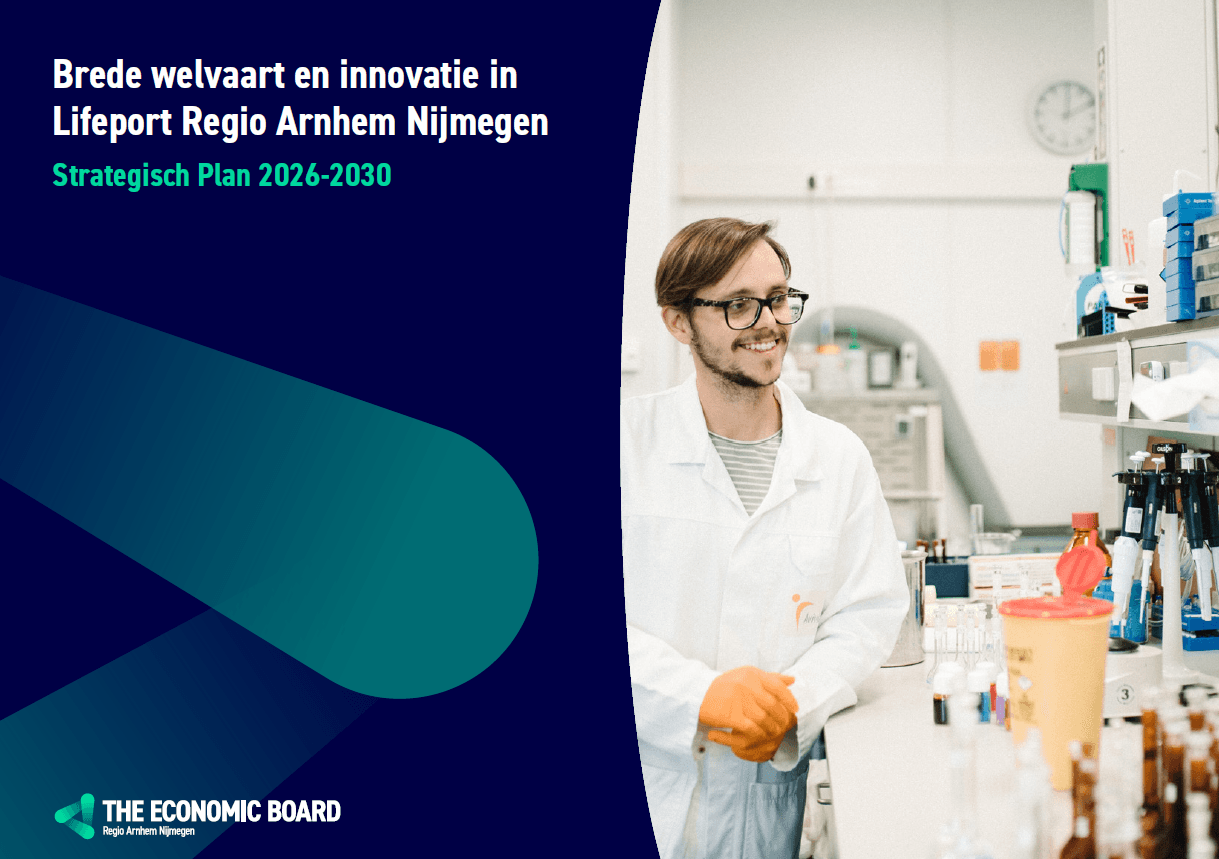
The Economic Board Regio Arnhem Nijmegen has presented its new strategic plan for the period 2026-2030, with the central ambition of strengthening the broad prosperity of Lifeport Regio Arnhem Nijmegen. The plan stems from an extensive evaluation process and emphasises the need for cooperation between businesses, governments and educational institutions to further develop the region economically and socially.
The Arnhem Nijmegen region suffers from a lower economic performance than comparable knowledge-intensive, urban regions in the Netherlands. However, the potential is great, especially within the three focus clusters: Energy, Health and High Tech. The new strategic plan focuses on exploiting this potential by focusing on innovation and social transitions.
"Our region has immense strength, but it only really comes to fruition when we connect innovation to people. In Lifeport, we not only build world-class technology, but also trust, craftsmanship and connection between people. This strategic plan is our joint promise: to a future where broad prosperity is no longer an ambition, but daily reality - here, in the region where cooperation is synonymous with progress," said Ahmed Marcouch, chairman of The Economic Board.
Five Strategic Issues
The strategic plan is structured around five key tasks:
- Technology-market combinations for societal challenges Innovating within the Energy, Health and High Tech clusters to tackle societal challenges, with a particular focus on AI, sustainable technologies and the labour market.
- Promoting economic activity and entrepreneurship Strengthening small and medium-sized enterprises (SMEs) and better connecting businesses with the triple helix (public authorities, knowledge institutions and businesses) is seen as essential for boosting the region’s innovative capacity.
- A balanced labour market The focus is on a labour market programme that brings together government, education and businesses to strengthen the labour market in a sustainable way. It focuses on lifelong development, attracting and retaining talent, and activating untapped labour potential.
- Broad prosperity as a driving force Social added value is central to every innovation. The Economic Board aims to work with partners on both an economic and a social agenda in order to contribute to broader prosperity.
- Tools for public-private ecosystems: Strengthening collaboration within the triple helix and further professionalising lobbying activities to put the region on the international map.
A stronger region through cooperation
According to The Economic Board, the region's success depends on enhanced cooperation within the triple helix. This not only means that companies, educational institutions and governments should cooperate more intensively, but also that civil society organisations and SMEs should be better integrated into the regional innovation networks. The strategic plan emphasises that the region needs to forge more links internationally, both in Europe and beyond, to exploit opportunities for innovation and cooperation.
Opportunities for the future
The coming years are dedicated to realising these ambitions. The focus here is not only on economic growth, but also on the broader social impact that innovative projects can have.
"Our region has the potential to be at the forefront of the innovations the world needs. Through cooperation between companies, education and government, we can maximise the innovative power of our region in Lifeport Regio Arnhem Nijmegen. Our goal is not only economic growth, but also the promotion of broad prosperity. This means deploying innovations that benefit all residents of our region, from improved healthcare to solutions for energy transition and labour market challenges," said Jan van Dellen, director of The Economic Board Regio Arnhem Nijmegen.
Download the Strategic Plan 2026-2030 in PDF