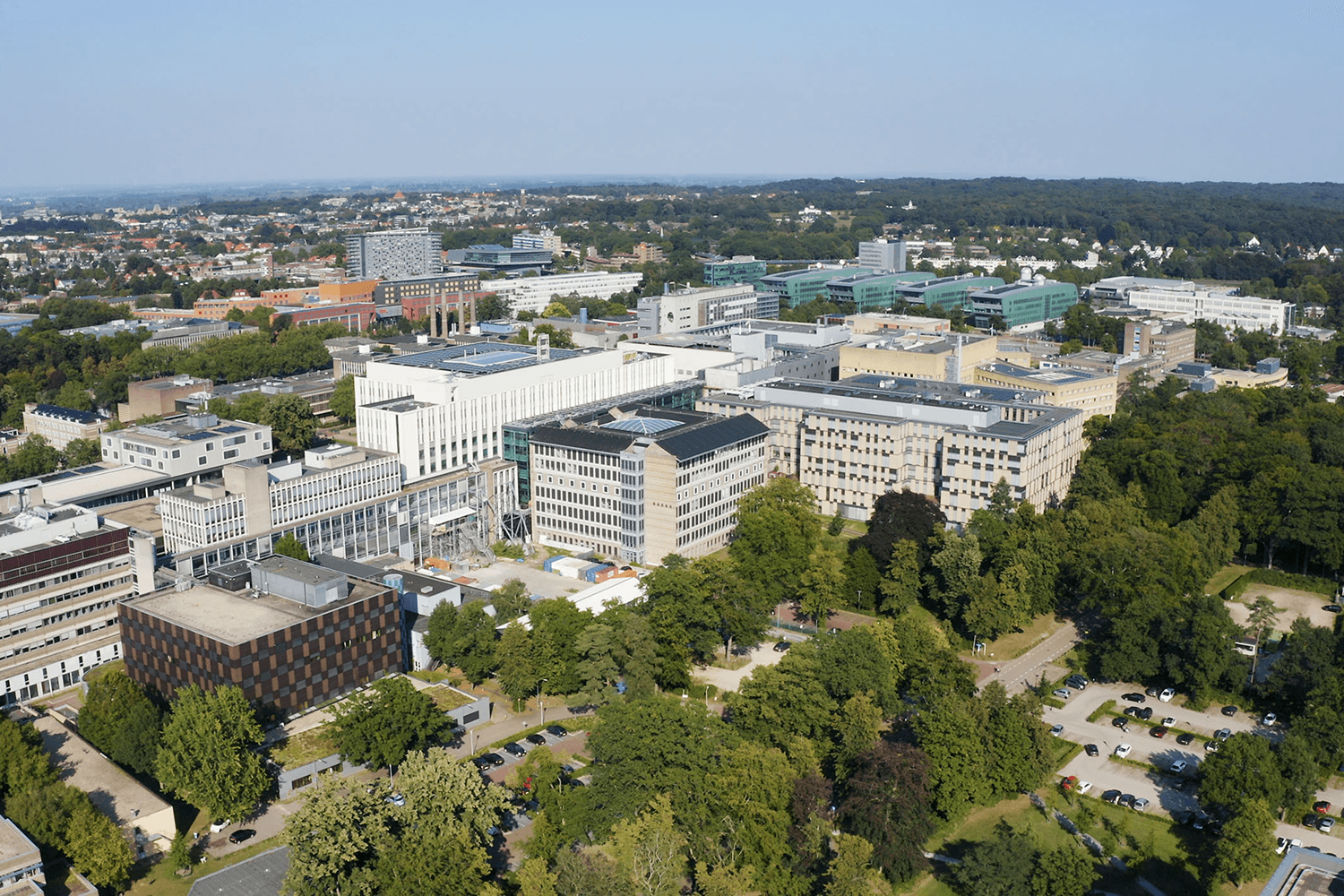
“If you manage to bring a Radboudumc invention to market globally, you’ll have a greater impact than if you simply publish it and nothing comes of it,” says Paul van der Hoeven, senior business developer at Radboudumc. He is responsible for knowledge commercialisation, intellectual property and strategic partnerships with companies.
Radboudumc actively seeks to capitalise on the value of scientific inventions. Every year, around three new subsidiaries are set up by the academic institution. “We patent our researchers’ inventions wherever possible. We then licence those patents to existing companies or to new start-ups that we help to set up ourselves. As Radboudumc, we hold a stake in those companies,” explains Van der Hoeven.
Setting up a biotech or pharmaceutical company is a lengthy process. “From the first discussion with a researcher to a fully operational company, it easily takes two years. You have to apply for a patent, draw up a sound business plan, arrange funding and go through all sorts of internal procedures, partly to avoid conflicts of interest. Everything has to be approved by the Executive Board.”
Publishing versus patenting
According to Van der Hoeven, patenting is crucial to making a real impact. “If a researcher discovers a new treatment for cancer and publishes it straight away, it is no longer considered new under patent law. You can then no longer obtain a patent for it. And without a patent, no pharmaceutical company will invest in its further development and market access.”
Legally speaking, an invention must meet three conditions to be eligible for patenting: “It must be new, innovative, industrially applicable, and we must believe that we can eventually licence it out.”
Strategic cooperation
A key part of Van der Hoeven’s work is establishing strategic partnerships with companies. One of the most significant partnerships is with Johnson & Johnson (J&J). This collaboration encompasses research, healthcare, education and sustainability; not only is Radboudumc involved, but Radboud University is too. “J&J gives guest lectures, we send interns to their sites and we carry out joint research,” explains Van der Hoeven.
The collaboration began six years ago, initially through J&J’s pharmaceutical division. “They were already working successfully with universities in Belgium, such as Leuven and Ghent, and wanted to set up similar arrangements in the Netherlands. That’s how they came to us,” he says.
Research into difficult-to-treat depression
A good example of such collaboration is the research into the use of esketamine nasal spray for treatment-resistant depression. During a joint meeting, contact was established between a J&J researcher and psychiatrist Dr Eric Ruhé of Radboudumc. This ultimately led to a large-scale research programme. “Esketamine already existed, but this application – as a nasal spray for treatment-resistant depression – was new,” said Van der Hoeven.
Radboudumc was the first hospital in the Netherlands to be granted permission to use esketamine under so-called ‘compassionate use’ conditions, even before the drug was officially approved in Europe. Radboudumc now coordinates a national consortium of hospitals and mental health institutions working with the drug.
Cooperation in the field of lung cancer
Another promising collaboration involves research into image-guided techniques for early detection of lung cancer. Professor Erik van der Heijden, together with clinical technologist Roel Verhoeven, is developing equipment to accurately extract suspicious pieces of tissue from the lungs using MRI and ultrasound. "Here we are collaborating with the MedTech branch of J&J. This kind of collaboration is always on the condition that, as an academic centre, we remain independent and can publish what we find - even if it is disappointing," Van der Hoeven stresses.
Early detection of Kahler's disease
A third example of collaboration with J&J centres on improving the diagnosis of a form of leukaemia known as multiple myeloma, also known as Kahler’s disease. “Our research group, led by Dr Hans Jacobs, has developed a method that makes it possible to detect this disease a thousand times more sensitively than before, enabling treatment to begin earlier and the course of treatment to be monitored more effectively,” explains Van der Hoeven. The method is based on mass spectrometry: the measurement of individual molecules in the blood.
“We are also collaborating with industry on grant applications to further expand our research. Ultimately, this benefits the patient.”
From research to education and sustainability
The cooperation between Radboudumc, Radboud University and J&J has also broadened over the years. "We started in pharmacy, but now we also work together in the field of medical technology. And besides research, there is also cooperation in education - such as internships and PhDs - and sustainability, which happens mainly with Radboud University," Van der Hoeven said.
Vision of the future: reassessment and new opportunities
The collaboration is currently being evaluated and reassessed. Together, we are identifying where the greatest opportunities lie for the future. “We want to retain what is working well, but also explore new possibilities based on a shared strategic agenda, for example in the fields of AI and data analysis,” says Van der Hoeven.
“The new European legislation on the European Health Data Space makes it possible – subject to strict conditions – to use medical data anonymously for research. There are enormous opportunities there. But we need to think carefully about how we, as an academic centre and business partners, should approach this.”
Making an impact
For Van der Hoeven, it is ultimately about impact. "I once started as a biochemist and worked at several biotech and pharma companies. Now I can connect both worlds. Here at Radboudumc, together with our researchers and companies like J&J, I try to make a real difference to healthcare. That is what drives me."