The dust from the provincial elections had not yet fully settled at the time of this round-table discussion. It was already clear, however, that the BoerBurgerBeweging had become the largest party in all provinces and that, for that reason too, it would have a significant voice in the Senate. Will the nitrogen plans be overhauled? And what does that mean for housing construction and making the existing housing stock more sustainable? This uncertainty for the construction sector does not help to accelerate the construction and sustainability agenda. Better collaboration within the triple helix and at local level could pay off. But how?
These and many other questions were discussed during a round-table discussion with a panel of nine experts and stakeholders on this topic.
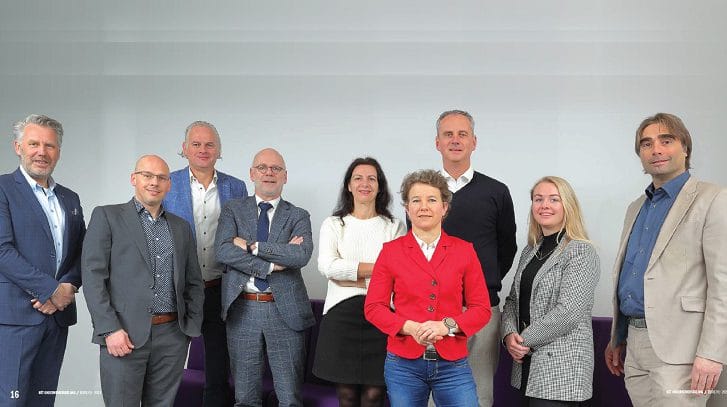
At the table were:
- Ronald Leushuis, Talis director and host;
- Caren Schipperus, managing director of ALEX Lawyers;
- Carol van Eert, mayor of the Municipality of Rheden, administrative principal of the Task Green Growth Region and member of The Economic Board;
- Rob Hagemans, managing director of Hagemans Property Maintenance;
- Jeanne van de Klok, managing director of WIL Group;
- Vincent Jansen, director of Energy & Sustainable Management at Ariens Partner in Property Maintenance and director of Energy & Sustainable Management at Hendriks Bouw & Ontwikkeling;
- Ina Hol, director WerkBedrijf Rijk van Nijmegen;
- Rob Withaar, commercial director at Talen Property Maintenance;
- Joep Burghouts, market development process owner at The Variable, a company also in property maintenance.
In fact, the complete triple helix was at the table, with education represented by two non-educational institutions: the work company and WIL Group. They both provide (re)training in different roles.
Technical solutions
Host Ronald Leushuis kicks off with the proposition:
'Making all homes natural gas-free will only succeed if a reliable technical solution that is affordable for residents is realised with government direction'.
He likes to explain the proposition: "Technical problems deserve technical solutions," he states. "The sustainability task is in fact a technical one, which in my view is made far too political. That makes it much harder to explain to people why sustainability is needed. Too many parties get involved when, for my taste, they should be more restrained. Because that makes the technical task far too complicated. Sustainability is better off with less political attention."
Government is political, so how can government take direction without being political, according to Ronald Leushuis? "The government is much more than politics and also has implementing organisations. The government is also about the building code, setting criteria, translating policies and creating clarity. We greatly benefit from unambiguous solutions, mass is tills. There is far too much variation. That also makes it far too complicated in the triple helix sphere, which makes training difficult."
Too many innovations
Jeanne van de Klok can only agree. She creates the new recruits for construction and engineering with WIL Group, and she finds that many of their people are seriously interested in sustainability and energy issues. The thesis she puts forward is:
'Making construction more sustainable will not succeed without (re)educating staff.'
"Frankly, we don't know how to frame that," she says. "What we need is a short summary from the construction of unified solutions on sustainability. Then we will come up with the programmes." WerkBedrijf is struggling with similar issues. "Together with the trainers, we are constantly looking at how to train for the new professions," clarifies Ina Hol. "Some things can still be explained, such as modular construction, but how should we explain to them what the work will look like in the future?" The multitude of new innovations and the pace at which they see the light of day are not helping to accelerate the transition to sustainable and circular construction, is one of the conclusions.
Still, Vincent Jansen believes there are successful parts in, for example, the energy transition. "Think of the solar panels and heat pumps. The central government has created a subsidy pot, ensuring affordability," he outlines. "We have trained a lot of people to install solar panels and air-source heat pumps. It's manageable, we get it. You could do the same with circular building."
He says he read in Talis' annual plan that the corporation wants to apply a circular solution. "As partners, we should think about what solution that should be. It should be affordable, so if we jointly select two to three applications, we could offer them to Talis." He realises that those solutions would of course have to meet all kinds of standards. "But circular applications have already passed that inspection."
The transition to sustainability is better served by less political attention
Opportunities and business models
Vincent Jansen sees another important condition to make circularity applicable in construction. "As builders, we need to start realising circular storage. Say Talis is going to demolish houses, you would want to store that demolition material somewhere, earmark it properly and use it again in the next project. For that, you then need a circular platform together with clients, builders, demolishers. Hendriks already has such a platform. That also means you need to train people to know which materials you can reuse in which way."
Jeanne van de Klok thinks we should not talk too much, but just roll up our sleeves. "For instance, I am working with Rob on re-harvesting products and we put people to work on that. For example, using materials from demolition in home repairs. There may be all kinds of rules, but if we just start, we will take out the teething problems," she suggests.
In this context, Rob Withaar often sees the solution very close at hand, but regulations often get in the way. "Starting point of circular economy is reuse of materials in construction and renovation. But legislation stands in the way of this because certain products do not yet comply with standard labels sizing or availability of materials," he believes. He cites the example of farmers in North-East Polder where he is trying to entice them to grow flax and hemp as building materials. "If we give farmers production security, they might want to join us in growing flax and hemp. But then farmers say their other crops will be compromised because they bring in much more in European markets. So you are caught in a system of interests," Rob Withaar clarifies.
The lawyer in the room does see opportunities in this example if expropriation were to take place because of nitrogen. "Before you get to expropriation, you always have the amicable process, and so then you can make agreements. You might be able to use the money that was meant for buyout or transformation to finance the non-profitable top in this transition phase." That would be nice, but is still a long way off Rob Withaar thinks aloud. "The farmer also has to move on at the moment."
Cards on the table
“Just like farmers, we’re struggling with the revenue model,” observes Joep Burghouts. “Nobody is taking the initiative. Nobody wants to be the first to take the plunge, because their livelihood is at risk. I’m calling for more leadership at government level.” He compares it to the phasing out of internal combustion engines, where the government did take the lead and introduced binding legislation. “The ink wasn’t even dry before Mercedes, Audi and the like were immediately moving towards electric cars.” Nevertheless, he and De Variabele, together with their partners, are taking an important step – the first hurdle. “Together with Takkenkamp Groep and Factory Zero, we’ve developed a concept called CTRL2050. We each have our own revenue model. With this concept, an existing home can become gas-free in one fell swoop. Technically, it complies with the housing associations’ guidelines,” he explains. “We’re laying our cards on the table and have shared it as open source. So anyone is free to use the concept, because we can’t pull it off on our own anyway.”
From project to programme
Ronald Leushuis is also wary of experimenting with housing associations. “My tenants don’t want to be guinea pigs,” he makes clear. Fortunately, things are going well in some respects. “Over the past few years, we’ve been able to make 7,500 homes more sustainable, meaning our housing stock now has an average energy rating of B. I’ve mainly explained to my tenants what the benefits of the insulation strategy are for them. So, even with new innovations, we need to explain how the tenant stands to gain from them. What’s the appealing prospect? I think that if Joep has a technically sound solution for improving sustainability, he doesn’t need to convince me. He needs to come into that meeting room with me to explain it, and if it fits into my revenue model, then I’m happy to go ahead with it. I’m very pleased, for example, that the municipality of Nijmegen is installing a public district heating network. Here, the local authority is taking the lead. I can explain to my tenants what we’re going to do.” Joep Burghouts is keen to join him in those meetings. “Thirty per cent of Ronald’s tenants are connected to the district heating network. So if we come up with an all-electric concept, we can reduce gas consumption by a further forty per cent,” he argues. But he sees a need to move away from working on a project-by-project basis, as the various parties – including his own – are currently accustomed to doing. “Ideally, innovations should be made available as open source, and we should turn them into programmes rather than running projects.” That is also Rob Hagemans’ view. “Thinking in terms of projects is still the norm throughout the entire chain – from planning and financing right through to production,” he says. “And this project-based thinking leads to delays, meaning that the transition to sustainability is progressing too slowly.” That is what he meant by the point he raised: “The enormous challenge of making the housing market more sustainable requires a fundamentally different way of thinking throughout the entire production chain: from project to process, from process to programme.”
The halls in
For Ronald Leushuis, the small meeting rooms filled with tenants are synonymous with the practical applicability of a particular solution. “We are realising dreams and ideologies at this table,” Ronald Leushuis emphasises. “But reality gets in the way. If you no longer take reality into account in the changes you’re talking about, then nothing will happen.” Carol van Eert agrees: “What I’ve learnt above all today is that we need to go back to the small meeting rooms. We have good regional cooperation here, and housing associations have also been working together for a long time. I believe we need to focus on finding a few solutions together within the region that will ultimately help us.” Yet Ronald Leushuis cannot get everyone into those small meeting rooms. “We need to stay as far away from those small meeting rooms as possible, because we act like a red rag to a bull due to the perception people have of us,” says Caren Schipperus. “We lawyers need to facilitate solutions. But for me, a reality check is at the top of that list. What is the problem you want to solve, and is that also the problem of the person you’re trying to talk to?” She cites the example of a sand quarry operator who wanted to expand. Local residents had been complaining about the traffic for years. So he approached them with a solution to the traffic problem and was able to expand without opposition. “The conversation we’re having here is very different from the one taking place on the street. Yet the interests are often the same. If you talk to one another outside the realm of politics and away from the cameras, you can always find common ground.”
Ina Hol also sees a role for WerkBedrijf. “We need to be able to explain to our people why it is so incredibly exciting to work in this sector. There are 15,000 people in this region who could make a great career move. We’re going to explain it, make it more concrete and present it more convincingly. That way, we can link a social problem to the challenge.” Jeanne van de Klok is involved in a similar initiative with WIL Groep. “I’d like to ask the clients, the housing associations and the co-creators: if you have an action plan, please share it with us so that we can train our staff,” she says. “It would be absolutely brilliant if we could train a housing association’s tenants and then deploy them in their own homes. But unfortunately, we can’t get past the front door.”