Lifeport Cool Lab is a project within the Healthy Green Growth Regional Deal. Five local authorities and HAN University of Applied Sciences are jointly investigating which interventions in public spaces are most effective in combating increasing heat stress and how best to involve local residents in this process.
Gerd-Jan Oud is a policy officer and lecturer at the Centre for Multiple Value Creation at HAN University of Applied Sciences and has a background in architecture. As the lab’s coordinator and project leader, he uses examples to explain how this research into cooling is progressing.
The Mosterdhof in Westervoort
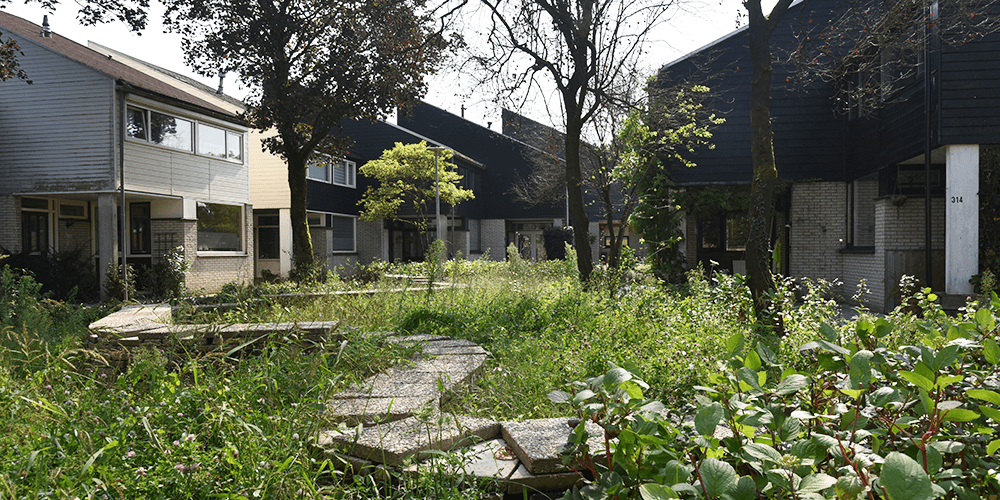
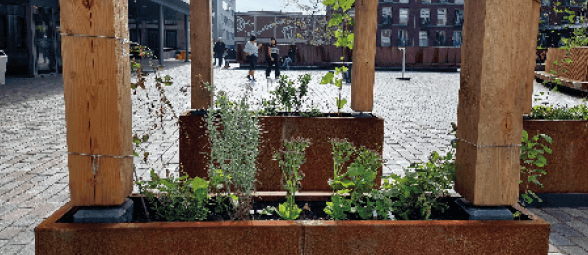
Oud begins by talking about a 1970s housing estate in Westervoort: Mosterdhof. “This estate was already quite green. The residents were involved in the plans and what they mainly did was to green the courtyards. Residents were invited to submit ideas, which were then developed in collaboration with a design agency. Our students looked into possible additional greening measures. This led them to the idea of a green urban pergola as a shaded meeting place.
What we’re now going to investigate further is how that participatory process with the residents went. What can we learn from it? How can a local authority better support such an initiative? What sort of initiatives should you take, and which ones are best left to residents? Questions like these play a role in all our projects.”
Sharing knowledge
The Lifeport Cool Lab project is designed as an ongoing knowledge-sharing initiative to exchange experiences. An initial meeting with the participating local authorities and researchers will take place in Westervoort in early February to evaluate this first pilot.
How did this participatory process go, and what about aspects such as planning and technical implementation? And what advice do the visiting local authorities have? The group will also take a walk through the neighbourhood to see how it has turned out.
In principle, this project is for and by the municipalities of the Green Metropolitan Region. However, Oud is also involved in research conducted by the Netherlands Climate Research Initiative (KIN) of the NWO. This is a national network that also addresses these issues. The results will also be shared within that network, thereby giving them a wider reach.
Croydonplein in Arnhem
Oud continues: “And I’m currently working with a group of students in Arnhem. The project involves greening Croydonplein. It’s a paved square that’s set to becomeCroydonparkplein. The design plans were drawn up in consultation with local residents.
The students are now carrying out participatory research using the ‘Leefplekmeter’. This research tool (a questionnaire) is used to assess how residents rate their living environment. It looks at their views on mobility, green spaces, amenities, and so on. This is the so-called baseline measurement, and in three years’ time, once the project has been completed and the square has been greened, we will carry out another measurement. This should reveal whether people feel more positively about their living environment following the greening.”
Participation
It is a challenge for local authorities to organise information and participation. There are tried-and-tested methods for this, but the trick is not to raise expectations too high. Having a say in something does not always mean that your idea will be reflected in the plans. However, under the new provisions of the Environment Act, local authorities are required to allow people to participate more.
“So that is certainly an area requiring attention. Particularly with transition projects of this kind, which are highly complex undertakings. So local authorities can still learn a thing or two from one another about the associated participation processes – what works and what doesn’t.”
Green corridor in Nijmegen
Oud cites another example: "And we will also start work on the Green Corridor in Nijmegen in February 2025. That study will also run for six months and is actually more of a participation study, we want to look together with residents at the plans being made for that greening and how they can influence it. Then we look at how participation with residents works in practice, what kind of things we can learn from it, what goes well and what doesn't go well."
Roadmap
Afterwards, the aim is to see how municipalities can create some kind of roadmap or roadmap, including a communication plan, and use it in subsequent projects.
Herveld and Andelst
Oud is also working with students in Herveld and Andelst in the municipality of Overbetuwe. Our students have now been involved in reviewing a participation plan drawn up by the local council. How could this be done with residents? How could that communication be structured? How could residents be encouraged to participate in the project? So that participation process still needs to be launched there in the municipality.
And soon there will be a follow-up group that will look at a number of practical matters, for example through a ‘neighbourhood safari’, in which they will visit locations in the neighbourhood with residents to generate ideas.”
Multidisciplinary
“The students’ backgrounds vary greatly here. Sometimes they have a financial or economic background, sometimes students come from Van Hall Larenstein, and sometimes people with a technical background. We also regularly welcome students from the Food & Business programme.
They work on what we call a ‘common thread’ project. In these, around four students from different backgrounds are mixed together in a team. The idea is that they approach a problem from multiple perspectives. It’s multidisciplinary. And from that perspective, they also look at that multiple value creation.”
The lecturers also come from different disciplines. Several researchers are involved in the project, for example a lecturer from the social sciences, who is used to running this sort of participatory project in neighbourhoods and residential areas. In addition, there are lecturers specialising in business communication – they are communication specialists. They focus in particular on the communication aspect and the roadmap, and are also accustomed to advising local authorities on these kinds of matters. Naturally, lecturers from the Centre for Multiple Value Creation at HAN University of Applied Sciences are also involved; they have specialist knowledge of the circular economy.
The Lifeport Cool Lab project
Goal
Reducing heat stress.
Sponsor
Gerd-Jan Oud, Centre for Multiple Value Creation HAN. He has been preparing and setting up for almost two years. Does accountability and state aid assessment.
Funding
Half of the funding comes from the government, the decision has been made, and the other half is co-financing by the participants.
Participants
Five local authorities: Arnhem, Nijmegen, Heumen (Malden), Overbetuwe and Westervoort.
Educator: HAN.
Subprojects
At five locations, researchers and students from the HAN are testing various climate adaptations, or green interventions.
1 Arnhem
2 Nijmegen, Green Corridor
3 Malden (municipality of Heumen), Kerkplein
4 Herveld and Andelst (Overbetuwe municipality)
5 Westervoort, Mosterdhof
6 The sixth subproject concerns collecting and sharing the knowledge gained.