The challenges in health and welfare are great. Demand is growing and the workforce is under pressure. In addition, people are more focused on shaping their own lives and living independently for longer. Technology can help. But in practice, many technological solutions do not yet fulfil their promise. Not because they do not exist, but because knowledge and experience on adoption and implementation are not yet widely shared and innovations are not optimally applied and scaled up.
In the Arnhem-Nijmegen region, HAN,Tech@doptie ( a joint initiative of Rijn IJssel and ROC Nijmegen) and Health Valley are working together to increase adoption. They are joining forces to create an ecosystem that genuinely helps healthcare and welfare organisations by developing and sharing fragmented knowledge and experience more collaboratively.
Much is already there but it remains fragmented
Anyone looking at the region will see a wealth of opportunities. There are innovation labs, research projects, training courses, pilot schemes and practical applications. Yet this wealth of resources is by no means always utilised. “There’s a great deal on offer,” says Jeltje Kok, Associate Practor at Tech@doptie, Rijn IJssel. “But everyone is reinventing the wheel.”
Organisations often work in parallel on similar issues, without knowing from each other what has already been developed or learned. Smaller organisations in particular suffer from this: they have less time, less capacity and often no innovation department of their own. The result? Good ideas get stuck in pilots. Knowledge gets left behind. And technology does not reach practice sufficiently.
From separate initiatives to one movement
The‘Samen Slimmer’ project examined the bottlenecks and challenges in the region. The conclusion is clear: the greatest challenges lie not in the technology itself, but in the processes and people required to scale it up following adoption.
In Tech@doption, the next step is discussed. How will we build a regional ecosystem around the adoption and implementation of technology in health and well-being? What focus do we bring to it to get more cooperation in this area?
The real challenge: from pilot to practice
Getting innovations off the ground is often still possible. But things get tricky after that. “Progress often stalls after a pilot,” says Charlotte Lommen, project leader at HAN Academy for People and Society. “Who takes ownership? How do you ensure something is embedded? How do you scale it up?”
Many organisations lack the conditions to use technology structurally: employees are not always sufficiently digitally literate, there is no clear direction, management is not always involved and knowledge about what works is missing or hard to find.
Implementation is especially difficult for smaller organisations. They often have no ICT department and little room to experiment.
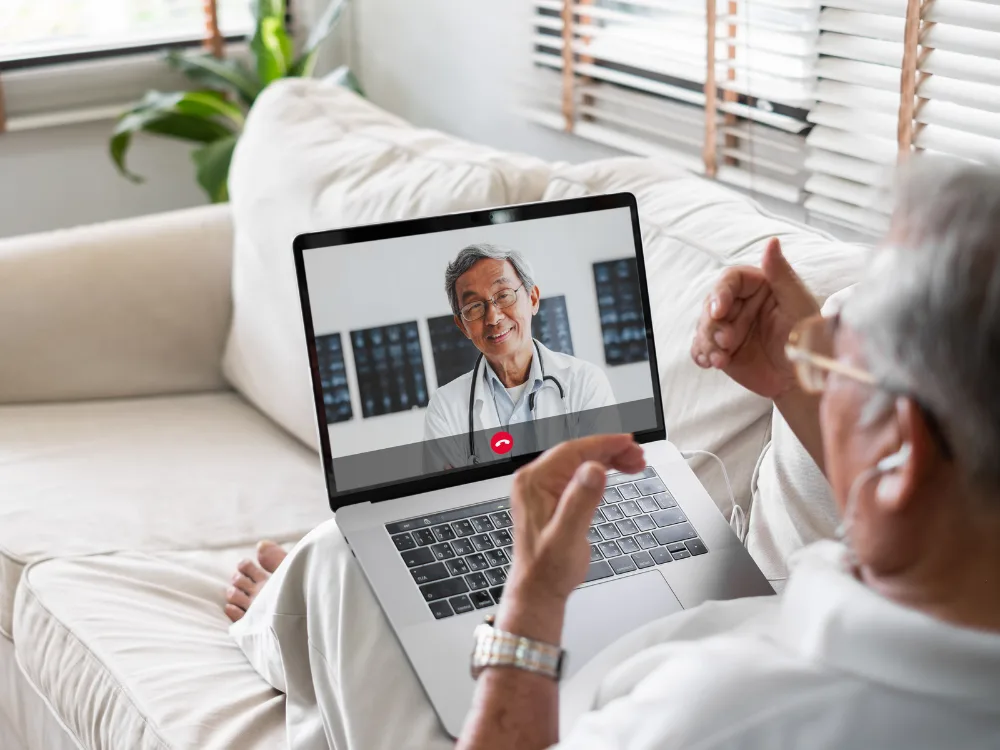
Technology as a means for health and wellbeing in one's own living environment
In the adoption approach of the cooperating partners, technology is emphatically not the focus as an end, but as a means. The starting point is always the question: what do people need to live independently in the neighbourhood for longer?
This may involve very different applications: apps to better organise informal care, tools for day structure, such as Tessa or Compaan, digital support for exercise or sleep, medicine dispensers or applications such as the Floortje app, which helps people maintain their own control.
In addition, there is growing interest in new technologies such as AI, which can, for example, support administrative processes or relieve healthcare professionals. But whatever solution you choose: in the end, what matters is that it fits daily practice and can be sustained in the long term.
Learning together what works (and what does not)
A key aim of this collaboration is to build shared knowledge – not just theoretical, but practical too. What works in a specific context? What doesn’t work, and why? When is a technology truly valuable; when does it really deliver results, and for whom? At HAN, for example, work is being carried out on methods to better determine the value of technology.
And how do you make an organisation‘innovation-ready’? Is an organisation even ready to innovate in the first place? Because if innovation rests on the shoulders of just one person, it often falls by the wayside.
“You need the whole organisation,” says Charlotte. “From the shop floor to management.”
Concrete support: knowledge, training and a counter
Although the joint ecosystem is still under development, there are already many concrete offers. Think of training in digital skills, implementation support, research into adoption and scaling up, guidance in innovation processes.
To make this more accessible, an important first step has been taken: a joint counter. Through this digital counter, care and welfare organisations can ask questions, discover the offer, indicate that they want to participate and get in touch with the right partners
Behind that counter, the various organisations work together. The goal: one entry point, instead of a fragmented landscape. "If something doesn't fit exactly yet," Charlotte stresses, "then we look at how we can make it fit."
Towards a regional ecosystem
The coming period is all about further shaping a regional ecosystem. This involves fundamental questions. Such as Where does the direction lie? Which themes are given priority? How do we ensure continued cooperation? And how do we organise ownership?
It also requires something from the organisations involved themselves. Thinking less from their own interests, more from the common goal.
"You have to be willing to provide a piece of the puzzle," says Jeltje. "And to take responsibility together."
An invitation to the region
Although the first steps have been taken, the movement is still developing. There are many organisations in the region, from large healthcare institutions to small welfare initiatives, that could still join.
The call is therefore clear: join in. Whether you are looking for access to knowledge and experience, support in innovation and implementation or cooperation with other organisations. It is ultimately about better care and support in the neighbourhood.
Or, as Charlotte summarises, "By working together on the whole trajectory from innovation to scale-up, we can deploy technology faster, better and more effectively and make a real difference."
Would you like to get involved or do you have any questions? Visit:techadoptie.nl/kennisloket
Building tomorrow's care together
The transition in care and welfare not only requires new technology, but especially new ways of cooperation. In Lifeport Regio Arnhem Nijmegen, that movement has already begun. Sharing knowledge, combining initiatives and acting together will create a stronger foundation.
Not perfect. Still developing. But with a clear direction: from fragmentation to cohesion, from single pilots to sustainable application, and from technology as gadget to technology as valuable support.
And ultimately it is all about people in the neighbourhood, who, with the right support, can live independently and with direction for longer.