Doctors should do what they do best
With its products, Thirona contributes to the automation of patient screening. More and more screenings are expected to take place automatically in the future. Van Rikvoort: "If the scan shows something abnormal, the patient only needs to be referred. This already happens, for example, in the national screening for cervical cancer in women. The analysis of the smear is done entirely by robots."
Only when an abnormality is found, a doctor comes into the picture. "It is important to take the screening of patients away from doctors. Then doctors can get back to doing what they are good at. Think about paying attention to people who are really sick, examining them and treating them. Of course, we still need doctors to properly interpret the images of the sick. Our tools, in addition to pre-screening, can be used to determine the final diagnosis more accurately or to draw up a treatment plan," Van Rikxoort further explains.
Products for triage Covid patients
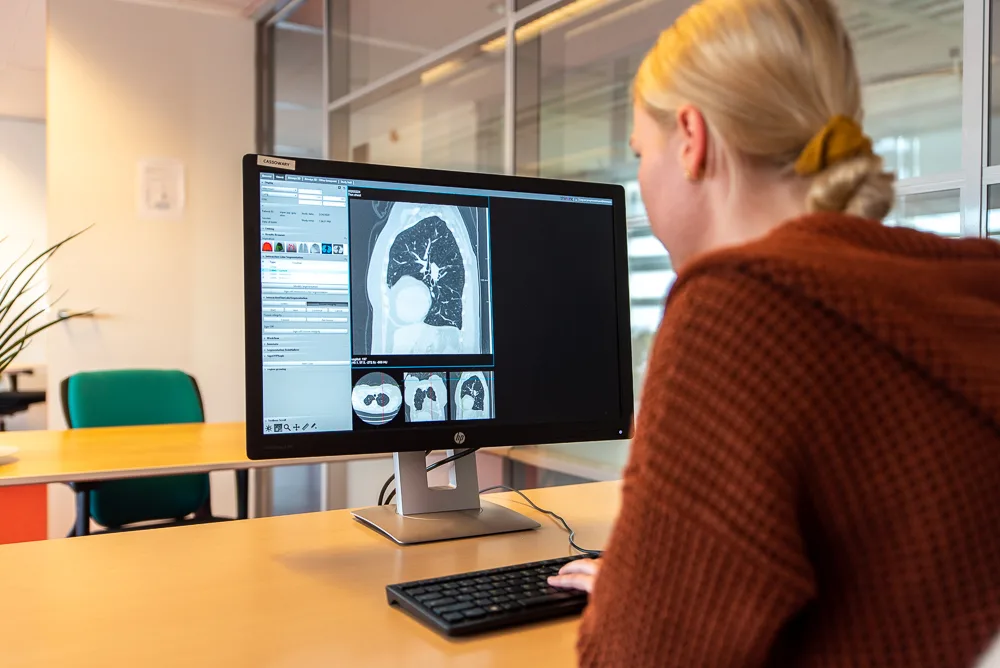
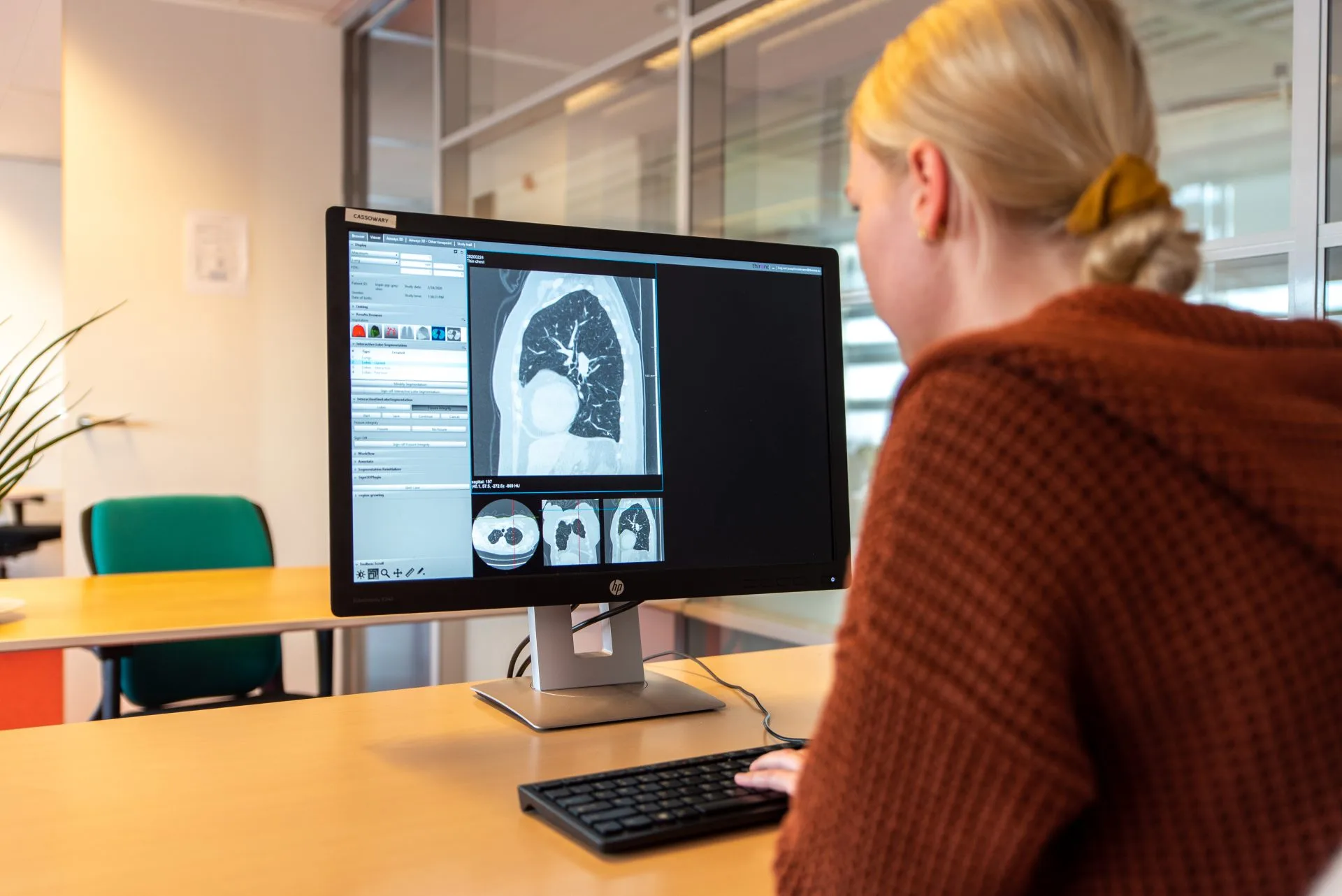
In March, things were briefly tense for Thirona. As almost all healthcare was shut down due to Covid-19, revenues fell silent. However, it also provided another development. "Hospitals started using images out of necessity to see very quickly whether someone needed to be admitted and/or isolated. We figured out that lung images could also be used for triage, without the need for an official diagnosis. Now radiologists can use templates to score the patient's images. These help them make choices. Not so much whether someone has covid, but whether the patient can go home or needs to be admitted, for example."
To make this happen, Thirona worked with Radboudumc to collect images very quickly. Within a month, two AI solutions were developed, both for CT scan and X-ray. A month later, thanks to all kinds of emergency laws, these were already clinically certified. Van Rikvoort: "Immediately, we made our products available free of charge so that developing countries could also have access. We were happy to contribute something to this global crisis in this way."
The products are incredibly popular, she continues: "Due to the large amount of attention, it has also been picked up by the Dutch Investment Bank, which now provides financial support for the cloud solution. Larger companies have also picked it up. They ensure that the solutions are integrated into hospitals so that they can actually be used. This has put us in touch with potential users of our other products. That was not the intention, but is nice."
Substantial expansion
Thirona is considering expanding her portfolio to include more infectious diseases. She is also currently betting on chronic diseases, such as cystic fibrosis. "With that, we can add a lot to patients' health gains. People - often young - with these conditions are getting a lot older than before. We are mainly looking for niches. Possibly in the future, we will also develop software for other organs, but initially we are focusing on lung diseases."
There is still much to be gained there, as several lung diseases are in the top ten most common causes of death. To examine lungs, you always need images. A third of CT scans involve lungs. To meet all the requests, Thirona wants to expand significantly in the next two years. Preferably with people from the region, but that is proving difficult. "Most of my employees come from abroad. Coincidentally, I have just hired someone from Nijmegen, but that is an exception. Many people study AI and computer science here in Nijmegen, but do not stay to work in the region. Big companies pull them away, especially software developers and they are very scarce anyway.
I would therefore like to cooperate even more with the university and hospital to put our 'Health IT region' on the map. I would also encourage education to explain to students the differences between working for a start-up or a big company. There is a big difference between the two. They should spearhead that."


 Toernooiveld 300, 6525 EC Nijmegen
 info@thirona.eu