The first Lifeport Semicon Event on Tuesday 27 January will showcase groundbreaking innovations in the field of chips that improve the way we live and work. Experts from the business sector, government bodies, universities and other research institutions across Europe will gather at the Goffert Stadium in Nijmegen to exchange the latest innovations and knowledge.
Semiconductors are found everywhere, from our phones and cars to healthcare robots. Developments are happening at breakneck speed, such as artificial intelligence (AI) and all kinds of medical applications.
The Goffert Stadium in Nijmegen is hosting the Lifeport Semicon Event, and this is no coincidence: the home ground of professional football club NEC is just a stone’s throw away from NXP, which develops and manufactures chips used worldwide, and the Noviotech Campus, home to many other high-tech and semiconductor companies as well as promising start-ups. Together with Radboud University, this semiconductor ecosystem offers excellent opportunities to develop the chips of the future.
Second Semicon region
Lifeport Arnhem-Nijmegen Region, as the Netherlands’ second semiconductor region after Brainport Eindhoven, plays a leading role both nationally and globally. For example, there is not a single car in the world that does not contain chips from the region. Companies specialising in chip technology, particularly those focusing on medical applications, are also based here and collaborate with organisations such as Radboudumc and care homes.
Participants from the international business community and from universities in the Netherlands and Belgium will come together at the event to learn about the latest semiconductor innovations and forge new contacts. ‘With this event, we aim to strengthen this leading semiconductor region by reinforcing both local and international connections,’ says Bas Doets, programme manager at KplusV and Briskr.
Scientific breakthroughs
New scientific breakthroughs in chip technology, such as energy-efficient photonic chips that use light rather than electricity, as well as practical applications of semiconductors, can all be seen at the Lifeport Semicon Event.
Take, for example, the new generation of wearable medical devices (wearable health tech) featuring biosensor technology for asthma and heart patients, developed by the Nijmegen-based company Sencure.
Beethoven project
Representatives from the education sector and public authorities are also in attendance, informing visitors about interesting partnerships, grant schemes and the Beethovenproject, which aims to train some 3,880 technical talents for the national semiconductor sector in the coming years, 600 to 700 of whom will be based in the Lifeport Arnhem-Nijmegen region.
Doets: ‘The Beethoven project focuses on training young people, but also on providing further training for professionals in the semiconductor regions of Delft, Eindhoven, Arnhem-Nijmegen, Twente and Groningen.’
Looking to the future
Mayor Hubert Bruls of Nijmegen will welcome visitors to the Lifeport Semicon Event during the opening of the programme. Speakers Paul de Bot, President of TSMC Europe, and Christelle le Cam, Senior Director of Technology & Quality at NXP, will update the audience on the latest developments in the semiconductor sector.
Afterwards, visitors can choose from three rounds featuring fifteen different parallel sessions on a wide range of topics, from ‘The Chip of the Future’ and ‘Disruptive Technology ’ to ‘Tech & Talent’.
The event will conclude with a range of speakers sharing their perspectives on the future of the semiconductor sector.
Chip of the future
Semiconductor manufacturer NXP in Nijmegen is working on the development of the intelligent chip of the future, which, amongst other things, will make robots smarter and safer. Daan Daverveld will explore the development of this new generation of semiconductors in more detail in the parallel session ‘Chip of the Future, Robotic Innovation at NXP: Shaping the Future of Intelligent Machines’.
Daverveld works as a product portfolio & marketing manager at NXP and is a visiting researcher at Eindhoven University of Technology. ‘It’s about the current momentum and developments in robotics. The integration of “AI on the edge” is a key driver in this regard,’ says Daverveld. ‘The complexity of modern robotics and how we develop reliable chips for applications such as drones, service robots and mobile platforms will also be discussed.’
Disruptive Technology
Professor of Scanning Probe Microscopy at Radboud University Alex Khajetoorians is also one of the speakers at the Lifeport Semicon Event. He is hosting the parallel session Disruptive Technologies titled National Efforts in Neuromorphic Computing. Neuromorphic computing involves researching new materials for a next generation of super-efficient computers based on how the human brain works. Among other things, Khajetoorians uses a super microscope with the highest resolution in the Netherlands, which he uses to study the electronic and magnetic properties of materials at the atomic level.
Photonic memory technology
Internationally operating companies, as well as highly innovative start-up entrepreneurs, will be showcasing their work at the Innovation Square. One such young start-up entrepreneur is Irina Dolgikh. She studied physics and joined the Faculty of Science at Radboud University as a PhD student. Using a patented photonic memory technology developed by the university, she has since founded the company AIMA Technology.
‘As an entrepreneur, I can translate this scientific knowledge into an application that benefits society,’ says Dolgikh. ‘Photonics technology works using light rather than electricity. As far as we know, it is the fastest way to process information. This is important for ensuring the better and safer functioning of, for example, data centres and navigation systems in cars and aeroplanes.’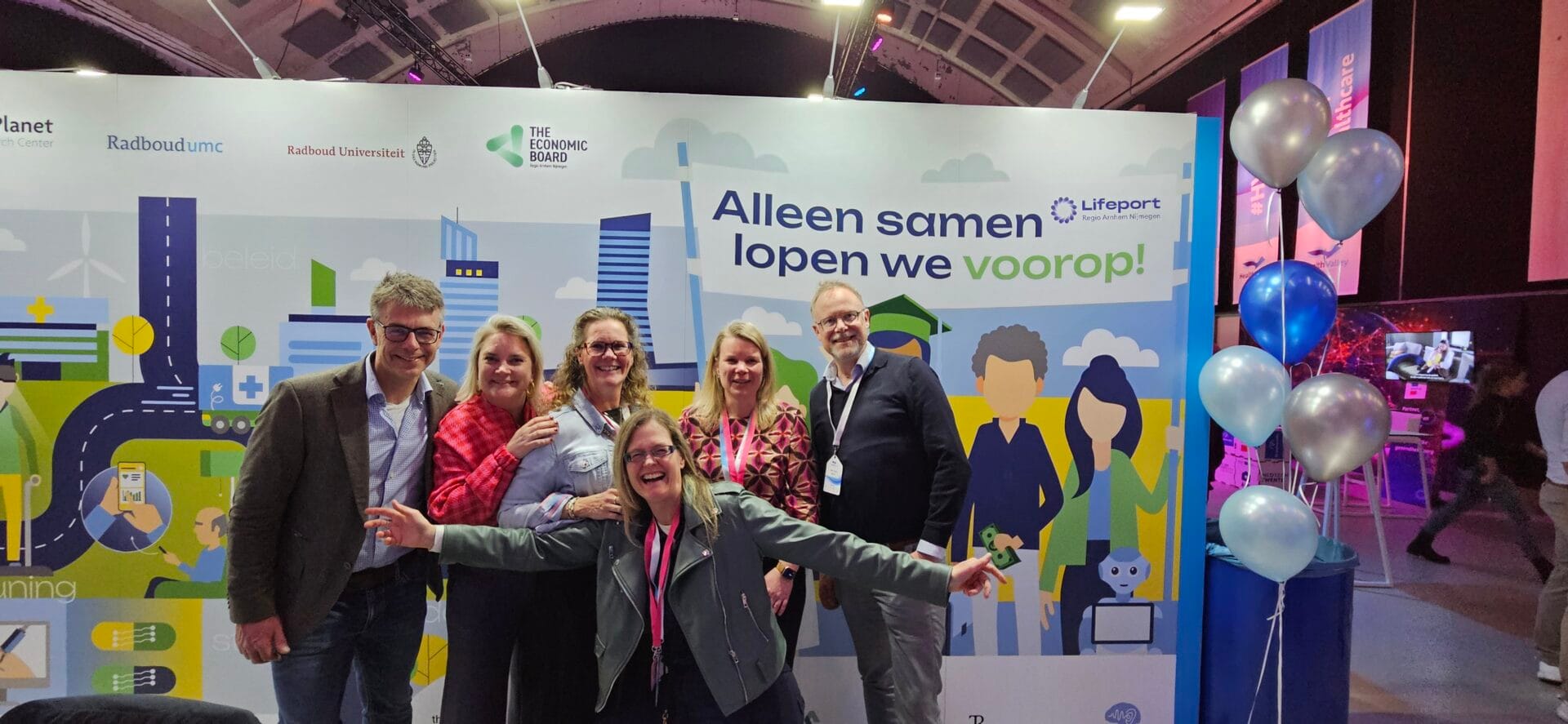 Bas Doets, Marieke Snieder and team members Briskr
Excellent opportunity
For the young entrepreneur, the Lifeport Semicon Event offers an excellent opportunity to build a network and make contact with potential customers. 'Such an event is crucial for me. Photonic technology is growing fast in the Netherlands and the Arnhem Nijmegen region plays an important role in this in Dolgikh's eyes. 'It is natural for me to locate my company in this region, close to Twente and Eindhoven. I want to stay close to the knowledge on photonic technology. Radboud University helps start-ups, such as AIMA, for example, with access to knowledge.'
First semiconductor factory
Students from ArtEZ University of the Arts in Arnhem have created a special historical presentation on the origins of the chip industry in Nijmegen, which will be on display during the Lifeport Semicon Event. The first semiconductor factory was built by Philips in Nijmegen in 1953. The semiconductor industry has therefore been established in the Arnhem-Nijmegen region for over seventy years.
‘The first chips were 16 microbits in size. We have a 16-metre-long drawing of the design of one such chip in the presentation,’ explains Marieke Snieder, communications & events at Briskr. ‘That’s a real artefact.’
Chip technology and Philips Semiconductors experienced rapid growth. Philips spun off its semiconductor activities in 2006, giving rise to NXP, from which companies such as Nexperia and Ampleon later emerged. The Arnhem-Nijmegen semiconductor region has grown up around these companies, comprising an extensive network of other chip firms and high-tech service and supply companies, which generate a great deal of economic activity.
Find out more: lifeport.nl/en/semicon-event-26