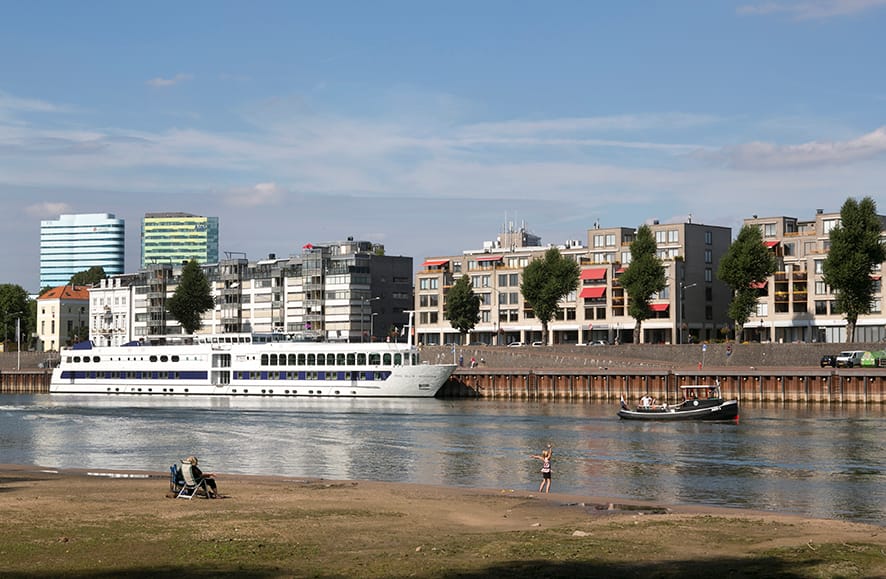
The development of technologies to use sustainably generated energy for households and industry is progressing faster in the Arnhem-Nijmegen region than almost anywhere else. ‘This region is a hotspot for the energy transition, particularly when it comes to electrification,’ says the newly appointed HAN lecturer Sadegh Seddighi. Together with his team, he researches and develops various methods of smart energy storage, having moved from Sweden to the Arnhem and Nijmegen University of Applied Sciences (HAN) for this purpose.
‘The Netherlands, but particularly the Arnhem-Nijmegen region, is leading the way in Europe when it comes to electrification,’ says HAN lecturer Sadegh Seddighi. ‘The development of technologies to store and utilise sustainably generated energy is progressing rapidly here. This is because businesses, knowledge institutions – such as HAN and Radboud University – and public authorities recognise the need and collaborate effectively. Other countries can learn from this, and we can sell that knowledge.’
Seddighi (47) moved to the Netherlands a year ago from Gothenburg in Sweden. He chose Lifeport Regio Arnhem Nijmegen to apply his knowledge of energy technology to the development of various types of energy storage. ‘There is no single solution for the energy transition. Various innovative technologies need to be developed.’
Seddighi was appointed as Professor of Balanced Energy Systems at HAN University of Applied Sciences in Arnhem on 27 November. He brings a wealth of knowledge and an international network with him. The professor has collaborated with leading companies in the energy sector in Sweden, Finland and Asia. He also represented Sweden for some time at the International Energy Agency (IEA).
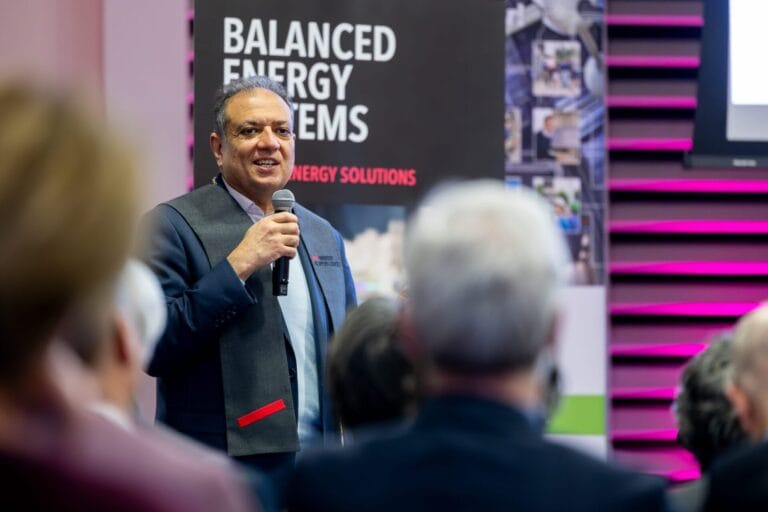
Sadegh Seddighi
From Sweden to the Netherlands
Seddighi lives in Nijmegen with his wife and son (10). ‘We’re happy with our move and our home. The people are friendly, and we’ve been made to feel very welcome in our neighbourhood. Sweden and the Netherlands have a lot in common, but I find the language beautiful and, at the same time, more difficult,’ says Seddighi, who speaks fluent Swedish. His son is enthusiastic about his school in Nijmegen and plays football for a local club. ‘He already speaks better Dutch than I do, but I can understand it quite well.’
The lecturer appreciates the Dutch directness, he says with a laugh. ‘It did take me a while to get used to it. The Dutch are a lot more direct than the Swedes. But that directness works: giving good feedback yields good results.’
Region as a living laboratory
Grid operators, such as TenneT and Alliander, are busy solving the congestion on the electricity grid (grid congestion). Laying more and thicker cables in the ground is one way to get the energy transition done. Smarter systems are also needed to enable the transmission, storage and distribution of electricity, Seddighi stresses. 'That is something that has been worked on here for years. In fact, the region functions as a living laboratory in the field of electrification. There are experiments with innovative energy technology at research institutes and companies, as well as in residential areas. Therefore, from my perspective, this is the best place to work.'
HAN at Cleantech Park Arnhem
Seddighi can often be found at HAN@Connectr in Cleantech Park Arnhem (formerly Industriepark Kleefse Waard), where the HAN Hydrogen Lab and the Power Lab are based. ‘These are excellent labs where we conduct research with our students and collaborate with many companies, such as Nedstack, HyGear and Elaad. This enables us to work together to train the professionals that companies in the energy sector need.’
Together with a team of researchers and lecturers, the professor is working to accelerate the energy transition. This involves collaboration with the Sustainable Electric Energy Centre of Expertise (SEECE); a public-private partnership between HAN and the energy-related business community. ‘Grid congestion is putting us under pressure. A lot of hard work is going into developing new technologies,’ says Seddighi. ‘The great thing about this region is that it’s not just about ambitions; people are already working in practice on solutions that are making a difference to the world.’
Storage key energy transition
Storing sustainably generated energy is key in the energy transition, says Seddighi. He is working on innovative ways of storing energy, such as in batteries for the short term and chemical storage for the longer term in, for example, hydrogen or methanol. He stresses that the energy transition is not only a technical challenge, but also has a social side. 'We are looking for resilient and affordable systems so that electricity remains available to all people.'
Cooperation with companies
It is the first time in history that so much sustainable electricity is generated in the Netherlands using wind and solar energy, Seddighi notes. Traditionally, Arnhem and its surroundings have been home to important energy companies, think KEMA and grid managers TenneT and Alliander. Hence, there is a lot of experience and practical knowledge, even among smaller companies in the region, Seddighi argues. For example, he works with Roel and Luc Bleumer's Volta Energy in Duiven, which develops and builds mobile solar energy systems. 'With innovative companies like this, we are doing research into converting solar energy into hydrogen and then into methanol. That is a chemical way of storing energy in liquid, which is easier to transport.'
Sustainability and economy
Seddighi's motivation to work on energy technology is not only related to his interest in engineering. For him, it is also about sustainability, economy and a social society. Seddighi was born in the city of Yazd located in a desert region in central Iran. 'Yazd is more than 3,000 years old. From my parents and grandparents, I was taught to live sustainably because of the lack of water and the high temperatures of up to 40 degrees Celsius in summer,' says the lecturer.
City of wind catchers
‘To cool the air, the city’s inhabitants designed and built stone towers long ago, which they call windcatchers. Yazd is also known as the city of windcatchers.’ Seddighi shows some photos of windcatchers in his hometown on his laptop.
With a smile, he says: ‘For me, sustainability isn’t a choice, but a way of living in harmony with nature and at peace with other people.’
Availability and affordability
The innovative systems developed to enable the energy transition must therefore not only be smart, but also resilient and affordable, Seddighi reiterates. 'In my view, expensive solutions are not acceptable because they are not affordable for everyone. That's how you create energy poverty. So we have to be extra critical, the current systems are too expensive. We need to develop solutions that really help people.'
About Sadegh Seddighi
Sadegh Seddighi completed a Bachelor’s degree in Mechanical Engineering at Sharif University of Technology in Tehran, Iran. He subsequently worked for energy companies in Japan and South Korea.
To further his expertise in ‘cutting-edge’ energy technology, he moved to Sweden in 2007, where he completed a Master’s degree in Mechanical Engineering at the KTH Royal Institute of Technology in Stockholm. He later went on to complete a PhD at Chalmers University of Technology in Gothenburg.
Seddeghi has worked, amongst other roles, as a civil engineer and project manager at leading industrial companies active in the energy sector. He has also worked as a research scientist on projects with energy companies in Scandinavia, Europe and Asia.
He represented Sweden at the International Energy Agency (IEA), specifically on initiatives relating to energy diversification.
@Francien van Zetten