A new co-creation platform for SME entrepreneurs who wish to become (more) circular will launch in February 2025. This Lifeport@ Circular Innovation Hub has been set up by the Lifeport@ organisation and forms part of the Healthy Green Growth Regional Deal.
Merijn Neeleman is the project initiator and talks about the hub.
“As soon as an entrepreneur decides to adopt a circular approach, a whole range of issues arises. In this new innovation hub, various entrepreneurs work together on their specific cases during a series of meetings. They do this through co-creation with knowledge institutions and public authorities. The participating companies – currently eight in number – have themselves identified their specific challenges.”
All participants will come together for a series of masterclasses and workshops, field trips and presentations from February to July, spread over ten mornings and two afternoons. The outcomes will be assessed with the help of the academic and educational sectors.
Knowledge and research
The entrepreneur is central and gains broad and up-to-date knowledge on circular entrepreneurship. To this end, experts from science and the field share their knowledge on relevant topics. Students from both knowledge institutes also get to work to develop the cases into an appropriate circular strategy and to find practical solutions. The outcome is for a much broader group of interested parties and is also shared transparently.
The Mesh Halls
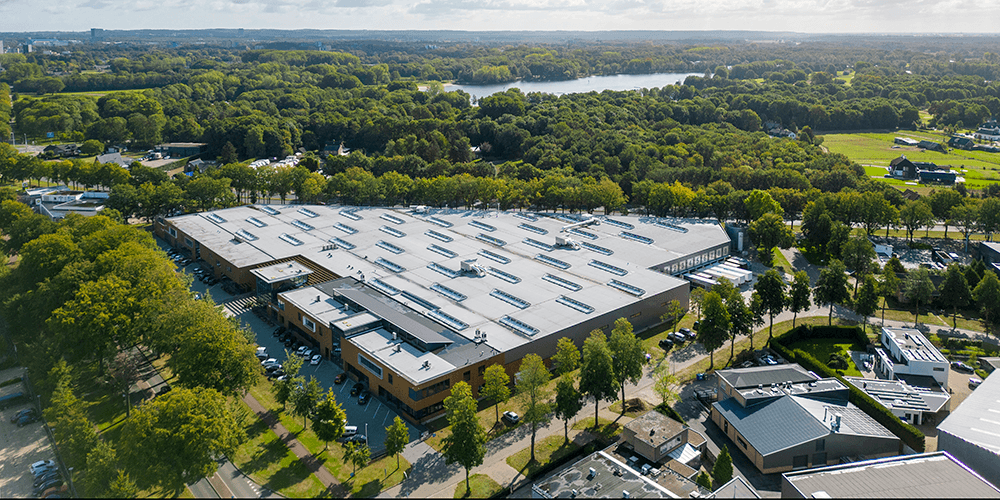
Its permanent physical location is De Meshallen in Wijchen, a ‘centre for networking, knowledge-sharing and inspiration in collaboration with knowledge institutions’, according to owner Eromesmarko. This company manufactures educational furniture using sustainable methods.
It is making the premises available, at cost, for the activities of the new innovation hub.
A case study: making circularity measurable
One of its many case studies is that of Road2Work. This is a social recycling company for e-waste. It has a partnership with Nijmegen-based Dar, which does waste management and public space management.
Neeleman goes into a little more detail about this collaboration. “Dar collects electronic waste from businesses, such as discarded equipment, laptops and chargers. Road2Wok checks the material, takes it apart, cleans it – both digitally and physically – reassembles it, certifies it and thus converts it into new equipment. This includes new, fully functional laptops. It then sells these, for example, in emerging economies such as Africa and Eastern Europe, where they are very welcome. And it can command a good price for them there too.
This means Road2Work already has a fully viable circular business case. The aim now is to be able to quantify this. How much do you actually save in terms of CO₂, energy and water through this activity? If it can provide that data to the organisations supplying the ‘waste’, they can then include it in their CSRD reports.”
Neeleman is in contact with an expert in life-cycle analysis at Radboud University. “He’s also coming to give a masterclass. So that’s an example of a company that’s already on the right track, but still has questions, and how science can help with that.”
Harvesting waste and clarifying digital footprint
Neeleman cites two further examples of submitted case studies to illustrate just how broadly the concept of circularity impacts businesses.
“Synprodo produces circular polyurethane foam and is looking for ways to ‘harvest’ waste – the raw material for the foam. So we’re going to look at: How do those flows work? How do you know when what is available? How do you get it on time?”
A second example is the software company Monkey Vision. “They’re very interested in the digital footprint, quantifying it and raising awareness about it. People often have no idea how much of an impact it has on the climate when you look things up online. When you get into your car, people understand the impact, but not when you’re searching on ChatGPT – then people have no idea what that means. And they want to gather information on this, in collaboration with the scientific community, and turn it into a model that can raise awareness of the issue.”
More information
“We’ll be holding many more sessions like this in the future, on this topic and others too. Are you interested? Then get in touch!”
Merijn Neeleman
Project Coordinator, Lifeport@ Innovation Hub Circular
06-24243216
merijn.neeleman@lifeporthub.nl
www.lifeporthub.nl