For women who lose part of their clitoris due to vulvar cancer, a clitoral reconstruction procedure has been developed for the first time. This comes forty years after the first penile reconstruction. The results for the first group of patients are promising.
Surgery for vulvar cancer can save lives, but it can also significantly alter women’s sex lives. ‘When the tumour is located in or around the clitoris, we sometimes have to remove part of it,’ explains gynaecological oncologist Mieke ten Eikelder of Radboudumc. ‘Until now, the wound was closed afterwards and the clitoris disappeared beneath a layer of skin. No consideration was given to quality of life or whether an orgasm would still be possible.’
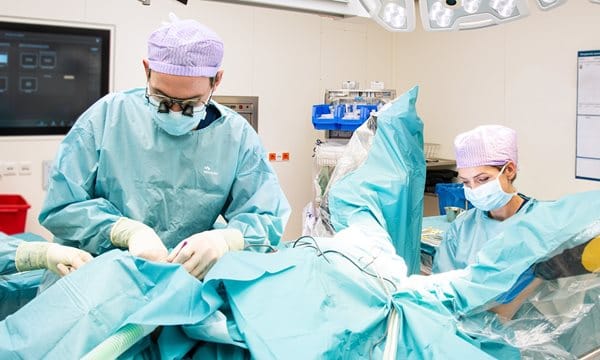
The first reconstructive operation for the penis following cancer dates back to 1987. It is high time to develop a method for restoring the sexual function of the clitoris as well. Plastic surgeon Tim Nijhuis therefore devised a new surgical technique together with Ten Eikelder. Nijhuis: ‘As soon as the tumour has been removed, the nerve bundles are detached and repositioned to form a new tip of the clitoris. We then cover this with a piece of cheek mucosa. This is because cheek mucosa resembles the tissue in the vulval area.’ In this way, the sensitivity of the clitoris is preserved.
Clitoral orgasm
Of the first 23 women with vulvar cancer who underwent surgery to reconstruct the clitoris, 90 per cent were able to experience a clitoral orgasm again after the operation. This occurred three to six months after the operation. Ten Eikelder: ‘At first, the clitoris is sometimes a little hypersensitive or, conversely, less sensitive, but after a year, recovery is complete. We find that for most women, sensation returns to what it was before the operation.’
In the Netherlands, around 450 women are diagnosed with vulvar cancer each year. In a quarter of these cases, the clitoris or the surrounding area is affected. Reconstructing the clitoris requires an additional fifteen minutes of operating time for these women. As well as for vulvar cancer, this reconstructive technique can also help following genital mutilation.
Training other centres
Clitoral reconstruction is now being rolled out nationwide as part of a scientific research programme. In addition to Radboudumc, eight other hospitals treat vulvar cancer. They are all taking part in a follow-up project, in which gynaecological oncologists and plastic surgeons are learning the new technique. In addition, Nijhuis and Ten Eikelder are currently training specialists from abroad.
The initial results are promising, but the researchers emphasise that they need to investigate the technique further. They will therefore, in collaboration with other Dutch hospitals and with financial support from KWF, investigate whether the recovery actually leads to improved sexual function and quality of life, and how they can apply the technique safely and effectively in day-to-day care.
More information
If you would like to know whether this surgical technique is suitable for you, please contact your treating doctor. Patients can be treated at Radboudumc, or in the near future at other centres in the Netherlands as well.
The results for the first 18 patients are described in this publication:
Clitoral reconstructive surgery for patients with vulvar carcinoma. Ten Eikelder M, Veldmate G, Pettai F, Schepens-Franke A, de Hullu J, Nijhuis T. DOI: 10.1016/j.ygyno.2026.07.013.
This article originally appeared on Radboudumc