Healthy Landscape is the name of a consortium based at Radboud University, in which various partners collaborate on ecological solutions for a liveable region. This is done in a multidisciplinary manner, ranging from legal to medical sciences and from ecology to urban planning.
Hans de Kroon is a professor of ecology at Radboud University and the initiator and project leader of the consortium. In this role, he works alongside Huub Ploegmakers, an urban planner and senior lecturer in the Department of Geography, Urban Planning and the Environment. His research focuses on the conditions necessary for the success of initiatives aimed at creating a healthy and sustainable living environment.
In this joint interview, they talk about the project and how, as it nears its conclusion, it will be followed up.
"If it's not sustainable, don't even start it"
The Crown makes it immediately clear how all the themes at play in a region, such as health, energy and sustainability, need to come together in a balanced way for a liveable region. "That is what Huub and I stand for with the Healthy Landscape collaboration. The Green Metropolitan Region, for instance, has the task of building tens of thousands of homes. A huge expansion with a huge use of space. There are also amazingly beautiful natural areas, of which we can be proud nationally and even internationally. How do we combine this now?"
Living Lab Ooijpolder-Groesbeek
The main project within Healthy Landscape is the Ooijpolder-Groesbeek Living Lab, in which farmers, conservationists, public authorities and businesses have successfully experimented together with nature-inclusive measures to restore biodiversity.
De Kroon continues: “And that is precisely what we are currently investigating in the Living Labs: that genuine interplay between governance, health issues, communication with farmers, economic and financial matters, and legislation. We have all that expertise in-house, and that is precisely what we want to combine to find out how to work together effectively on the challenges in a particular area.”
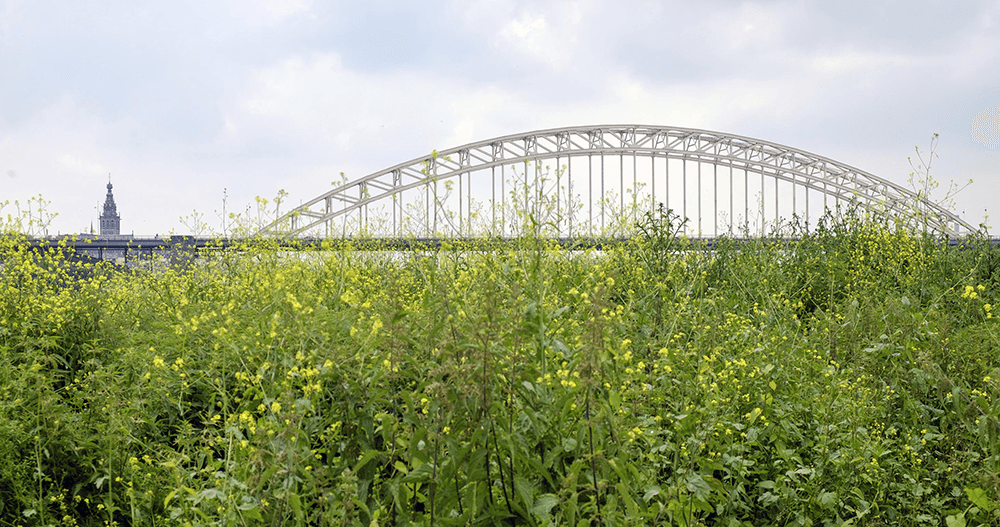
The efforts to restore nature have yielded significant results. “The Ooijpolder is truly very attractive because we have wild nature in the form of the Millingerwaard, which forms part of the Gelderse Poort. And we have beautiful, iconic flower-filled dykes that are among the finest in the Netherlands. And the hedgerows and flower strips in the rural areas have been restored. This creates a very attractive landscape.”
What works
Ploegmakers talks about the factors that made the area development in Ooijpolder-Groesbeek such a success – both for nature and for the farmers.
“Agricultural nature management has been practised for a very long time, involving, amongst other things, the addition of landscape features at the edges of farmers’ plots. But this project is unique in the way the scheme has been designed. Contracts that farmers could sign for 30 years, funding for the use of the land, and a management fee made it attractive for farmers to take part. The fact that the plots retained their agricultural designation made it attractive to farmers. If the plots had been designated for nature conservation, they would have had to deal with very different rules and regulations.”
Another factor was that various stakeholders from the agricultural and nature conservation sectors came together to collaborate on landscape development plans for that area. A great deal of effort went into building trust and working together.
De Kroon adds: “The interesting thing about the whole process that Huub has just described is that it allows you to talk to farmers about what sustainability issues are really all about. What is most important to you as a farmer right now? It goes without saying that you need to make a living from it. But could there be another way? Not harping on about problems like nitrogen, but working together on new revenue models.”
Finalise and continue
As the project nears its conclusion, it is time for the researchers to consider how they can build on the findings of the Living Labs.
De Kroon: “At this stage, we want to deliver tangible results. What can we tell our partners about a successful approach to agricultural nature management and landscape development for a healthy living environment? And how can we embed this collaboration here at Radboud, so that it continues and effectively becomes a sort of revolving fund? We are currently setting out our ideas on this.”
In addition, the Radboud Centre for Sustainability Challenges (RCSC) is an organisation that is already established, and Healthy Landscape will be one of its themes.
A new Master’s programme in Science for Sustainability is also set to start in September this year. Bachelor’s graduates from various disciplines will be able to enrol.
“This Master’s programme aims to train new professionals and enable them, drawing on different perspectives and disciplines, to tackle sustainability issues in an innovative way within various organisations. It attracts all sorts of students from different backgrounds. I teach the first-year Ecology course myself. There are students who don’t have the right background in ecology but still want to do this Master’s programme; they come to the course, where they learn the basic principles. So that’s really great – they’re very motivated people. And there are also people from other disciplines who are doing supplementary work. So they’re all ready to get started in September.
So that’s the kind of integration we’re aiming for. There are so many different aspects; ecology – which I personally champion – is just one of them. Restoring biodiversity is what we’d like to see, in combination with all the other challenges we face.”
In the Green Mantle project, a number of local authorities around Nijmegen are creating a green mantle around the city. The plan – drawing on lessons from Ooijpolder-Groesbeek – is for interested farmers and other landowners to participate in nature and landscape restoration.