The 'Solar Park' project is the first Regio Deal project completed. What started from NXP's concrete question - how do we still provide power in the event of a power failure? - grew into an exploration of a much broader solution: a Smart Energy Hub. "There is so much more possible than meets the eye," says programme manager Tycho Tomassen.
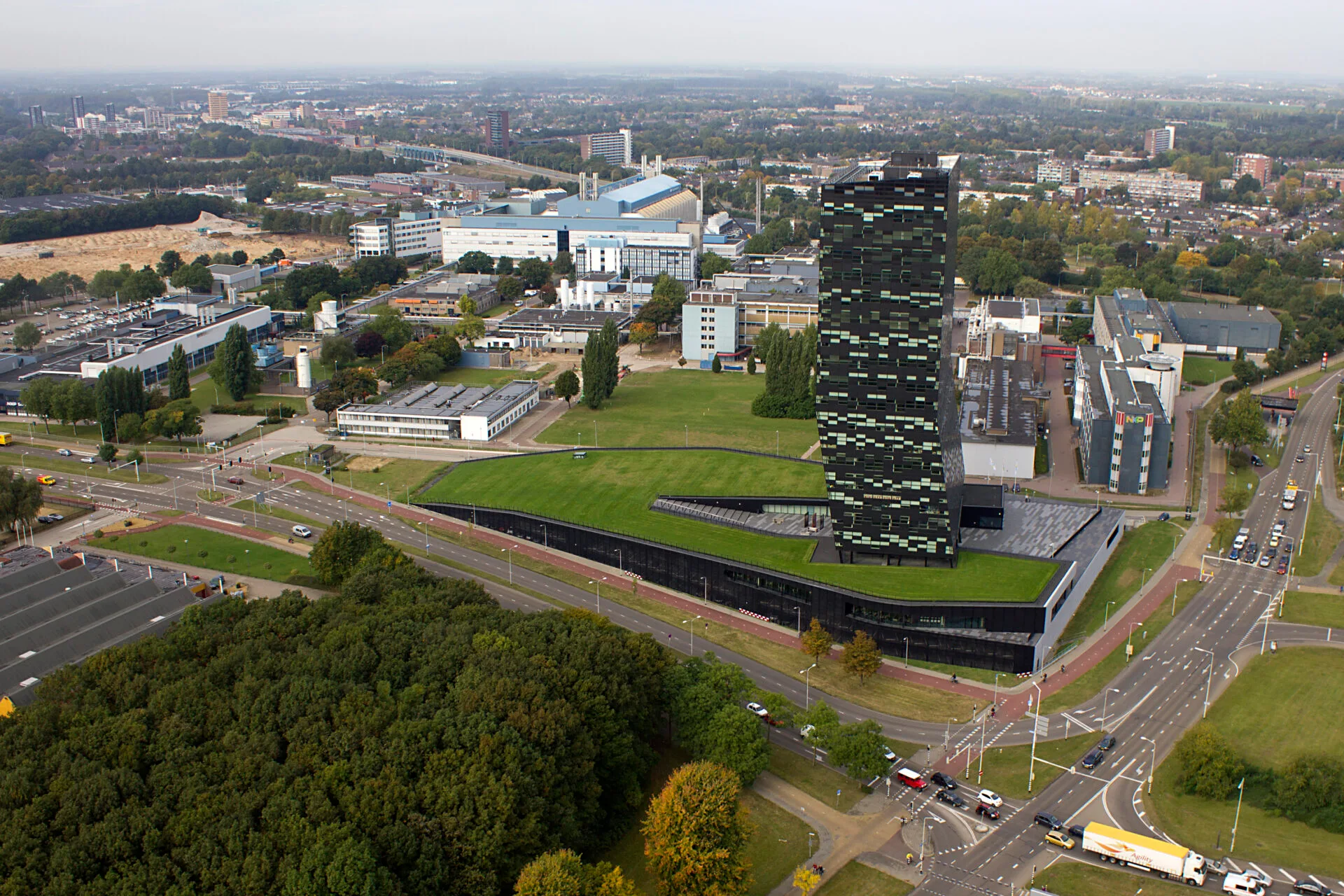
For chip manufacturer NXP in Nijmegen, a stable energy supply is crucial. “If the power goes out there, the consequences are enormous,” explains Tycho. “Processes come to a standstill, recovery takes a long time and the damage can run into millions.” This is how the idea of large-scale energy storage came about at NXP. Research followed, but the outcome was disappointing: an entire football pitch full of containers would be needed to supply NXP with energy in the event of a power cut. “So purely for the‘what if’ scenario. Financially, that’s simply not viable,” says Tycho, who subsequently became involved in the project.
Solar power from residential roofs
Because the issue remained. Tycho: "More and more places were now talking about grid congestion. The region indicated that it did want to take responsibility in this. At the same time, the region also wanted to look at the possibilities for NXP." And so the 'Solar Park' project was born. The idea was to use solar power from roofs of rental houses in the area. Three housing associations in the surrounding neighbourhoods, the municipality of Nijmegen and NXP got round the table. The Economic Board became the pen leader and Tycho programme manager, which he did together with internal project leader Nicky Hogenkamp. "The idea was: if NXP buys that power, residents can also get something in return. Then you immediately pick up on something about energy poverty."
Simply too expensive
The enthusiasm for the idea was great. "It even took on a life of its own. It even sounded like housing corporations would solve the grid congestion problem," Tycho says with a smile. But practice proved recalcitrant. "Such a direct cable from homes to a major consumer sounds logical, but proved financially and legally unfeasible. Small consumers are strongly protected by law. Besides, such a physical connection is simply too expensive."
Virtual power supply
The project seemed to be stalled. "But when I hear 'it can't be done', my first reaction is: what can be done?", Tycho continues. That question proved crucial. Instead of a physical connection, they looked at supplying power virtually: exchanging energy through the existing energy grid. With smart agreements, an energy cooperative and software that matches supply and demand. This creates the principle of a Smart Energy Hub. Tycho: "Basically, you start up a local energy company. With a cooperative that buys and distributes energy."
Smart Energy Hub
Smart Energy Hubs are under development in many places in the Netherlands. What makes this Nijmegen project special is the combination of parties. "On one side, you have a company like NXP, with a huge energy demand and great risks if the power goes out. On the other hand, housing corporations, where it is precisely about residents and affordability. And the municipality again looks at social goals, such as energy poverty," mentions Tycho, who is involved in several Smart Energy Hubs around the country. "Everyone is looking through their own glasses. You really have to understand each other. We spent a lot of time on that."
"With a Smart Energy Hub, you actually start up a local energy company," he says.
Clear insights
The study provided clear insights. For instance, solar panels alone on the roofs of housing association houses proved insufficient to serve a large consumer like NXP. "Housing corporations have the panels very well tuned to residents' own consumption. So that leaves little to share with NXP, for example," Tycho explains. "If you want to make this interesting, you need to add volume. For example, through larger company roofs or links with other generation, such as heat." It also became clear that sustainability and affordable energy are more feasible in the shorter term than solving grid congestion. "For the latter, you really need a next step, with storage and smart control."
Start small and keep focus
Besides substantive insights, the project also yielded important lessons. About the importance of focus, for instance. Tycho: "The tendency is to go broad right away, including heat, storage, everything. But then it becomes too complex. Start small and keep focus." The importance of collaboration and communication also came up. "Even terms can be interpreted differently. It is very important to speak the same language. Understand each other's perspectives. Each other's perceptions." And perhaps the most important lesson: "More really is possible than you think."
Good basis for follow-up
The Solar Park project has been completed. According to Tycho, there is a solid foundation for further work (see also the lessons learnt in the White Paper). The municipality of Nijmegen is working on an implementation plan to support local energy systems and energy communities, including smarter management through software. “The‘local for local’ approach fits in very well with the times,” says Tycho. “In today’s world, people want to have much more control over their own energy supply and costs. So it’s really great when that next step is actually taken.”