Bertrik Berfelo is a lecturer and researcher at HAN University of Applied Sciences, as well as project manager for esports talent development at the Papendal Centre for Elite Sport and Education. (Esports is also written as e-sports, and refers to the organised and competitive playing of video games).
His vision? Not to view esports and gaming as a pastime, but as an opportunity. An opportunity to promote health, develop talent and accelerate innovation. Lifeport has the potential to grow into an international player at the intersection of sport, technology and social impact.
From gaming to health
With a background in high-level sport, he knows how important it is to maintain a balance between body and mind. “Technology isn’t meant to keep us sitting still,” says Berfelo, “it should actually get us moving.” That vision forms the basis of his work. Rather than viewing gaming as a passive activity, he uses it as a means to make people physically and mentally fitter.
As well as the esports games played by the talented athletes at Papendal, there are other forms of gaming that are of interest.
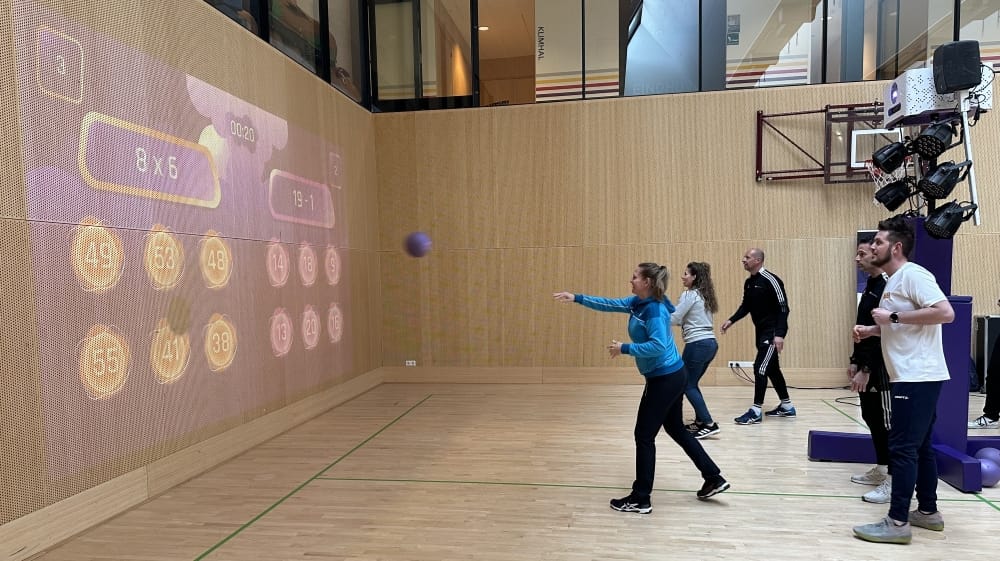
Take exergaming, for example – a form of gaming where you have to move in order to play. The body is the controller. Applications include rehabilitation, care for the elderly and vitality programmes. Exergaming helps older people, for instance, with fall prevention and training fine motor skills, as in the Silver Valley project.
Then there is serious gaming, where game elements are used to achieve a primary objective other than entertainment, such as learning or training. Fun is the means, but knowledge transfer is the end.
Broad application
The Ministry of Defence is currently using esports for recruitment and as a sporting activity, and is investigating its potential for training and selection.
Berfelo is therefore working on a proposal for his PhD research at the Ministry of Defence, focusing on whether and how non-technical skills (soft skills) such as communication and decision-making can be transferred from games to real-life situations (skill transfer), and on mental health.
The police are also using Virtual Reality (VR) for advanced training. A striking example is the DUST programme (Decision Under Stress Training), a collaboration between the Police Academy and Radboud University.
“This is more than just shooting practice,” explains Berfelo, “it is a biofeedback game that teaches officers three crucial skills: stress regulation, decision-making and situational awareness. The game responds to the officer’s heart rate variability. As stress levels rise, the virtual world becomes dark and confusing. If you manage to regain control of your body through breathing, you are rewarded with a clear view. In this way, you practise physiological control in a context where you simultaneously have to make complex decisions.”
Bio Vakantieoord will soon be launching the Bio Game Club, a project led by Berfelo as a researcher. This guided gaming programme, based on scientific insights such as Self-Determination Theory, is designed to give children with disabilities greater self-confidence and a sense of social connection. Berfelo explains: “Through playful technology, they can participate in their own way. That’s what it’s all about: using technology to create a healthier, more inclusive society.”
Esports: top-class sport in digital form
Esports involves the organised and competitive playing of video games, both in teams and individually. Examples include games such as EAFC (formerly FIFA) and League of Legends, which are played in structured competitions at various levels, similar to traditional sports. The difference from ordinary gaming lies in the formal, competitive structure.
Papendal is home to the Esports Talent Centre Gelderland (ETCG), where ambitious young talents from the region are trained to become professional esports players. They follow a comprehensive elite sport programme, including physical training, mental coaching and nutritional advice. “Just like all the other elite athletes at Papendal,” emphasises Berfelo.
Gamers can specialise in four disciplines: EAFC (a football game), e-sim racing (realistic racing simulations), Valorant (a tactical shooter) and League of Legends (a strategic team game). The approach has proved successful; several talented players have already moved on to professional teams. “This shows that esports also offers career prospects,” says Berfelo.
In 2024, Arnhem was named the best esports city, a title secured by the team that Berfelo put together and coached as team manager during the winning tournament in Rotterdam.
“With these kinds of ongoing, weekly programmes, the Lifeport region is leading the way in the Benelux when it comes to sustainably linking traditional sport with digital innovations, whereas other programmes often limit themselves to shorter boot camps.”
A market with impact
The figures speak for themselves. By 2025, the global games market will have 3.6 billion players, generating a turnover of $188.8 billion. In Europe, there are 465 million players, generating a turnover of $33.1 billion. The industry is shifting from pure growth towards retaining players through meaningful and long-term engagement. This is precisely where the opportunities lie for applications in health and education.
These figures underscore that the technology and mechanisms from the gaming world are a powerful tool for achieving Lifeport’s social objectives.
Technology in education
Berfelo is also a regional ambassador for Npuls, the national innovation programme for education co-funded by the Ministry of Education, Culture and Science. He is committed to accelerating the adoption of technologies such as Extended Reality (XR). His role is to act as a link between vocational colleges, universities of applied sciences and universities in the Central Netherlands region. The aim is to drive knowledge sharing and build the bridges needed for educational transformation.
“For example, we are developing an exercise game for students, so that they can work on their well-being in a fun way,” he adds. “Ultimately, we are training the professionals of the future here. By teaching them now how to use technology to create a healthier and more socially connected world, we are making a direct contribution to the Dutch Digitalisation Strategy.”
The New Power of Gelderland
The Esports Talent Centre Gelderland was a key component of the ‘Esports and Gaming: The New Strength of Gelderland’ project, which ran until March 2025. It was an initiative of the Province of Gelderland, Topsport Gelderland and HAN University of Applied Sciences, with HAN acting as the lead partner and Berfelo serving as project leader.
The project is a textbook example of quadruple helix collaboration, a model that Berfelo often cites. In this model, government (the Province of Gelderland), education (HAN University of Applied Sciences), the business sector (such as tech partners, with Logitech G as the ETCG’s main sponsor) and citizens and civil society organisations (Topsport Gelderland) work together to drive innovation.